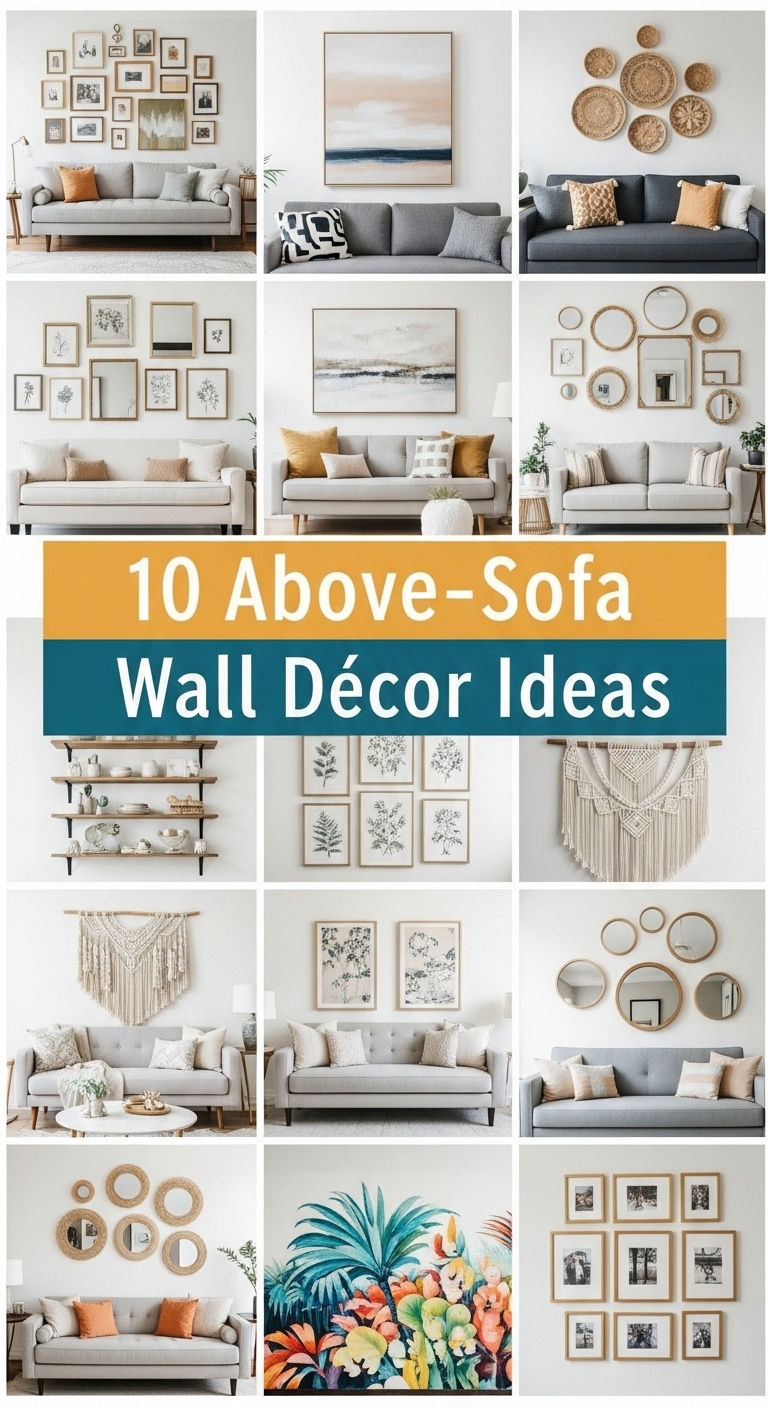
The wall above our sofa sat blank for the first year we lived here, and it bothered me every single evening — this big empty rectangle looming over the coziest spot in the flat. I’d hung things everywhere else, but the sofa wall felt like it needed something significant, and “significant” kept stopping me. What finally broke the deadlock was realizing the wall doesn’t need one perfect thing; it needs a decision. I’ve since tried, rearranged, and lived with most of the approaches below (some simultaneously, during an indecisive month). Here are the ten that actually work above a sofa, with what I learned hanging each one.

1. Gallery Wall Display

The gallery wall is what I have now, and it’s the most forgiving option because there’s no single focal point to get wrong. Mine is nine frames in a loose grid — family photos, a flea-market sketch, a postcard from Lisbon — and the rule that made it work was the paper-template trick: I cut newspaper to the size of each frame, taped the shapes to the wall, and lived with the arrangement for three days before hammering a single nail. Three days of looking at paper rectangles saved me from at least two bad decisions. Keep 5 to 8 cm between frames and one unifying element — mine is all black frames, mixed sizes. A gallery wall above a sofa should span roughly two-thirds of the sofa’s width; narrower looks timid, wider overwhelms. It’s personal, it’s expandable, and when I get a new print I love, there’s always room for one more.
2. Large Statement Artwork

Before the gallery wall, I had one huge abstract canvas above the sofa, and there’s a case for the single statement piece: it’s decisive, it’s calm, and it makes the room feel designed in one move. The size rule I learned from a gallery-owning friend: the art should be 60 to 75 percent as wide as the sofa. Smaller looks like an afterthought; I measured, and my first attempt was 40 percent, which is why it looked lost. Hang it so the center sits about 15 to 20 cm above the sofa back — lower than most people think. The canvas I had was an affordable print on stretched canvas, not an original, and nobody ever knew or cared; at that scale, presence matters more than provenance. One statement piece also means one hanging point, one level check, done in twenty minutes. When I want calm, I miss this option.
3. Floating Shelves with Decorative Accents

Two floating shelves above the sofa, styled with small art, ceramics, and books — this was my maximalist phase, and I loved it for a year. Shelves give you what flat art can’t: dimension and changeability. I rearranged mine seasonally, which scratched the decorating itch without any new purchases. The practical rules: keep the bottom shelf at least 25 cm above the sofa back (tall guests lean back; you don’t want a vase meeting a head), and secure everything with museum putty — I lost a small ceramic bird to an enthusiastic cushion-plumping incident before I learned. Style in odd-numbered groupings with varying heights, and leave breathing room; a shelf crammed edge-to-edge reads as storage, not display. When the styling started feeling like dusting duty, I knew it was time for the gallery wall. Shelves are wonderful but they are a commitment to maintenance.
4. Mirrors for Light and Space

Our living room faces north, which in Munich means it’s moody at best and gloomy at worst from October to March. A large round mirror above the sofa was the single most effective thing I did for the light — it bounces the window light from the opposite wall deep into the room, and the difference at 3 p.m. in November is remarkable. Placement matters: hang the mirror where it reflects something worth seeing (a window, a plant, the bookshelf), not the ceiling or the TV. I went round rather than rectangular because the sofa is all straight lines and the circle softens the composition. One caution: a mirror above a sofa reflects the people sitting on it, so position it high enough that you’re not staring at the back of your own head from across the room. Done right, it doubles the perceived size of the room — the oldest trick in the book, and it works.
5. Tapestries or Fabric Wall Hangings

A textile above the sofa does something no frame or mirror can: it softens the acoustics. Our flat has hard floors and bare walls, and the echo was real until I hung a large woven wall hanging — suddenly conversations sounded warmer, literally. Beyond the sound, fabric adds texture and movement that flat art lacks; mine shifts slightly in the draft from the window and it feels alive. Hanging is easy: a wooden dowel in a sleeve, two hooks, done — and it’s the most renter-friendly option here since it’s light and leaves minimal marks. I wash mine once a year (gentle cycle, air dry) because textiles above a sofa collect cooking smells and dust. Choose a piece with some weight to it; the cheap thin tapestries ripple and look temporary, while a proper woven hanging drapes like it means it.
6. Sculptural Wall Art

Sculptural pieces — metal wall sculptures, carved wood panels, ceramic wall installations — cast shadows, and shadows are what make a wall interesting after dark. I have a set of three brass wall sculptures that throw the most beautiful shadows in the evening lamplight, and guests always ask about them. The trick with sculptural work above a sofa is scale and clearance: it projects from the wall, so keep it high enough that nobody’s head meets it (I allow 30 cm above the tallest likely head) and make sure it’s mounted into studs or proper anchors — sculptural pieces are heavier than they look. One strong piece beats a cluster of small ones here; small sculptures scattered on a big wall look like they’re apologizing. I found mine at a craft fair for less than a framed print would have cost, and it’s the most distinctive thing in the room.
7. Wall-Mounted Planters or Greenery

Plants above the sofa were my attempt to bring the balcony inside for winter, and trailing pothos in wall-mounted planters is genuinely lovely — green spilling down toward the sofa like a living curtain. The reality check: watering. Anything above a sofa gets watered with a watering can held overhead, which means drips on the cushions unless you’re careful. I solved it with planters that have built-in reservoirs and a strict “water over the sink, then rehang” routine for the smaller ones. Choose trailing plants (pothos, philodendron) over upright ones — upright plants at that height just look like they’re trying to escape. And keep them out of direct reach of the cat; Miso considers hanging pothos a personal salad bar, so mine are high enough that she’d need wings. When it works, it’s the freshest, most alive wall in the house.
8. Decorative Wall Clocks

An oversized clock above the sofa is functional decor at its best — I check it a dozen times a day, and it fills the wall with presence. Mine is 60 cm across with a silent sweep movement, and the silent part is non-negotiable: a ticking clock in a living room will drive you mad within a week; I know because my first one did. Style-wise, the clock should read as art that happens to tell time — interesting face, good materials — not as an office supply. I hung it slightly off-center with a small framed print beside it, which keeps it from looking like a waiting room. One practical note: put it where it’s readable from your main sitting position without turning your head; a clock you can’t comfortably read is just a circle. It’s the only wall decor I own that earns its keep twice over.
9. Floating Ledges with Art Rotation

Picture ledges are the commitment-phobe’s gallery wall: a narrow shelf with a lip that holds framed prints upright, no nails per frame, rearrange in seconds. I had a long ledge above the sofa for a while and rotated the art with the seasons — botanical prints in spring, moody landscapes in autumn — and it kept the room feeling fresh with zero new purchases. The ledge itself needs to be level and well-anchored (it’s holding real weight), and the lip must be deep enough that frames can’t slide off — 4 cm minimum, learned from a frame that took a dive during a door slam. Layer frames in front of each other for depth, tallest at the back. The only downside: dust collects on the ledge and behind the frames, so it’s a quarterly cleaning job. For people who get bored of their walls, nothing beats the ledge.
10. Mixed Media Displays

The bravest wall I ever did mixed everything: a framed print, a small mirror, a woven hanging, a floating shelf with ceramics, and a wall clock — all in one composition above the sofa. It shouldn’t have worked, but it did, because I held two things constant: a tight color palette (black, brass, cream, green) and consistent spacing. Mixed media is the hardest option to get right and the most rewarding when you do; it’s a wall with personality instead of a wall with a theme. My method was the same paper-template trick as the gallery wall, but I lived with the paper version for a full week because the composition is more complex. The rule I made for myself: if I can’t explain why an element is there, it doesn’t go up. Every piece earned its place, and the wall reads as collected over time rather than decorated in a day — because it was.
Conclusion
That blank rectangle above the sofa isn’t a problem to solve perfectly — it’s a wall to live with and change as you do. I’ve had the statement canvas, the shelves, the ledge, and now the gallery wall, and each one taught me something about the room. Start with the paper templates, hang it lower than you think, and give yourself permission to change it next year.