10 Macrame Wall Art Ideas
My first macrame piece came home in a paper bag from a Munich flea market, a lopsided diamond pattern on a crooked stick, and I paid 12 euros for it because the woman who knotted it told me she had made it on her balcony while her laundry dried behind her. I hung it above my desk, slightly off centre, and stared at it for a week while I worked out why I liked it so much. It was the texture, and the fact that a human hand had made every knot.
Before You Knot: Four Things I Wish I Had Known
- Measure the wall first: Hold a piece of string where the hanging will go and step back, because a piece that looks generous in a shop can look lost on a wide wall.
- Buy cord by weight, not by length: A 1 kilogram spool of 3 mm cotton cord costs around 15 euros and covers most medium pieces.
- Comb the fringe last: Leave the fringe long until the piece is hung, since combing too early makes the ends uneven and hard to trim.
- Check the fixings: A dowel wider than 60 cm needs two hooks set into a stud or a solid wall plug, because a single nail will tilt under the weight of the piece.

1. Bohemian Macrame Wall Art

I made my first bohemian piece on a rainy Sunday in February, sitting on the floor of my living room with a 70 cm beech dowel balanced across two chair backs and a pile of cream cotton cord that kept tangling around my ankles. I had planned a neat diamond pattern and ended up with something looser, a mix of square knots and long fringe that fell in uneven waves, and that looseness turned out to be the whole charm of it. Bohemian macrame works best when it looks a little wild, with cords of different lengths, knots that are not all identical, and fringe that moves when someone walks past. I used 3 mm single twist cord, cut each strand to about 2.4 metres, and knotted for three evenings before I was happy with the shape. The cost came to around 25 euros for cord and dowel, plus a packet of wooden beads I found for 4 euros at a craft shop near Marienplatz. What I learned from that first piece was to hang it and live with it for a few days before trimming the fringe, because the cord relaxes and drops by a few centimetres once it hangs under its own weight.
Try this: Knot a small test panel of ten rows before you start the full piece, so you can check your tension and knot size against the dowel. It works in a living room, a bedroom, or a reading nook, and it makes a thoughtful housewarming gift for a friend who likes handmade things.

2. Minimalist Macrame Wall Hanging Art

After the wild fringe of my bohemian piece, I wanted the opposite, and I knotted a minimalist hanging for the wall above my desk, where I needed calm rather than clutter. I chose undyed ivory cord, 4 mm this time, on a slim 50 cm dowel, and I kept the pattern to three rows of square knots, a straight line of double half hitches, and a short fringe trimmed to one even length. The whole piece took one evening, and the restraint was the hard part, because every instinct told me to add one more row, one more bead, one more knot. I stopped myself, hung it, and the empty space around the knots did the work. That is the point of this style, and it is why it suits rooms that already have plenty going on, a desk with books and a lamp, a bed with patterned bedding, or an entryway with coats and shoes. If you are new to knotting, this is the place to start, since the pattern repeats and a mistake is easy to undo. Keep the fringe short, around 15 cm, and comb it once with a wide tooth comb so the strands fall in a clean line. If you want other simple wall art for the same room, keep the palette plain and let one piece carry the texture.
Good to know: Undyed cotton yellows a little in strong sun, so hang this style on a wall that gets soft morning light rather than full afternoon sun. It fits a home office, a hallway, or a calm bedroom, and it suits a small flat where a busy piece would crowd the room.
3. Color-Dipped Macrame Wall Art

I dipped my first macrame piece in a bucket on my balcony, wearing rubber gloves and an old shirt, and I still remember the smell of the dye and the way the colour crept up the cord further than I had planned. I had meant to dip only the last 20 cm of fringe in terracotta, and the cord drank the dye up to nearly 35 cm, which gave me a softer gradient than the sharp line I had imagined, and I liked it better. That is the lesson of colour dipping, that the cord has its own ideas, and the best results come from working with them rather than fighting them. I use fibre reactive dye, about 8 euros a packet, mixed in a bucket with warm water and a spoonful of salt, and I dip the finished piece while it hangs from a hook, lowering it in stages so the colour fades from deep at the tips to pale where it meets the undyed cord. I also learned to wear gloves I do not mind staining, because the dye finds every small cut and colours it for a day, and to keep a second bucket of clean water nearby for rinsing my hands between dips.
Make it yours: Dip only the fringe on your first try, and test the dye on a spare cord first so you can see the true colour when dry. It fits a hallway, a kitchen, or a nursery, and it makes a bright birthday gift for someone who loves colour.
4. Geometric Macrame Wall Art

Geometric macrame is the style I turn to when I want a wall to feel ordered, and I knotted my first diamond pattern for the hallway, where the straight lines of the door frames and the skirting board were asking for something with the same discipline. I drew the pattern on paper first, a row of diamonds made from double half hitch knots, with a chevron band at the top and a short fringe at the bottom, and I measured each cord before I cut it, because a geometric design shows a short cord at once. I used 3 mm cord in two tones, natural and a soft charcoal grey, alternating the colours so the diamonds stood out against the background, and I worked on a clothes rail hung between two hooks so I could step back and check the symmetry as I went. I keep a small ruler on the rail while I work, and I check each diamond before moving on, since one that drifts throws the whole row out of line. The piece is 55 cm wide and 80 cm long, it cost around 20 euros in materials, and it took me four evenings, longer than the bohemian piece, because every knot had to sit in line with its neighbours.
Budget tip: Two tones of cord cost little more than one, and the contrast does the work of a far more complex pattern. It fits a modern living room, a home office, or a hallway, and it suits a housewarming gift for someone with a tidy, modern home.
5. Circular Macrame Wall Art

I bought a 40 cm brass ring at a craft market in the Glockenbachviertel with no plan at all, and it sat on my shelf for a month before I worked out what to do with it, which is often how my best pieces begin. In the end I knotted a half moon design inside the ring, square knots across the middle, a row of double half hitches curving down, and a fringe that fell below the ring like a small curtain, and the circle changed everything about the piece. A round frame softens a wall full of rectangles, doors, windows, shelves, and picture frames, and it draws the eye in a way a straight dowel never does. I used 3 mm cord, about 60 metres in total, and I worked with the ring hung from a hook on the back of a door so the circle kept its shape while I knotted. The cost was around 18 euros, ring included, and the piece took two evenings, most of that time spent on the curved edge, where the knots need to sit close together or the circle starts to look lopsided. If you want wall art for the living room that does not compete with a sofa or a television, a circular piece is a good choice, since it reads as a single quiet shape from across the room.
Beginner tip: Knot the top half of the ring first and hang it to check the shape before you start the fringe, since a lopsided top is hard to fix later. It fits a living room, a bedroom, or a bathroom, and it makes a gentle gift for a new home.
6. Layered Macrame Wall Tapestry

The layered piece in my bedroom is the biggest thing I have ever knotted, 90 cm wide and nearly 130 cm long, and it started as a dare to myself after a friend said I would never finish anything that size. I worked on it for three weeks, an hour most evenings, with the dowel hung from the ceiling beam in my living room and the cord pooling on the floor around my feet, and Bruno, my terrier, kept stealing the loose ends and dragging them under the sofa. The design has three layers, a wide panel of square knots at the back, a shorter panel of diamonds in front of it, and a fringe of different lengths at the bottom, so the piece has depth and shadow in a way a flat panel never does. I mixed 3 mm and 5 mm cord, which gave the layers different textures, and I used a driftwood branch instead of a dowel, since a straight dowel would have looked too tidy for something this wild. Hang a piece like this where it can be the main event, above a bed, above a low sofa, or on a large empty wall, and keep the furniture around it plain so the texture can carry the room.
Where it works: Give it a wide wall and plain furniture, and let it be the one strong piece in the room. It fits a bedroom or a large living room, and it suits a long winter project when you want something to work on in the evenings.
7. Macrame Wall Art with Wooden Beads

Wooden beads were the detail that taught me restraint, because my first beaded piece had beads on every cord and looked like a curtain from a bead shop, and I spent an evening unknotting half of them. The piece I kept is a simple panel on a 60 cm dowel, with a row of square knots, then a single line of beads threaded onto the working cords, then more knots, so the beads sit in a neat band across the middle like a belt. I used beads in three sizes, 15 mm, 20 mm, and 25 mm, all in pale beech, and I bought a mixed bag for 6 euros, which left me plenty for other projects. What worked for me was threading each bead onto two cords at once, which stops it sliding down the fringe, and knotting firmly above and below it so it stays put. My beaded piece hangs in the corner of my living room, above a wooden plant shelf that holds three small pots, and the wood tones tie the two pieces together without matching too neatly. It suits a room with plants, a jute rug, and rattan, and it suits a hallway where the beads catch the light as people pass.
Watch out: Beads threaded on a single cord slide down over time, so always use two cords and knot above and below each bead. It fits a living room, a hallway, or a bedroom with plants, and it makes a warm gift for a plant lover.
8. Macrame Wall Art with Feathers and Leaves

Feathers were the first macrame shape that made me laugh out loud, because my first attempt looked less like a feather and more like a flat leaf that had been sat on, and I had to comb it three times before it started to behave. The method is simple once you know it, you knot a leaf shape from a central cord, then brush the fringe out with a pet comb until the fibres separate into a soft plume, and then you trim the edges with sharp scissors to get the feather outline. I made a set of five feathers in different sizes, the largest about 30 cm long, on a single 50 cm dowel, and I hung them at different heights so they overlapped a little, like leaves on a branch. I used 3 mm single twist cord, which brushes out better than braided cord, and I dipped the tips of two feathers in sage dye, which gave the whole piece a quiet green note without turning it into a colour project. The cost was around 15 euros, and the piece took one afternoon, most of it spent combing, which is slow work and oddly calming, a bit like brushing a small dog.
Try this: Comb each feather on a flat surface and trim it in small cuts, since one deep cut can ruin the shape. It fits a bedroom, a nursery, or a bathroom, and it makes a soft gift for a new baby or a new home.
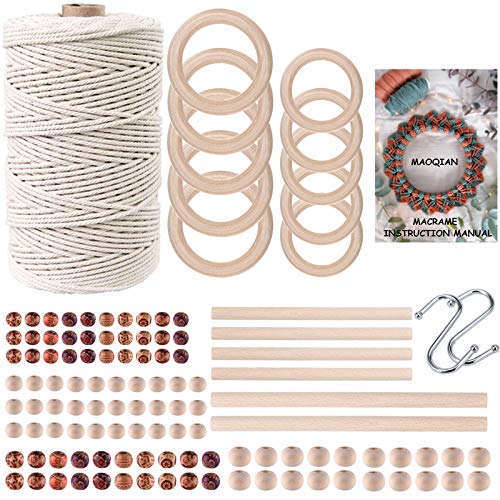
Macrame Wall Art Supplies for This Project

9. Small Macrame Wall Art Pieces

Small pieces are the ones I make when I have an hour and a ball of leftover cord, and they have taught me more than the big projects, because a small piece has nowhere to hide a mistake. I keep a basket of cord ends by my desk, and when I have a quiet evening I knot a mini hanging, maybe 20 cm wide, on a short stick or a small brass ring, with a simple pattern and a short fringe. The first one I made went above the light switch in my hallway, a spot I had walked past for a year without noticing, and it turned a blank patch of wall into something I smile at every morning. A cluster works even better, three small pieces hung at different heights on a narrow wall, one round, one rectangular, one with a bead or two, and the mix of shapes keeps the eye moving. Each one costs almost nothing, a few euros of cord and a stick from the park, and each one takes under an hour, which makes them the best way to practise a new knot without committing to a large piece. If your walls feel bare but you are not ready for a statement piece, start here, and let the small pieces teach you what you like before you knot anything bigger.
Good to know: A cluster of three small pieces looks planned, while a single tiny piece on a wide wall can look lost, so group them or pick a narrow spot. It fits a home office, an entryway, or a reading nook, and it makes an easy gift when you need something handmade in a hurry.
10. Large Statement Macrame Wall Art

A large statement piece is a commitment, and I knew that the moment I carried a 120 cm driftwood branch home on the tram, wrapped in newspaper, with people staring at me as if I had brought a tree indoors. The branch now holds the biggest piece I own, a panel 110 cm wide and 150 cm long, knotted from 5 mm cord in a mix of square knots, diamonds, and long fringe, and it hangs above my sofa, where it fills a wall that used to swallow every picture I tried there. I worked on it for a month, a little each evening, and I learned to knot standing up, with the branch hung from two ceiling hooks, because a piece this size is too heavy to work on a table. The cord alone cost around 60 euros, and the branch was free, found on a walk along the Isar, which is my favourite kind of material. If you make one, measure twice, buy more cord than you think you need, and ask a friend to help you hang it, because holding a heavy branch steady with one hand while finding a hook with the other is a job for two people.
Make it yours: Use a found branch or a wide dowel and keep the pattern simple, since size alone gives the piece its impact. It fits a spacious living room, a large bedroom, or a long hallway, and it suits a home where one strong piece can anchor the room.
Conclusion
Macrame suits my flat because it is handmade, forgiving, and honest about the time it took, and each of these ten pieces taught me something different, from the patience of a large panel to the calm of a plain minimalist hanging. Pick the one that fits your wall and your week, start with the cord you already have, and let the first knots be a little uneven. The piece will hang well, and you will have made something with your own hands.