10 Macrame Wall Hanging Ideas
My first macrame piece was a lopsided ring with fringe that stuck out at odd angles, and I hung it above my bed anyway because I had made it with my own hands on a rainy Sunday in my Munich flat. That crooked little circle taught me more than any tutorial had, and it stayed on my wall for two years while I learned to knot properly. Macrame suits a bedroom because it softens hard edges, warms up plain white walls, and gives a room a handmade layer that shop bought art never quite manages. I have knotted, bought, gifted, and rehung more of these pieces than I can count, and the ten ideas below are the ones I keep coming back to, each one tested in my own home or in a friend’s flat where I helped hang it.

Five things I wish I had known before my first knot
- Buy cord by the metre, not by the hank: A wall piece eats cord fast, and running out halfway through a row means a visible join you will stare at for months.
- Measure the wall first: Hold a tape measure where the piece will hang and write the numbers down, because a hanging that looked generous online can shrink to a postage stamp above a double bed.
- Comb the fringe last: Knot the whole piece, hang it, step back, and only then comb and trim, since fringe settles differently once gravity has had a day to work on it.
- Test your hook: A plaster wall in an old Munich building needs a proper wall plug, and a heavy layered piece can pull a plain nail straight out overnight.
- Wash your hands before knotting: Natural cotton cord picks up hand cream and coffee marks, and pale cord shows every smudge once it hangs in daylight.
1. Boho Dreamcatcher-Inspired Macrame Wall Hanging

I made my first dreamcatcher style piece on a 30 centimetre wooden ring I found at a craft market near Viktualienmarkt, and I still remember how the circle shape forced me to slow down and knot with care instead of rushing to the fringe. I used 3 millimetre natural cotton cord, Lark’s Head knots around the ring, and a simple net of Double Half Hitch knots inside the circle, then left long trailing cords below that I combed out into soft fringe. I added three wooden beads in warm brown and two pale feathers I had saved from an old cushion, and I hung the ring above the small reading chair in the corner of my bedroom where the morning light hits it first. It took me one long evening, about four hours with tea breaks, and the cord cost me around 12 euros, which felt fair for something I look at every single day. I keep a small diffuser on the shelf beside mine, and the scent of cedar with the soft fringe makes that corner the calmest spot in the flat. Friends always ask where I bought it, and I like saying I knotted it myself on a Sunday when the rain kept me indoors.
Try this: Knot the ring in one sitting so your tension stays even, and hang it in a bedroom reading corner where soft morning light can play across the fringe.

2. Minimalist Macrame Wall Panel in Neutral Shades

When my bedroom started to feel crowded with colour and pattern, I stripped everything back and hung a plain rectangular panel in undyed cotton above my headboard, and the room exhaled in a way I had not expected. I chose a 60 centimetre wooden dowel, cut cords to 2 metres each, and worked a simple pattern of Square knots in straight rows with a clean V shape at the bottom, leaving the fringe cut straight across with sharp scissors. The whole piece took me an afternoon, and I spent more time measuring than knotting, because a minimalist panel shows every uneven row and there is nowhere for a mistake to hide. I hung it so the bottom of the fringe sits about 15 centimetres above the pillows, which keeps it out of the way when I sit up in bed with a book. This is the piece I point people to when they say they like DIY wall art but worry macrame will look too boho for their home, because it reads as quiet craft rather than a theme. I still have mine up, and it is the first thing I see when I wake up, calm and uncluttered.
Good to know: A straight fringe edge needs a sharp cut after hanging, so leave the cords long, live with the piece for a day, and trim once it has settled on the wall.
3. Layered Macrame Wall Hanging for a Cozy Statement

I bought a layered piece at a Christmas market in Munich three winters ago, and I carried it home on the tram wrapped in brown paper because it was too wide for my shopping bag and too pretty to leave behind. It has three tiers of knots in cream, taupe, and a hint of blush, each layer hanging a little lower than the one before, and it fills the wide blank wall opposite my bed in a way a single flat panel never could. Layered work suits a big empty wall because the depth gives the eye somewhere to travel, and the shadows between the tiers shift through the day as the light moves across the room. I hung it on two hooks rather than one, spaced about 40 centimetres apart, because the piece weighs more than it looks and a single hook would have let it tilt within a week. I pair mine with linen bedding in natural white, a chunky knit throw folded at the foot of the bed, and a wooden tray on the dresser, and the room feels layered without feeling full. It works in a living room too, but I love it most in the bedroom, where it softens the largest wall and makes the whole room feel finished.
Make it yours: Mix two cord shades in the same family, like cream and taupe, and hang this layered style on the widest bedroom wall or above a low dresser where the tiers can fall freely.
4. Macrame Wall Hanging with Beads and Feathers

I added beads and feathers to a plain wall hanging one spring because the knots alone felt too serious for the corner by my vanity, and the beads changed the whole mood of the piece in an afternoon. I used smooth wooden beads in two sizes, threading them onto single cords and fixing each one with a knot above and below so they stay put instead of sliding down to the fringe. The feathers came from a craft shop in Glockenbach, pale grey and cream, and I tied each one to a cord end with a short wrap of thread so it hangs straight and does not spin in a draught. I hung the finished piece above my nightstand, where it catches the light from the small lamp I switch on in the evening, and the beads throw tiny shadows on the wall that I find oddly soothing. I have made a smaller version of this as a housewarming gift, and it now hangs in a friend’s hallway, which tells me the style travels well beyond the bedroom. The beads also give the piece a gentle sound when I brush past it, a soft wooden click that reminds me someone made this by hand, knot by knot.
Budget tip: Buy one bag of mixed wooden beads for about 6 euros and share it across two pieces, and save this beaded style for a nightstand wall or vanity corner where the details can be seen up close.
5. Geometric Macrame Wall Hanging

I avoided geometric macrame for a long time because I assumed the diamonds and triangles would demand a level of precision I did not have, and then I tried one on a dare from a friend and found the structure oddly relaxing. I worked from a simple chart I drew myself on graph paper, marking each diamond with a pencil dot before I started, and I knotted a row of Square knots into a wide diamond shape using 4 millimetre cord in natural white. The counting is the whole game here, and I kept a tally on a scrap of paper beside me, checking off each row so the left and right sides stayed mirror images of each other. I hung it dead centre above my bed, measured from both bedside tables so the gap matched on each side, and the symmetry pulls the whole wall together in a way my looser pieces never do. This style suits a modern bedroom with clean furniture and plain bedding, and it also suits a home office wall where a soft boho piece might feel out of place. Geometric work taught me that macrame can be orderly and calm, not only loose and flowing, and that is a lesson I carry into every piece I knot now.
Beginner tip: Draw the diamond on graph paper first and count knots aloud per row, and hang this structured piece dead centre above the bed or on a home office wall where symmetry can shine.
6. Macrame Headboard Wall Hanging

I replaced my wooden headboard with a wide macrame panel two years ago, and I have never missed the wood, because the soft cotton behind my pillows makes the bed feel like a nest rather than a piece of furniture. I used a dowel 140 centimetres wide, which spans my double bed with a little overhang on each side, and I knotted a dense pattern of Square knots at the top that loosens into long flowing fringe at the bottom. The fringe falls to just above the mattress, and I trimmed it so it brushes the pillows without tangling in them when I sit up to read. I hung the dowel on two sturdy hooks screwed into wall plugs, because a headboard panel carries its own weight plus the odd tug when someone leans back against it, and I check the hooks twice a year when I change the bedding. A tightly knotted panel suits a room that needs structure, while a loose flowing panel suits a boho bedroom that already has a lot of straight lines and needs softening. It has become the backdrop to my mornings, and I would choose it again over any shop bought headboard.
Where it works: Use this wide panel as a soft headboard in a master bedroom or a guest room, and add fairy lights behind it for a warm glow on dark winter evenings.
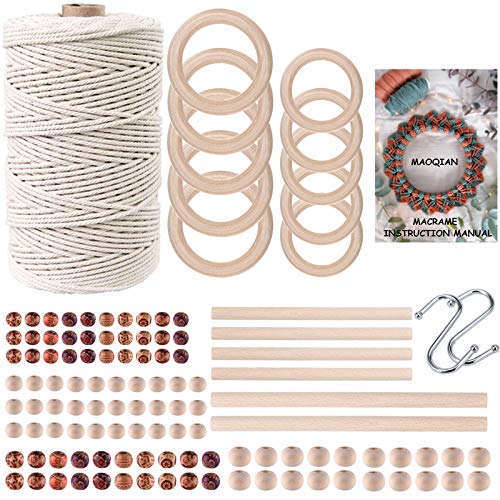
Macrame Wall Hanging Supplies for This Project

7. Color-Dipped Macrame Wall Hanging

I dipped my first macrame fringe in dye on my kitchen table, wearing rubber gloves and an old shirt, and the blush pink that crept up the cords felt like a small piece of magic I had made with my own hands. I knotted the piece first in natural cotton, then lowered just the fringe ends into a bowl of fabric dye mixed with warm water, holding the cords for about ten minutes until the colour reached the depth I wanted. Dip in stages, lifting the cords a little higher each time, so the colour fades gently instead of stopping in a hard line, and I learned that by watching the dye climb the fibres rather than by timing it with a clock. Hang a colour dipped piece on a light wall, white or pale grey, so the dipped ends stand out, and keep the rest of the room quiet so the colour has space to breathe. This is the piece I recommend when someone loves colour but does not want to paint a wall, because the dye gives you a wash of colour you can move, swap, or take down in a minute.
Watch out: Dye only the fringe ends and rinse until the water runs clear, and hang this colour dipped piece on a pale wall in spring or summer when its soft colour can lift the whole room.
8. Macrame Wall Hanging with Wooden Accents

I found my driftwood branch on a walk along the Isar one autumn afternoon, carried it home in my tote bag, and let it dry on my balcony for a week before I knotted a single cord onto it. The branch was about 70 centimetres long, slightly curved, with a pale grey bark that had been smoothed by the river, and it gave the piece a character no shop bought dowel could match. I used 3 millimetre cotton cord in natural white, Lark’s Head knots along the branch, and a simple pattern of Square knots with small wooden beads tucked into the fringe ends. The wood and cotton together make a calm, grounded pair, and the piece now hangs in my bedroom above the dresser, where it sits well with neutral bedding and the jute rug under my feet in the morning. I sanded the ends of the branch lightly so no splinters catch the cords, and I sealed it with a thin coat of clear wax that keeps the pale grey colour without adding shine. I like that the branch keeps a memory of the river walk in my home, and every time I look at it I remember the cold air and the sound of the water that day.
Try this: Use a driftwood branch or a carved dowel as the base, and hang this wooden accented piece above a dresser in a bedroom or a cabin where natural materials already set the tone.
9. Small Macrame Wall Hangings Set

I made a set of three small hangings for the narrow wall beside my bed, where one large piece would have looked cramped and a picture frame felt too flat, and the trio turned that awkward strip of wall into my favourite corner of the room. Each piece hangs from a short dowel about 25 centimetres wide, one in a triangle, one in a semicircle, and one in a simple rectangle with a V shaped fringe, and I spaced them about 10 centimetres apart so they read as a group without touching. The small size makes them forgiving to knot, because a mistake in a 20 centimetre piece is easy to undo, and I finished all three in a single weekend while listening to a podcast. Small sets suit bedside walls, vanity corners, and the wall above a floating shelf, and the same trio works as living room wall art above a low console, which also suits a rental flat where you want impact without drilling a dozen holes. If you hang a set, step back after the first piece and check the spacing by eye before you fix the rest, because a set that drifts upward by a centimetre looks accidental rather than arranged.
Good to know: Keep the cord the same across the set and vary only one small detail per piece, and use this trio on a narrow bedside wall, above a shelf, or as a housewarming gift for a small flat.
10. Large Statement Macrame Wall Hanging

I bought my large statement piece from a maker at a summer market, and I remember standing in front of her stall for a long time before I committed, because a piece that spans 120 centimetres wide is a decision, not an impulse. It has layered fringes, a symmetrical pattern of diamonds at the top, and a deep V of combed fringe at the bottom, and it hangs above my dresser where it fills the wall from one side to the other. The scale is the point here, and a big piece needs a big wall, so I measured twice and chose the one wall in my flat with no door, no window, and no shelf competing for attention. The rest of the room stays quiet around it, neutral bedding, a plain woven rug, and wooden side tables with nothing fussy on them, so the macrame can hold the room without a fight. This is the piece guests notice first when they walk into my bedroom, and it makes the room feel like a place someone cares about, which is the best thing I can say about any object in my home.
Make it yours: Give this oversized piece a whole empty wall and keep the bedding and rugs plain around it, and choose it for a spacious bedroom or a creative studio where it can be the room’s focal point.
Conclusion
I started with a crooked ring and a lot of patience, and macrame has given my bedroom a warmth I did not know it was missing until the first piece went up. Pick the idea that fits your wall, your budget, and the time you have this weekend, and knot it slowly, one row at a time. The piece you make yourself will always mean more than the one you buy, and your bedroom will feel like yours in a way no shop can sell you.