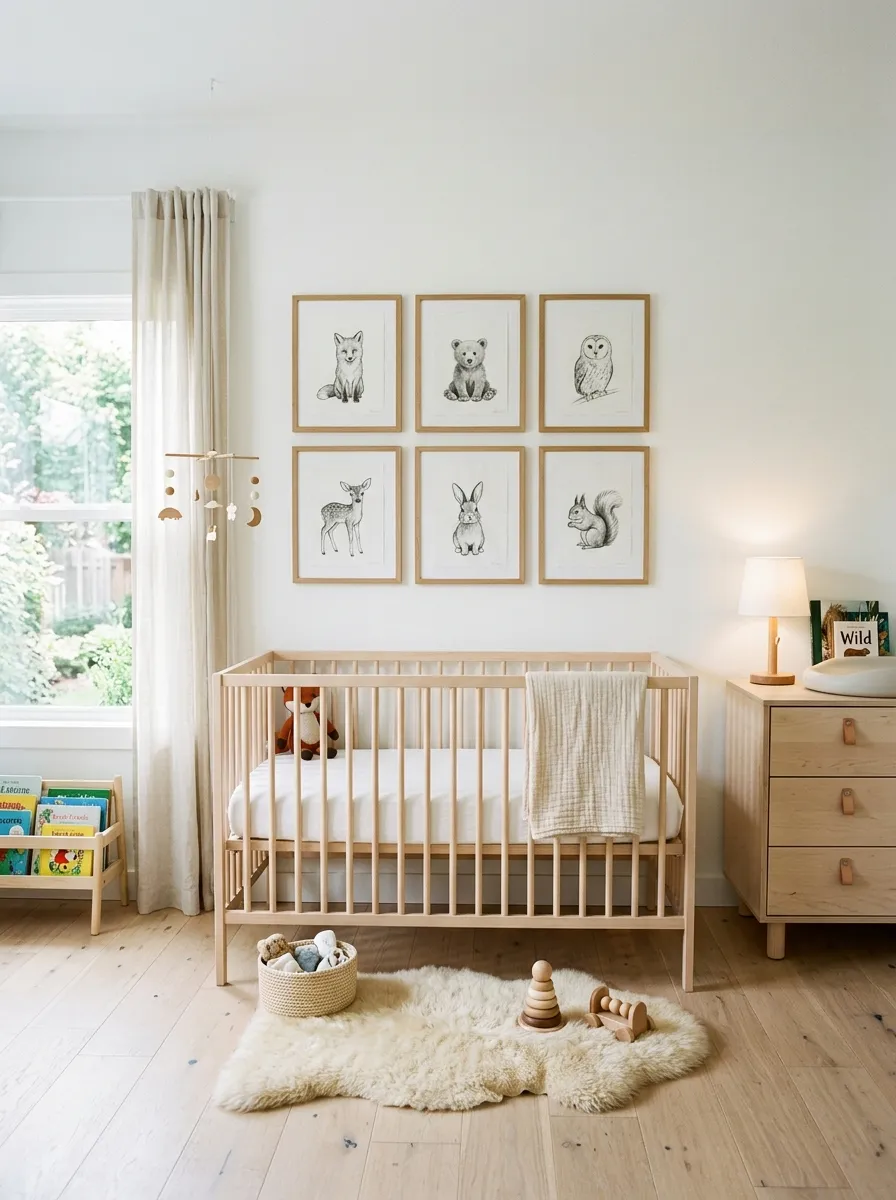
When my sister asked me to help plan her baby’s nursery, she had one clear wish: a forest feeling, but calm, not cartoonish, and nothing that would feel babyish in two years’ time. We spent a rainy weekend in Munich looking at paint samples and second-hand furniture, and I learned quickly that a forest nursery works best when you pick one strong idea and let the rest stay quiet.
The ten ideas below are the ones we tried, kept, or wished we had tried, drawn from that nursery and from two more I have helped friends put together since. I have included honest notes about what was easy to change later, what was a pain to repaint, and where spending a little more made a real difference. A nursery should grow with a child, so I favour paint, textiles, and prints over anything glued permanently to the wall.
1. Misty Pines Watercolor Mural & Brass Accents

A watercolour-style mural of misty pines gives a nursery instant atmosphere, and it is softer than a bold printed wallpaper. We used a peel-and-stick mural, which cost around ninety euros for one wall, because my sister rents and did not want to repaint when she moves out. The pale blue-green trees fade towards the top of the wall, which makes the ceiling feel higher, and small brass details, a picture light, drawer knobs, and a mobile hanger, warm up the cool colours without adding another strong colour to the room.
Measure the wall twice before ordering, and order a little extra width, because mural panels are unforgiving if you cut one short. We hung the mural on a Saturday morning with two people, one holding the panel straight while the other smoothed it down, and it took about two hours including trimming.
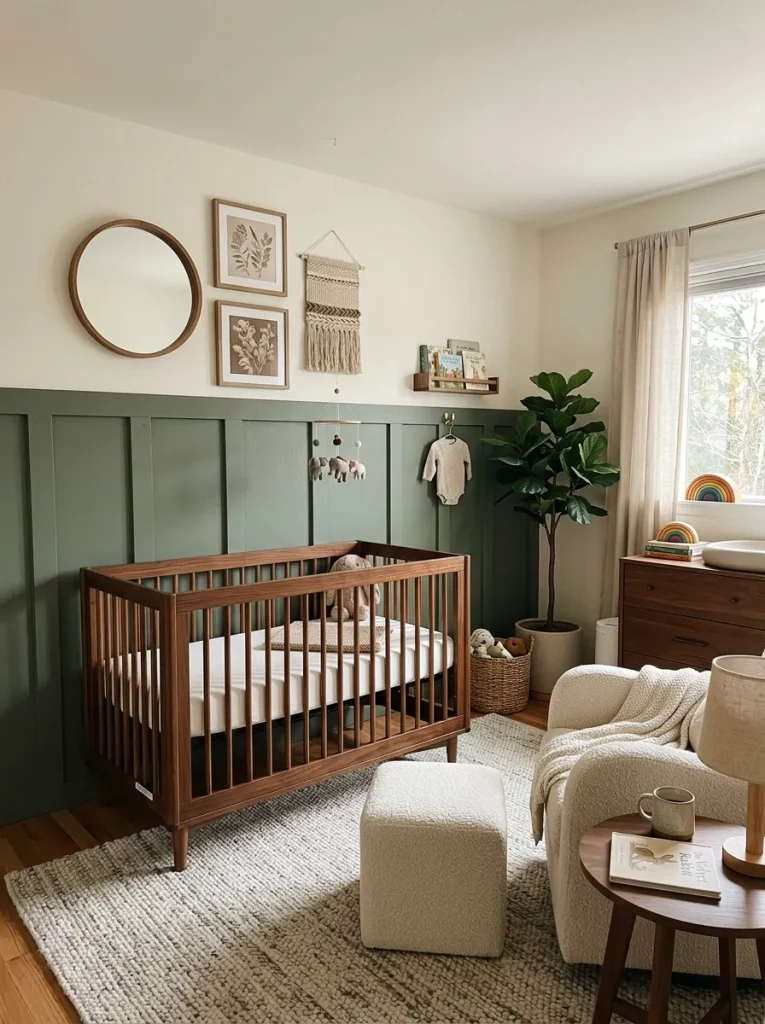
2. Deep Sage Green Board & Batten Accent Wall

Board and batten is one of those projects that looks far more expensive than it is, and sage green keeps it gentle enough for a nursery. We fixed thin MDF battens to the wall behind the cot, spaced evenly, painted them the same sage as the wall behind, and suddenly a plain wall had depth and rhythm. The materials cost under sixty euros, including paint, and the whole job took a weekend, mostly because we waited for the filler to dry between sanding and painting.
Use a spirit level for every batten, even if the wall looks straight, because a slightly sloping batten is obvious once the whole grid is up. We also painted a test patch first and lived with it for three days, since sage looks very different in morning light and in evening lamplight.
3. Scandinavian Birch & Woodland Animal Sketch Art
Simple line sketches of woodland animals in light birch frames are my favourite nursery art, because they feel grown-up enough to keep for years. We chose three prints, a fox, a deer, and an owl, all in the same soft brown line style, and hung them in a row above the changing table at adult eye height rather than baby height, so they work as room decor first. The birch frames cost about fifteen euros each, and the prints were downloaded and printed locally, which kept the whole set under fifty euros.
Keep the frames identical and the spacing even, since matching frames make different animals feel like a set rather than a random collection. Hang them with proper wall fixings, not adhesive strips, because frames above a changing table must not fall, and check them every few months as the house settles.
4. Enchanted Botanical Forest Wallpaper & Velvet Touches

Botanical wallpaper with ferns and trailing leaves can make a nursery feel like a secret garden, especially when you pair it with soft velvet cushions and a throw. We papered just one wall, the one behind the nursing chair, and kept the other walls a warm off-white, which stopped the pattern from overwhelming the room. The wallpaper was a paste-the-wall type, which is much easier for beginners than paste-the-paper, and cost about forty-five euros per roll, with two rolls covering the wall.
Order one extra roll beyond your calculation, because matching a botanical pattern across seams wastes more paper than you expect, and a discontinued batch is hard to replace later. Velvet in a nursery needs to be washable or at least easy to spot-clean, so we chose a velvet-look cushion with a removable cover rather than real velvet.
5. Whimsical Canopy & Wooden Forest Mobiles
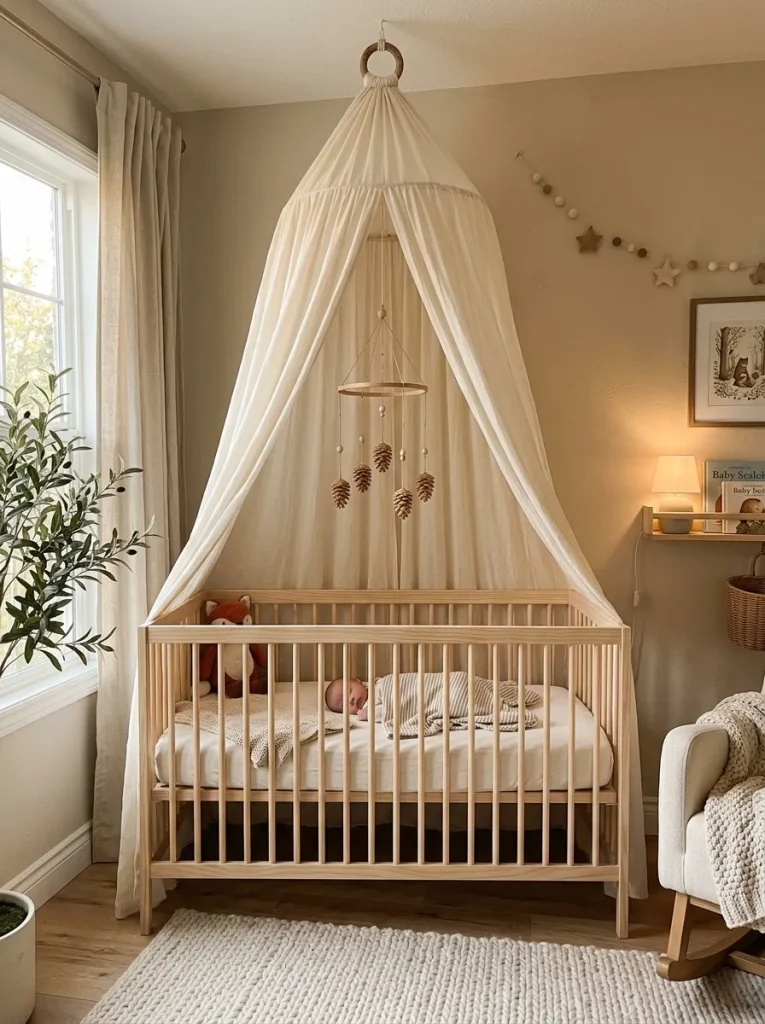
A canopy over the cot creates a cosy, den-like feeling, and a wooden mobile with small forest shapes gives a baby something gentle to watch. We hung a sheer cotton canopy from a ceiling hook above the head end of the cot, draping it so it fell outside the cot rails rather than inside, which is important for safety. The mobile was a simple wooden ring with felt leaves and a couple of small wooden animals, hung from a separate arm, and it turned slowly in the draught from the window.
Safety comes first here: the canopy must never hang inside the cot where a baby could pull it, and the mobile must be well out of reach once the baby can sit up, so plan to remove it at that stage. Check ceiling fixings carefully, and use a hook rated for more weight than the canopy actually needs, since a falling canopy in the night is frightening for everyone.
6. Moody Forest Floor Dark Teal & Walnut Nursery

A darker nursery can still feel calm and sleep-friendly, and deep teal with walnut wood is a combination that ages beautifully as a child grows. We painted the lower half of the walls in a deep teal and kept the upper half warm white, with walnut-stained furniture, a cot, a dresser, and a small bookshelf, tying the room together. The dark colour actually helped with daytime naps, since the room felt dimmer even with the curtains open, and the walnut stopped the teal from feeling cold or flat.
Dark paint needs two coats at least, and a good primer underneath, or the old wall colour shows through in patches, which we learned the hard way on the first wall. Test the teal in the actual room light before committing, because teal shifts towards blue or green depending on the bulbs you use, and warm-white bulbs suit it best. Keep bedding and rugs light, in cream and soft grey, so the room does not feel heavy, and add a warm lamp for evening feeds rather than relying on the ceiling light.
7. Rustic Modern Log-Cabin Beadboard & Leather

Beadboard gives a nursery a log-cabin warmth without needing actual logs, and pairing it with a leather nursing chair makes the room feel like a proper retreat. We fixed beadboard panels to the lower half of one wall, painted them a soft cream, and left the upper wall a pale warm grey, which kept the cabin feeling light rather than dark. The leather chair was second-hand, found for about one hundred and twenty euros, and it has survived countless feeds, spills, and naps far better than a fabric chair would have.
Beadboard panels are easy to cut with a fine saw, but measure around plug sockets carefully and cut those holes before you fix the panel to the wall. Paint the panels before fixing them if you can, since painting in the grooves afterwards takes twice as long and drips everywhere.
8. Fairytale Birch Tree Trunk Wall Stencils
Stencil birch trunks are a lovely middle ground between plain paint and full wallpaper, because you can place the trees exactly where you want them. We used a reusable birch trunk stencil, painting tall white trunks with soft grey shading and small dark marks, spaced unevenly across the wall behind the cot. The stencil cost about twenty-five euros, the paint was leftover wall paint, and the whole wall took an afternoon, including time to step back and check the spacing from the doorway.
Fix the stencil firmly with low-tack tape and use very little paint on the brush, dabbing off the excess first, because too much paint bleeds under the stencil edge and ruins the crisp trunk line. Work from the top of the wall downwards, and overlap the stencil marks slightly so the trunks look continuous rather than patched together. A few small green leaves stencilled near the top of each trunk, added with a second small stencil, finished the forest effect without making the wall busy.
9. Vintage Earthy Terracotta & Moss Green Fusion

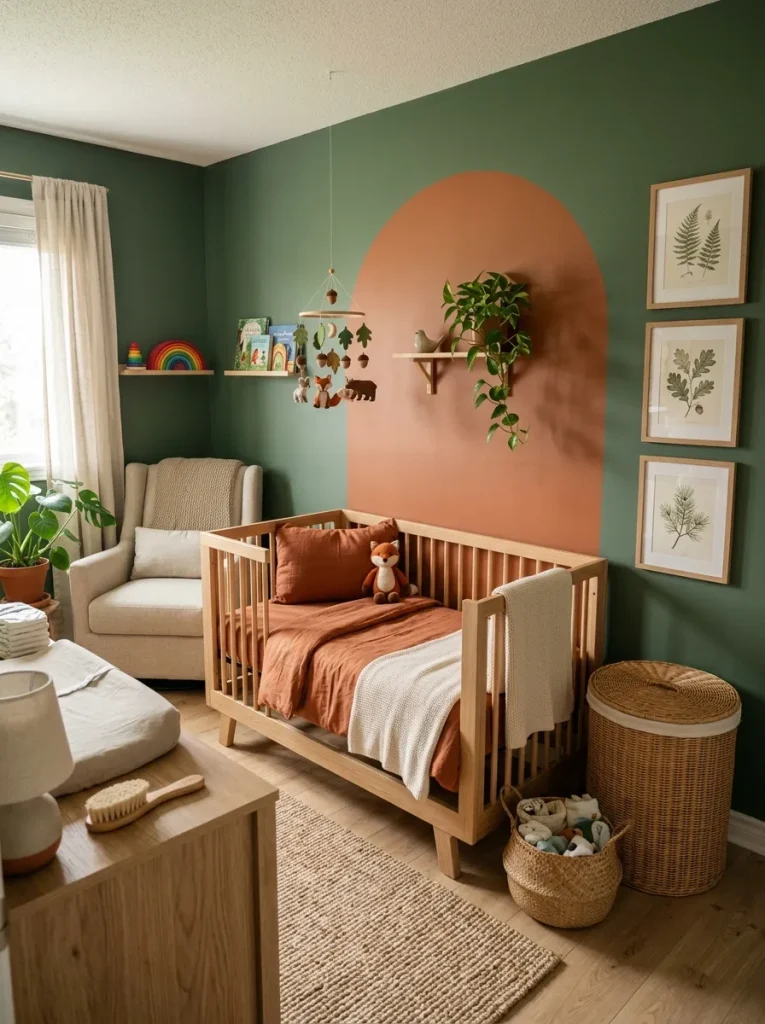
Terracotta and moss green together feel earthy and warm, like autumn leaves on a forest floor, and they suit vintage furniture beautifully. We painted one wall in a muted terracotta, used moss green for bedding and curtains, and brought in a vintage wooden dresser that we sanded and waxed rather than repainting, so its grain stayed visible. A terracotta pot with a trailing plant on the windowsill, well out of reach, and a few framed botanical prints completed a room that felt collected over time rather than bought in one shopping trip.
Terracotta can go very orange under warm light, so test a large patch and look at it morning and evening before you paint the whole wall. Vintage furniture needs a safety check before it goes into a nursery, so we fixed the dresser to the wall with an anti-tip strap, sanded any rough edges, and made sure the drawers could not be pulled out fully by a climbing toddler later on.
10. Organic Modern Rattan, Jute & Fern Garden

Rattan and jute bring a natural, garden-like texture into a nursery, and real ferns, kept safely out of reach, make the room feel alive. We chose a rattan bassinet for the first months, a jute rug that is soft enough for tummy time, and a rattan pendant light that casts lovely dappled shadows in the evening. A couple of ferns on high shelves and one larger plant in a corner, all non-toxic varieties checked beforehand, added green without any wallpaper or paint, which made the room easy to change later.
Check that any plant in a nursery is non-toxic, because babies put everything in their mouths eventually, and keep plants where they cannot be pulled down. Jute rugs shed a little at first, so vacuum them well before the baby arrives and choose one with a non-slip backing, or add a rug pad underneath.
A forest nursery does not need to be finished all at once, and the rooms I love most are the ones that grew slowly, one thoughtful piece at a time. Start with the wall colour and the cot, live in the room for a few weeks, and then add the art and textiles that feel right. The forest will still be there, quietly, while your baby grows up inside it.