
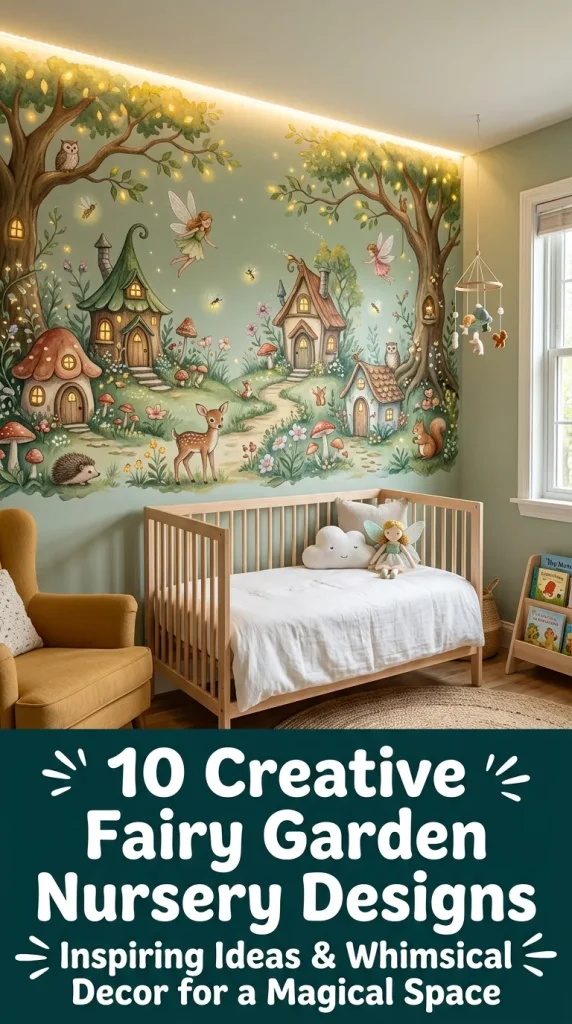
My sister asked me to help with the nursery last spring, with one firm instruction from my four-year-old niece: it had to look like where fairies live. Not pink-princess — fairies. Moss, mushrooms, tiny doors, dappled light, the whole enchanted-forest brief. I took it as a design challenge: a nursery that feels like a woodland glade but still works for 3 a.m. feeds and can grow with her into a big-girl room. We did it over two months of weekends for about 550 EUR, and the trick was grounding every whimsical choice in something practical. A fairy-tale nursery cannot just be cute; it has to survive real life. These are the ten projects that built it.
1. Muted Dusty Rose Shiplap Accent Wall
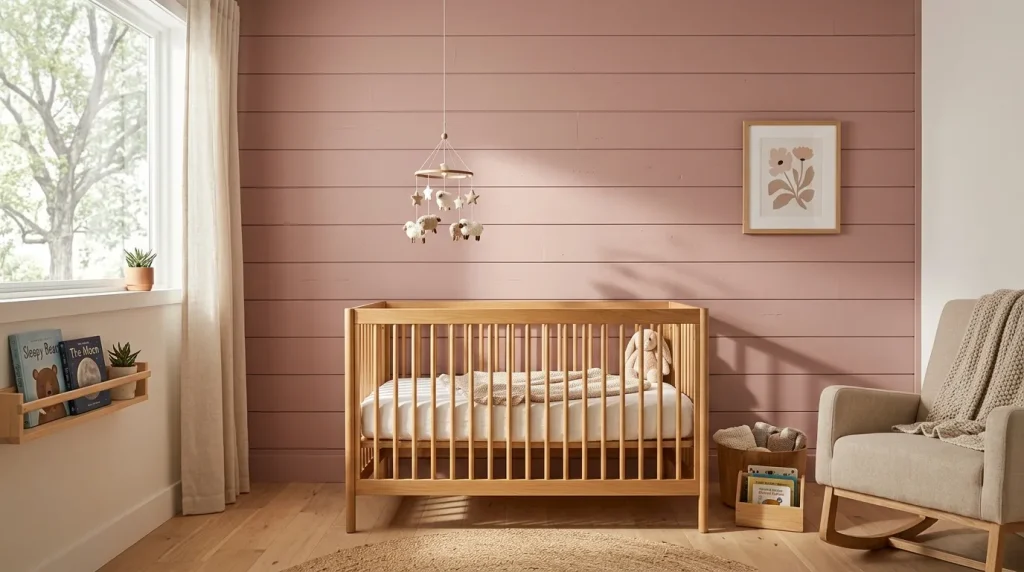
Every fairy glade needs its backdrop, and ours became a dusty rose shiplap wall behind the crib — warm like the inside of a tree hollow at sunset. I chose rose over green because green walls go muddy in low light, while this shade glows even under a nightlight. The boards are thin pine, mounted horizontally with tiny shadow gaps, and I painted them after caulking so the lines read crisp. My niece calls it “the sunset wall,” which is better than anything I could have named it. One practical note for nurseries: matte washable paint, always — tiny hands will touch this wall daily, and we have already wiped mystery smudges off it a dozen times. One Saturday, about 60 EUR, and the room went from blank box to storybook in a day.
2. Raised Ash Wood Mid-Loft Sanctuary
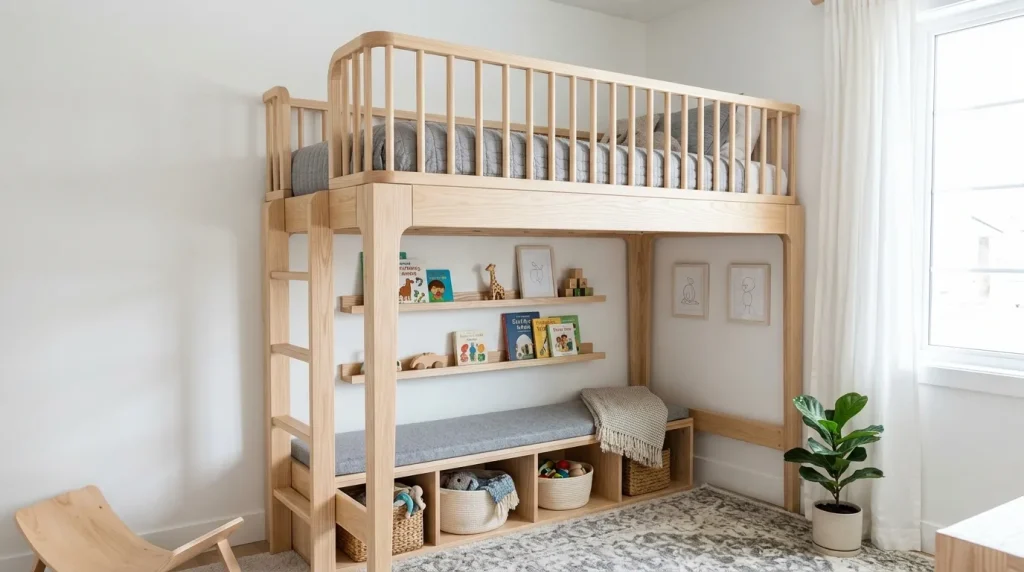
This one is for later — I built the mid-loft frame now, while we had the tools out, but it is currently stored flat in the cellar waiting for the big-girl-bed transition. It is a low ash platform at 90 cm that will become her reading loft, with the space beneath dressed as a fairy hollow: moss-green rug, toadstool pouf, and the twinkle-light canopy I am already hoarding. Building it early meant I could stain it to match the wardrobe and get the dusty finish right without a toddler “helping.” The frame breaks down with eight bolts, all labeled in bags taped to the rails, because future-me will not remember otherwise. When she outgrows the crib, the room transforms in one weekend instead of needing another full project. Planning one phase ahead is the most parent-brained thing I have ever built.
3. Deep Custom Wall-Pocket Alcove Crib
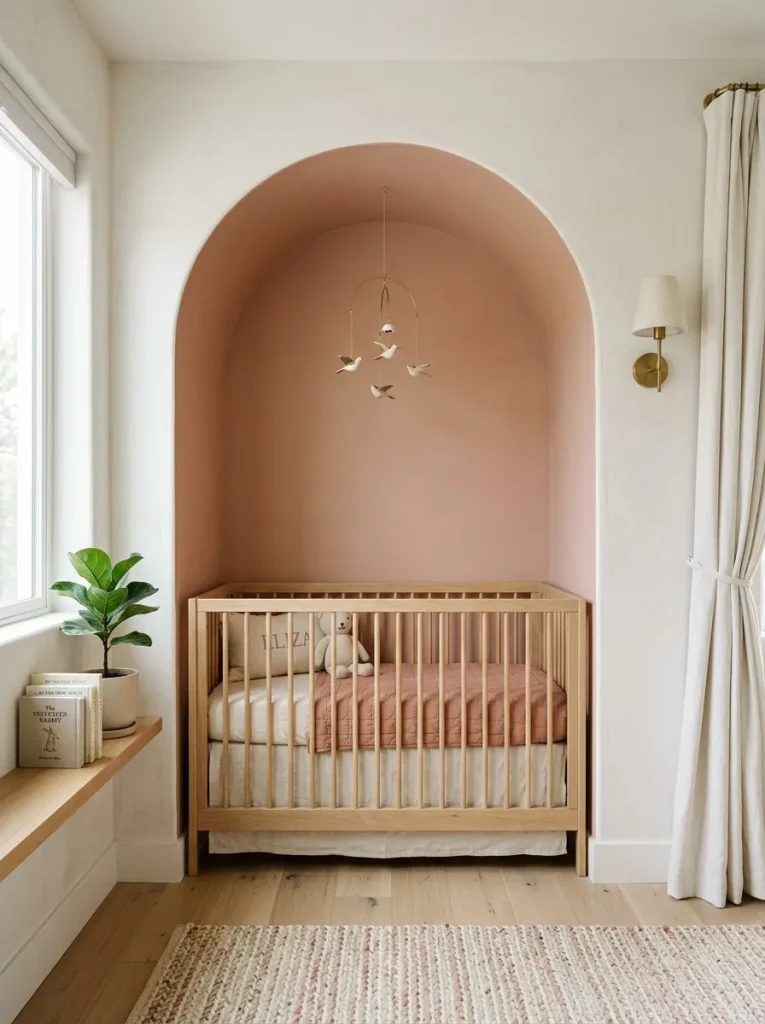
The room’s best feature is an accident of architecture: a deep wall recess that fit the crib almost exactly, like it was waiting for it. We lined the recess with the same dusty rose shiplap, added a dimmable warm LED strip along the top edge on a remote, and the crib slid in to become a little sleeping grotto. The alcove blocks drafts from the window wall and muffles hallway noise — she sleeps noticeably better in there than she did in the old flat’s open corner. Safety first, obviously: the strip light is 12V, fully enclosed, mounted where no small hand can reach, and there is nothing climbable within reach of the crib rails. At night with the strip on low, it genuinely looks like a fairy hollow. The lining cost about 40 EUR; the effect is worth ten times that at 3 a.m.
4. Asymmetric Floating Box Cube Modules
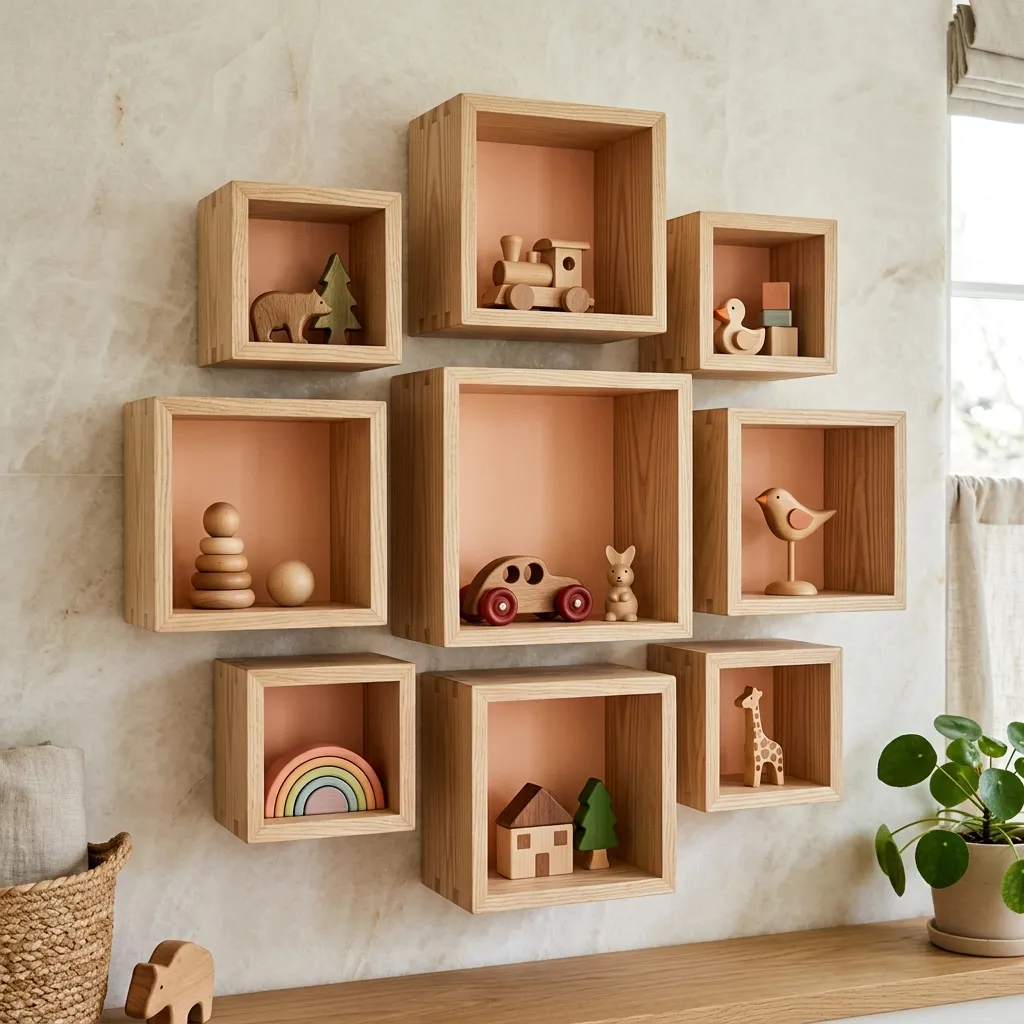
For toy storage I built seven open cubes and scattered them up the wall like hollowed-out tree nooks — deliberately irregular, some holding books, one holding the fairy-door collection, one empty on purpose because a four-year-old needs an empty shelf to fill with Important Finds. I painted the cube interiors a soft sage while leaving the exteriors white, so each one reads as a little mossy hollow. They are all screwed into studs with the heavy-duty brackets, because cubes at toddler height become climbing frames by age three — plan for it. The lowest cube is hers to arrange freely; the higher ones hold the nice things. About 50 EUR in birch plywood. She now “tidies for the fairies” before bed, which is the only cleanup bribe that has ever worked in this family.
5. Minimalist Monochromatic Book Ledges
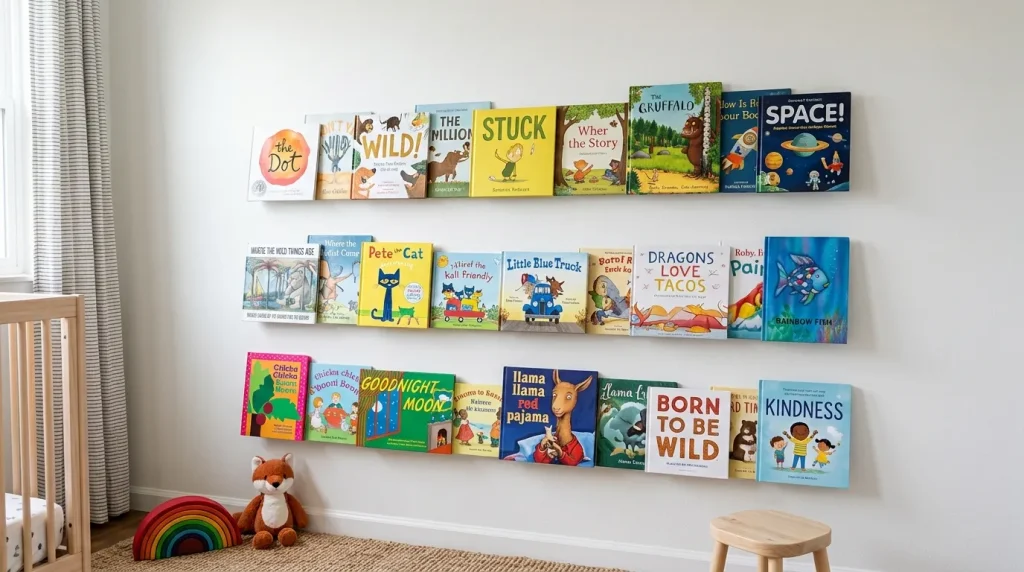
Bedtime stories are the heart of this room, so the books got prime real estate: three long ledges at her eye level along the wall opposite the crib, painted wall-white so the covers do all the talking. Right now they hold the woodland picture books — the mushroom field guides (picture only, obviously), the badger stories, the fairy tales with the good illustrations — facing out like a little forest library. The ledges are shallow enough that she can reach every book herself, which means she “reads” to her stuffed animals for twenty minutes before she calls us in. I mounted them with the 4 cm lip after the Great Book Avalanche of the temporary shelf taught us the lesson. Under 20 EUR, one evening’s work, and the single most-used feature in the room after the crib itself.
6. Minimalist Drop-Front Storage Ledges
Nurseries accumulate small necessary things — diapers, wipes, creams, the thermometer — and they look terrible on open shelves. I built a shallow drop-front cabinet on the wall by the changing area: closed it is a plain white panel that blends into the wall; the front folds down on soft hinges to reveal divided compartments for all the supplies. Above it I ran a narrow display ledge for the rotating seasonal nature finds — pinecones in autumn, feathers in spring — which keeps the whimsy visible and the clutter hidden. The fold-down front is held by quiet magnetic catches, no slamming during naps. Everything wipes clean, which in a nursery is not a preference but a requirement. About 35 EUR in materials, and the changing corner finally looks like part of the room instead of a pharmacy shelf.
7. Woven Cotton Rope Basket Columns

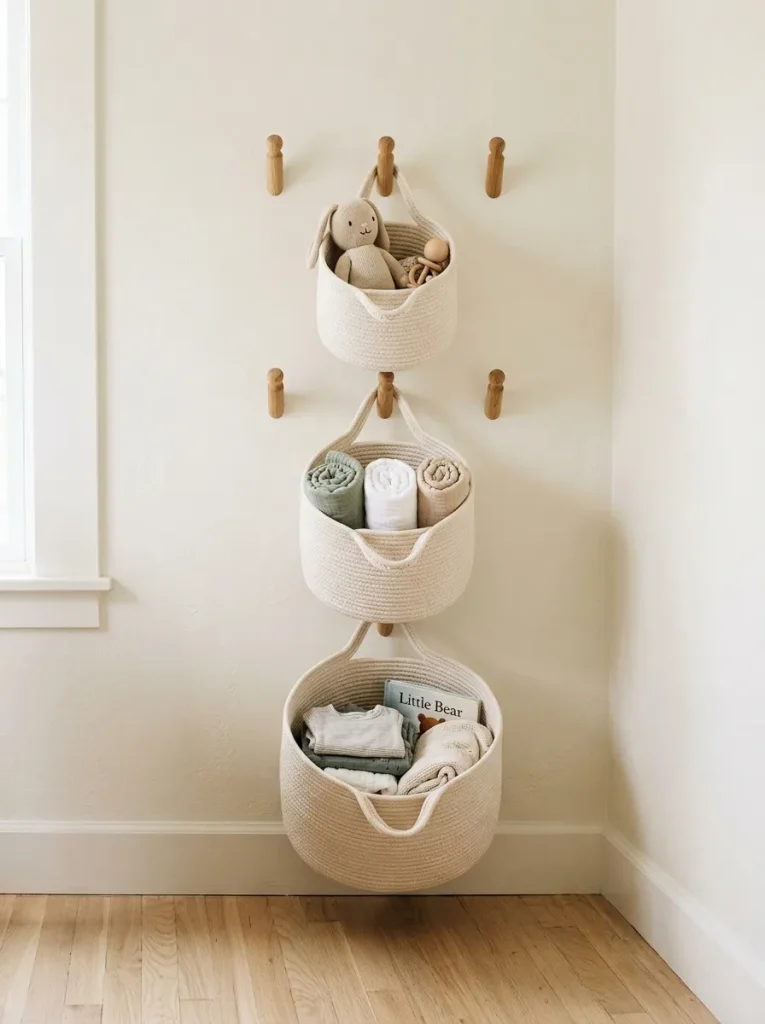
Soft toy storage was non-negotiable — anything with corners in a toddler’s room is a future incident report. I stacked three big cotton-rope baskets in the corner: plush animals in the bottom, dress-up capes and fairy wings in the middle, blankets on top. The rope texture fits the woodland brief perfectly, like foraging baskets, and they are light enough that my sister can carry the whole column to the living room when the grandparents visit. I tied the three together with jute cord so they cannot topple individually, and the top basket’s rim is exactly the right height for a bedtime-story pile. They get washed in the bathtub every few months and dry overnight on the balcony. 40 EUR for the three, and the fairy wings finally have a home that is not the hallway floor.
8. Double-Layer Light-Reflective Window Drapery
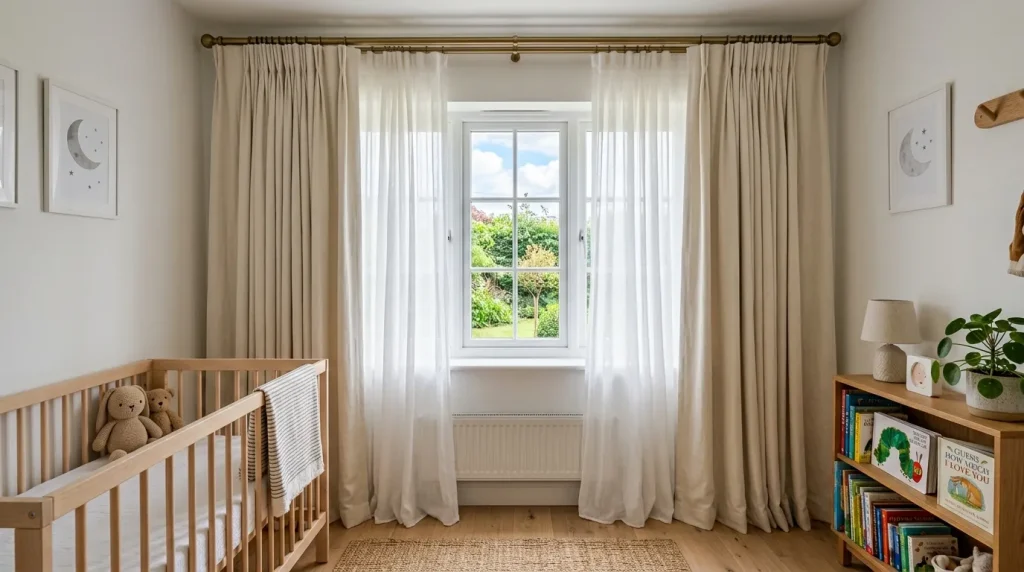
Light is the whole fairy-garden trick. By day, a sheer ivory curtain diffuses the sun into that dappled-forest glow — I chose a linen-look weave specifically because it scatters light instead of just dimming it. Behind it hangs a full blackout panel for naps and early bedtimes; in summer this room needs to go dark at seven while the sun is still up. Both run on a double rod mounted high and wide so the window looks twice its size when the sheers are drawn back. The blackout has been the single best sleep investment in the room — naps lengthened by forty minutes the first week. About 50 EUR for both panels. A nursery that cannot go properly dark is just a pretty room where nobody sleeps; this one does both.
9. Curated Artisan Matte Pottery Vignettes
The fairy details live in three tiny pottery groupings, all at adult height where small hands cannot redecorate: a cluster of matte bud vases with dried lavender on the high cube, a handmade mushroom-shaped pot holding hair ties on the wardrobe top, and a shallow stoneware dish of “fairy treasures” — acorn caps, a tiny pinecone, sea glass — on the windowsill. Everything is thrifted stoneware, nothing over 4 EUR, all unbreakable enough to survive a fall. I keep the groupings to odd numbers and change one element with the seasons, which takes five minutes and keeps the room feeling alive. My niece is allowed to hold the treasures supervised, which makes them magical instead of merely decorative. Small, cheap, and the detail visitors photograph.
10. Slatted Timber Acoustic Wardrobe Doors

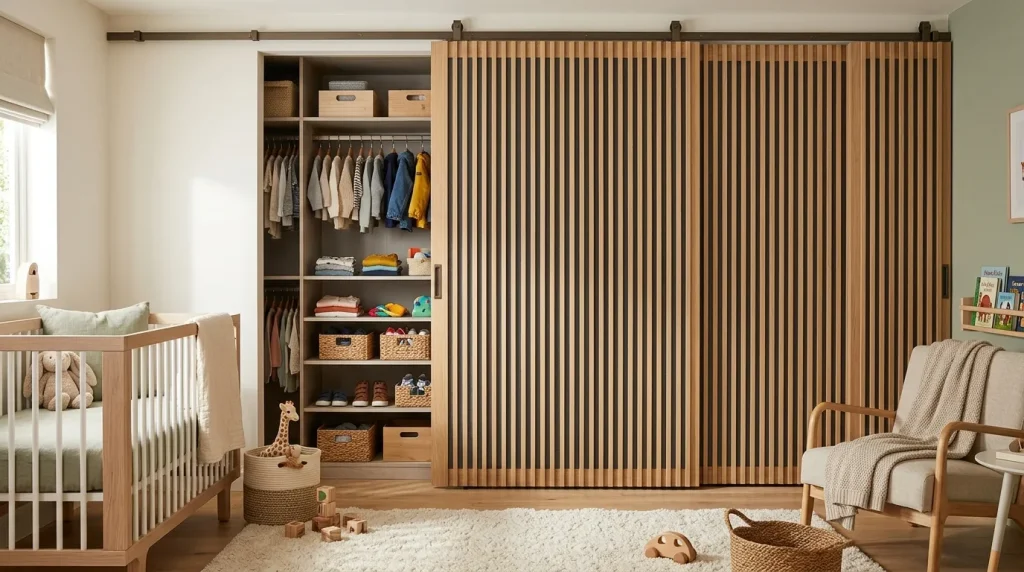
The wardrobe got slatted timber doors stained a warm honey oak — vertical battens that read as a little forest of tree trunks, which my niece noticed before I did (“the trees!”). Beyond the look, the slats genuinely soften the room acoustically; nurseries echo, and a calmer-sounding room settles babies faster, or so my sister swears. I kept the old carcass and hinges and just rebuilt the fronts, which kept the cost to about 65 EUR in battens and stain. The gaps between slats are narrow enough that no fingers fit — I checked with the actual fingers in question. It is the room’s biggest surface after the walls, and making it beautiful instead of merely functional lifted the whole space from “baby’s room” to somewhere the adults like being at midnight too.
Conclusion
Two months, about 550 EUR, and one very specific brief from a four-year-old — and the nursery genuinely feels like the edge of an enchanted forest while handling every unmagical reality of baby life. My advice for a themed nursery: pick the theme’s feeling (dappled light, natural textures, hidden nooks) rather than its merchandise, build the practical stuff first, and let the whimsy be the seasoning. She will outgrow fairies eventually; she will not outgrow a room where everything has its place. Though between us, I hope the fairy door stays forever.