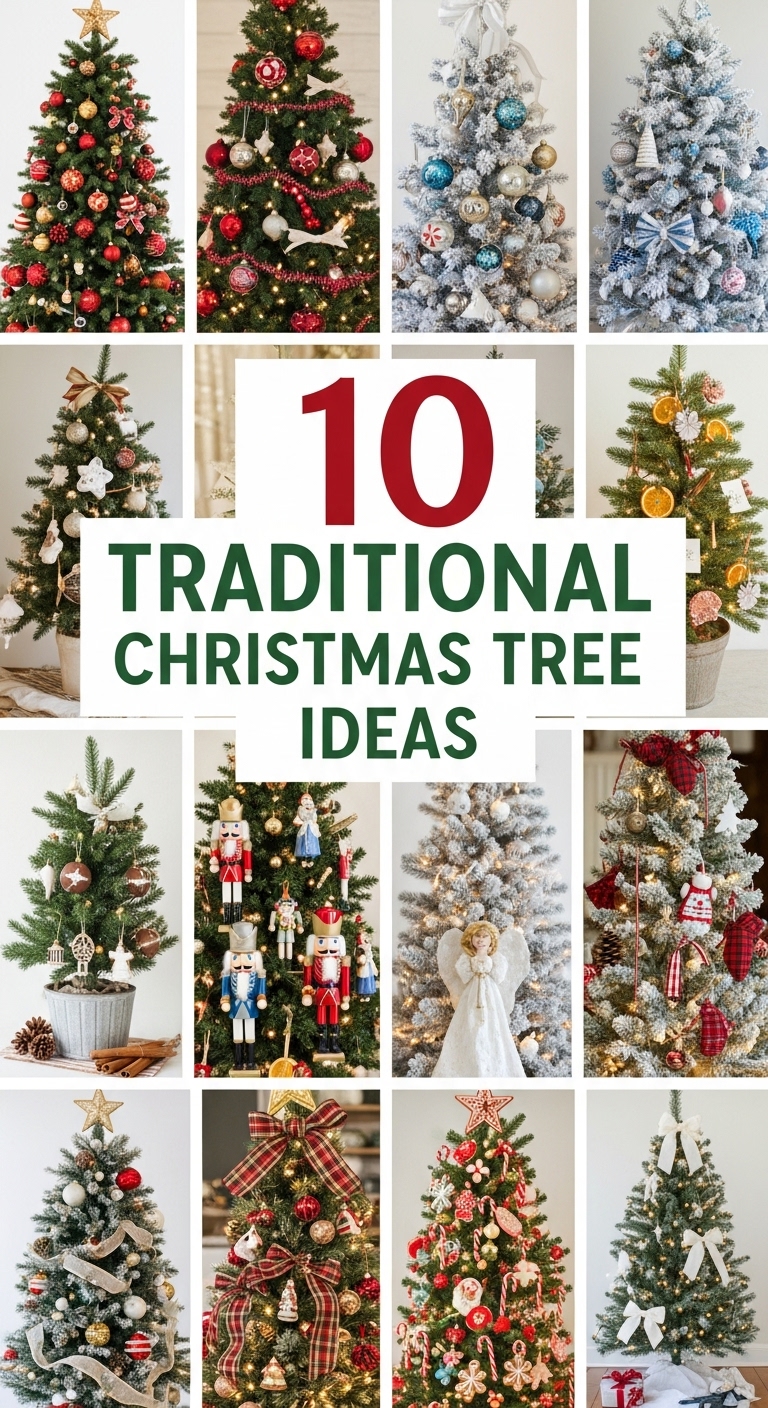
Every December I tell myself I’ll try something modern for the tree, and every December I end up with the red baubles anyway. Last year I stood in my Munich flat with a box of heirloom glass ornaments my grandmother packed in newspaper from 1987, a spruce needle in my sock, and the honest realization that the classic look is the only one that makes my living room feel like Christmas actually lives there. This is the tree I put up year after year, refined through about a decade of overbuying baubles, underbuying lights, and learning which corners of the tree nobody ever looks at anyway. Here are the ten traditional styles I’ve actually tried, tested, and kept notes on.

1. Classic Red and Green Tree

This is the one everyone pictures when they hear “Christmas tree,” and there’s a reason it never dies. I put mine up every second year or so, a real Nordmann fir about 1.80 meters, because nothing smells like the holidays quite like real resin in a warm room. I learned the hard way to buy the baubles in sets rather than one tragic ornament at a time — a mixed set of forty red balls from the Christmas market cost me around 25 EUR and covered the whole tree, whereas the fancy individual ones I bought the year before left me with a tree that looked underdressed and a wallet that didn’t. My system now: lights first (two strands of 100 warm-white LEDs, always warm, never that cold blue-white), then the big ornaments deep inside the branches, then medium ones on the mid-layer, then the small glittery ones right at the tips where they catch the light. The mistake I kept making was putting all the big baubles on the outside, which left sad empty holes near the trunk — tucking them inside gives the whole tree depth. Finish with a red velvet tree skirt to hide the stand, and you’re done in an afternoon.
2. Gold and White Traditional Tree

When I want the tree to look a little more grown-up — usually the years we’re hosting my in-laws — I go gold and white, and it always photographs beautifully. The secret here, which I figured out after one sad attempt that looked like a beige smudge, is contrast: you need three finishes of gold at minimum. Matte, shiny, and glittered, mixed freely. If everything is the same shiny gold, the tree reads as flat. I use my artificial spruce for this one since the dense green background makes the gold pop, and I add long champagne-colored bead garlands that catch the warm-white lights from behind. A gold angel topper from a flea market in Sendling — I think I paid 8 EUR — finishes it. Around the base I scatter a few pinecones I sprayed gold one bored Sunday, which cost almost nothing and look far more expensive than they are. One practical tip: gold shows every fingerprint and dust speck, so I now wipe the baubles with a dry microfiber cloth as I hang them, which saves a lot of squinting later.
3. Vintage Ornament Tree

Some of my favorite ornaments are the chipped glass birds my grandmother bought in the sixties, and one year I decided the whole tree should be a tribute to them. I raided flea markets and my mother’s attic for glass baubles, wooden figurines, little tin bells, and those paper fan decorations that unfold like accordion fans. The multicolored lights were a deliberate choice — warm white felt too polished for a tree this nostalgic, and the old-style multicolor strands gave it that warm sixties living-room feeling I remembered from childhood photos. Dried orange slices threaded on twine added scent and filled the awkward gaps between the fragile ornaments, and they cost me exactly one bag of oranges and an afternoon at 90 degrees in the oven. The lesson from this tree: don’t mix in too many new shiny things or the vintage pieces get lost. I gave the old glass pieces the best spots at eye level and put newer filler pieces up top and down low, and the whole tree told a story instead of just sitting there.
4. Natural Woodland Tree

This is the tree for people who love Christmas but hate plastic — and the cheapest one on this list by a long way. I collected pinecones from the English Garden in October, gathered walnuts and acorns on a walk, and cut my ribbon from a roll of jute burlap I had left over from a gardening project. Wooden ornaments — little carved animals and stars — I bought over two years at craft markets for 2 to 4 EUR each, and they never date. I kept the palette strictly brown, cream, and deep green with warm candle-glow lights, and deliberately left breathing room between ornaments because woodland styling falls apart the moment it looks crowded. A sprig of real holly tucked here and there added that glossy dark green contrast, though I learned to put it up high where nobody brushes against it — holly leaves are genuinely sharp. The whole thing took an evening, cost me under 30 EUR total beyond the tree itself, and honestly it might be the coziest tree I’ve ever had. The only maintenance is shaking the pinecones off the dog’s interest.
5. Candy-Themed Traditional Tree

I did this one the year my niece was small enough to believe the tree was edible, and it was pure joy from the first candy cane. The trick is using mostly shatterproof ornaments shaped like sweets — gingerbread men, peppermints, little cupcakes — because real candy hung on a tree goes sticky and sad within a week, and a three-year-old will absolutely pull at them. I did hang real candy canes as the one edible element, but only on the upper branches where small hands couldn’t reach without a chair, and I replaced them weekly when they got tacky. A popcorn-and-cranberry garland threaded together over two evenings sounds charming in theory, and it was, but plan for it to look a bit rustic — mine was lumpy and I loved it anyway. Red, white, and green carried the color scheme, with warm lights to keep it cozy rather than garish. My tip: put a small basket of wrapped treats under the tree skirt, because guests will assume the tree ornaments are snacks, and having real ones to hand out saves the decorations.
6. Classic Red and Gold Elegance

Red and gold is the combination I reach for when the tree has to impress — it’s the tuxedo of Christmas trees, and in my formal living room it works every time. I’ve found the difference between this and the classic red-and-green version is all about restraint and shine: here everything should gleam a little. Deep red velvet baubles paired with polished gold ones, a gold bead garland draped in generous swags, and lights with a golden tone rather than cool white. I hang a big glittering gold star on top — my current one has survived six seasons and cost 12 EUR at a department store sale, money well spent. What made this tree genuinely elegant rather than just loud, I discovered, was the tree skirt: a deep red velvet skirt with a gold trim changed the whole base from an afterthought into part of the design. I keep the large statement ornaments sparse and let smaller gold balls fill in, because too many big baubles make the tree look like it’s about to fall over. Lanterns with LED candles around the base added a soft glow that photographs like a dream.
7. Traditional Scandinavian Tree
Living in Munich, Scandinavian Christmas is never far away — half my neighbors hang straw goats on their balconies — so one year I went full Scandi and never looked back. The rules I set for myself: red, white, and natural wood only, nothing shiny, nothing that plugs in beyond simple warm-white lights. Straw ornaments, little woven hearts, wooden stars, and paper cutouts gave the tree a handmade warmth that fancy baubles never achieve. I made about half the decorations myself over two weekends, mostly straw stars following an online tutorial and wooden beads threaded on string, which turned out to be genuinely relaxing evening work with a cup of tea. The tree itself I kept slightly sparse in styling — Scandinavian trees are allowed to show some green between ornaments, and I had to resist my usual urge to fill every gap. A ring of pinecones and a little moss around the base instead of a tree skirt kept it feeling natural. It’s a quiet tree, and in a world of glitter it felt like a deep breath.
8. Nutcracker-Themed Tree

This one started as a joke — a friend gave me a tiny wooden nutcracker and dared me to build a whole tree around him — and became one of my favorite holiday projects ever. I collected miniature nutcrackers over the season, the small carved ones from toy shops for 3 to 6 EUR each, plus ballerina ornaments, tiny drums, and little gift boxes I wrapped myself in leftover paper. The color palette stayed traditional: deep red, gold, and cream, with warm lights so the little wooden figures glowed rather than glittered. I discovered that small figurines vanish on a big tree unless you group them, so I clustered the nutcrackers in trios on sturdy branches and dotted the ballerinas between them like dancers on a stage. A miniature nutcracker hat as the tree topper got more compliments than any expensive topper I’ve owned. Under the tree I stacked real gifts wrapped in classic red-and-gold paper so the base became part of the scene. It’s a storytelling tree, and kids gravitate to it like it’s a shop window — which is exactly the point.
9. Traditional Family Keepsake Tree

Every year I add one ornament that means something — a souvenir from a trip, a handmade one from a craft afternoon, a dated bauble for the year — and the tree has slowly become a family archive you can walk around. When I finally made this my whole tree concept, I pulled out everything sentimental at once: the lopsided clay angel I made at age nine, my parents’ first married-Christmas ornament, tiny framed photos of us decorating trees years ago hung on ribbon. The visual challenge is real — a keepsake tree can look cluttered fast — so I unified it with one simple red-and-gold bead garland weaving through everything and warm white lights, which tied forty years of mismatched memories into something coherent. I put the fragile heirlooms high, the sturdy handmade ones where they can be admired up close, and the newest additions at eye level. Decorating this tree took an entire Sunday because every ornament triggered a story, and honestly that was the best part. It’s the least photogenic tree I own and the one I’d save in a fire.
10. Candlelit Traditional Tree

My grandmother decorated with real candles on the tree, a tradition I admire from a safe distance — I have a dog, a cat, and a healthy respect for fire insurance, so LED candles it is. I bought a set of clip-on flickering LED candles for about 20 EUR, the warm amber kind, and clipped them to the outer branch tips where they’d be visible rather than buried. They change the whole mood of the room after dark: the tree stops being a decoration and starts feeling like it’s glowing from within, exactly the old-world atmosphere I was chasing. I kept everything else simple on purpose — deep red and gold baubles, a few pinecone garlands, holly sprigs — because the candlelight is the star and busy ornaments fight it. Red and gold was the natural palette; anything cool-toned would have clashed with the warm flicker. Around the base I placed real lanterns with LED candles inside, which extended the glow without a single open flame in the flat. It’s now my Christmas Eve tree, lit only after dinner, and the ten minutes of sitting in front of it in the dark are my favorite part of the whole season.
Conclusion
After all these years and all these trees, the red baubles still win most Decembers — but the point was never finding one perfect style, it was learning that a traditional tree has room for every version of Christmas I’ve wanted to have. Pick the one that matches the season you’re having, give yourself a whole afternoon instead of a rushed evening, and hang the ornaments that make you smile even if they don’t match. That’s the tradition that actually matters.