
My bedroom used to be the room I never quite finished. Every other corner of my flat got attention — the living room got the nice lamp, the balcony got the plants — but my bedroom just had to be “good enough for sleeping in.” Then I spent one miserable winter waking up in a grey, bare box and finally admitted I deserved better. Over about six weeks I redid the whole room for roughly 450 EUR, mostly from IKEA runs, a flea market morning, and one slightly impulsive Baumarkt afternoon. Here are the ten things that made the biggest difference, in the order I actually did them.

1. Choose a Calming Color Palette
The first thing I did was repaint, because nothing else made sense while the walls were still that tired, rented-flat off-white with a faint yellow cast from years of tenants before me. I chose a muted sage green — specifically a chalky sage that stays soft even in bright morning light — and painted just the wall behind the bed, leaving the rest white so the room wouldn’t feel small. I spent 34 EUR on a two-litre tin and one Sunday afternoon on the job, and I learned the hard way to do the cutting-in with a proper angled brush instead of the cheap one from the multipack, which left bristles in my first pass. The effect was immediate and honestly a little emotional: the room finally felt like a place you could exhale in. My tip is to live with a painted A4 sample taped to the wall for three days first, because paint looks wildly different under your own lamps than under Baumarkt fluorescents. And don’t repaint the whole room at once — one accent wall is cheaper, faster, and much harder to regret.

2. Create a Statement Headboard
My bed used to just sit with its head against the bare wall, which made even my new sage wall look unfinished, like the room was still waiting for someone to move in. I found a secondhand upholstered headboard at a flea market for 40 EUR — dusty beige, a bit saggy in the middle — and re-covered it with a grey linen-look fabric I got for 18 EUR a metre, stapling it over the back with a staple gun I borrowed from a neighbour. The whole fix took an evening and cost under 60 EUR, and it changed the entire room more than anything else I did. What worked for me was going upholstered instead of wood: my flat has a lot of hard surfaces, and the soft headboard makes leaning against it to read genuinely comfortable, which a wooden one never was. If you’re buying new, measure your bed width twice before ordering — headboards that are 10 cm too wide make the whole room look off, and I nearly ordered the wrong size twice because I kept measuring the mattress instead of the frame.

3. Layer Textures for Comfort
I used to think “layering textures” was decorator speak for buying too many cushions, but I changed my mind one evening when my flatmate’s bedroom just felt nicer to walk into than mine, and I couldn’t work out why until I touched things: her bed had the nubby waffle throw, the smooth linen duvet, the slightly scratchy jute rug, and my bed had none of that. So I started collecting textures on purpose — a chunky knit throw from IKEA for 29 EUR, a washed-linen duvet set in a warm off-white, and two cushions in different weaves that I found reduced at a home store. What I learned is that texture works best when the colours stay in the same family: mine are all creams, warm greys and the sage from the wall, and because the palette is quiet, the different surfaces don’t fight each other. My mistake was buying a sequinned cushion first because it was cheap — it looked like it belonged to a different flat entirely and now lives on my sofa. Stick to three or four textures max, all in tones that already exist in the room, and the whole bed suddenly looks like it was styled by someone who knew what they were doing.

4. Incorporate Functional Storage
My bedroom is twelve square metres, which sounds fine until you subtract the bed, the wardrobe and the desk, and suddenly there’s nowhere to put anything except the floor. I was honest with myself about the actual problem: not too little storage, but nowhere to hide the ugly useful stuff. So I bought two flat under-bed boxes on wheels for about 15 EUR each and filled them with the winter clothes and the spare bedding that used to live in a sad heap on top of the wardrobe. Then I replaced my old nightstand — a wobbly thing with one drawer that stuck — with a small three-drawer dresser from a classified ad for 25 EUR, which holds my books, the charger chaos and the moisturiser collection I pretend isn’t a collection. The biggest win, though, was a 20 EUR set of fabric baskets on the wardrobe shelf for the stuff that needs a home but doesn’t need to be pretty. Everything I bought has a lid or a door, because I’ve learned that visible storage just becomes visual noise within a week, and my bedroom finally stays tidy without any effort on my part.

5. Add Personal Artwork or Photography
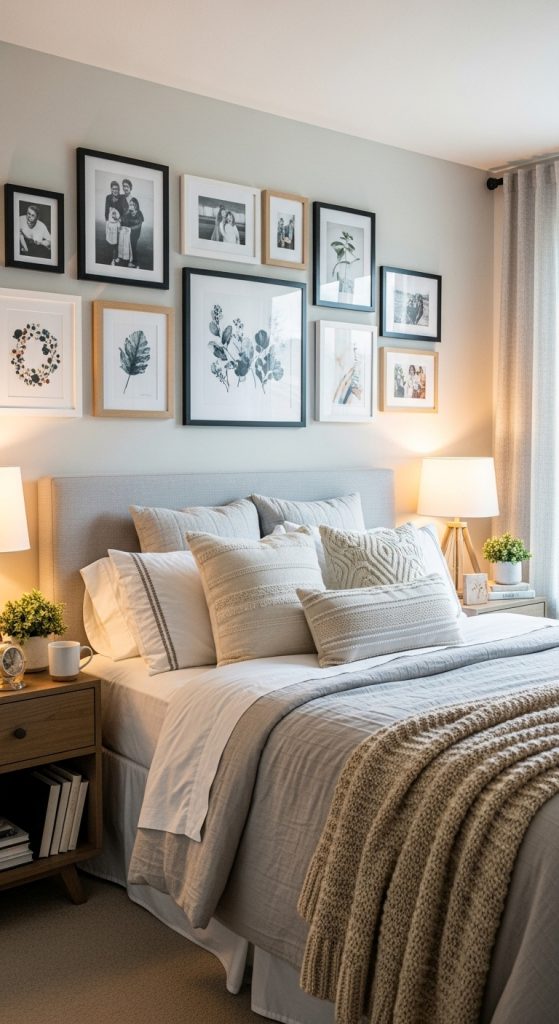
For years the only thing on my bedroom walls was a clock I never looked at, and the room felt like a guest room in someone else’s house. The change started when I printed twelve photos from a trip to the Baltic Sea — nothing fancy, just phone photos — and put them in identical black IKEA frames above the dresser. It cost me about 30 EUR total and it took me longer to choose the photos than to hang the frames, but now that’s the wall I look at every morning and it genuinely improves my mood. After that I got braver: I hung a small framed print I bought at a Munich flea market for 5 EUR, and I leaned a larger unframed canvas against the wall on top of the wardrobe instead of hanging it, which sounds lazy but looks intentional. My practical tip is to hang things at eye level when you’re standing — I hung my first frame too high and it hovered up near the ceiling like it was trying to escape. And don’t be precious about it; prints from your own camera beat expensive art you don’t care about every time.
6. Invest in Quality Bedding
I spent years buying the cheapest duvet sets and wondering why my bed never felt like hotel beds do, and then a friend told me to check the fabric weight and the weave, which I had never once considered. I replaced everything at once — washed linen duvet cover, two good sleeping pillows with proper filling instead of the flattened pancakes I’d been using, and one long body pillow because I read best propped on my side — for about 120 EUR total, which felt like a lot until I did the maths on sleeping in it every single night. The difference was not subtle: I stopped waking up tangled in a damp polyester sheet and started actually looking forward to getting into bed. What worked for me was choosing washed linen in a warm natural tone, because it looks good un-ironed, which matters enormously since I will never iron a duvet cover, and it gets softer with every wash instead of pilling. If the budget is tight, start with the pillows — a 25 EUR pillow that actually supports your neck changes your sleep more than any duvet pattern ever will.

7. Optimize Lighting
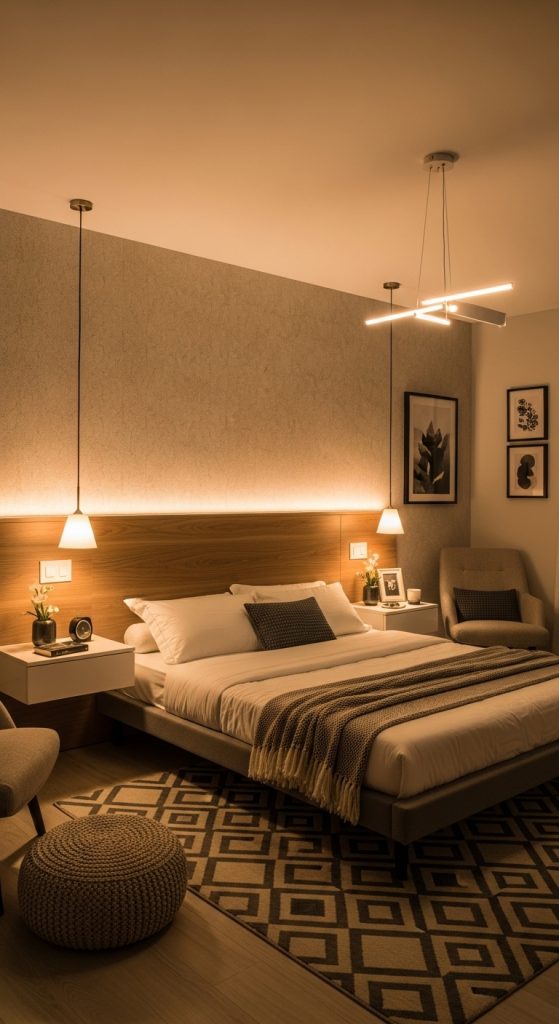
Until this year my bedroom had exactly one light source: a ceiling lamp with a bare 6000K bulb that made the room feel like an interrogation chamber every evening. I fixed it in layers, which sounds technical but just means I stopped expecting one lamp to do everything. I got two small bedside lamps with warm 2700K bulbs for the nightstands — about 22 EUR each — so I can read without the ceiling light on, and I added a dimmable floor lamp in the corner behind the reading chair, which is where I sit with tea on Sunday mornings. The single best purchase was a 12 EUR LED strip behind the headboard that throws a soft wash of light up the sage wall; it cost almost nothing and makes the whole room feel expensive at night. My hard-won lesson is to check the colour temperature on every bulb before you buy, because one daylight bulb in a warm room stands out like a torch, and I mixed them up twice before I started reading the packaging properly.
8. Include Greenery
I used to kill every plant I touched, so for a long time my bedroom stayed plant-free out of pure self-knowledge. Then I bought a snake plant for 12 EUR because the garden centre label literally said it survives neglect, and it not only survived but thrived on my north-facing windowsill with me watering it maybe once a fortnight. That one success gave me the confidence to add a pothos on top of the wardrobe — it trails down the side in the most satisfying way — and a small pilea on the dresser that my friends always comment on. The plants changed the room more than I expected: the green softens all the straight lines of the furniture, and watering them on Sunday mornings has become a little ritual I genuinely enjoy. If you share my history of plant crimes, start with exactly the plants I did — snake plant, pothos, pilea — all nearly indestructible, all cheap, and all perfectly happy in a bedroom that doesn’t get direct sun. Skip the fiddle-leaf fig dreams for now; I’ve seen too many crispy ones on the kerb.

9. Use Rugs to Define Space
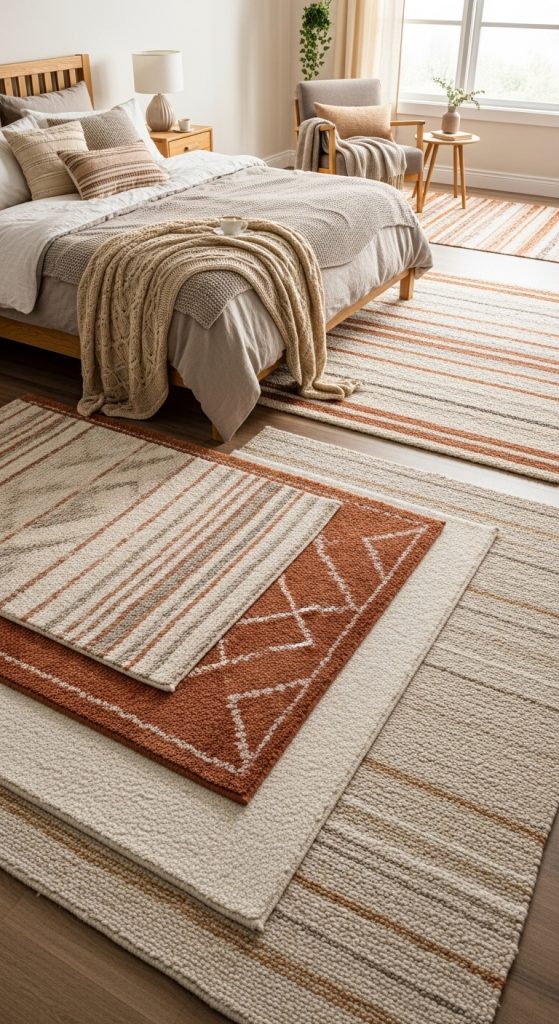
The floor in my bedroom is pale laminate that looks clean in photos but feels cold and loud underfoot — every step echoed, and getting out of bed onto it on a January morning was genuinely unpleasant. I solved it with a large flat-weave rug tucked under the lower two-thirds of the bed, extending about 60 cm out on each side so my feet land on something soft every morning. I paid 79 EUR for a 160 x 230 cm one in a warm grey pattern, and I laid a cheap non-slip pad underneath because on laminate, a rug without one migrates across the room like it has somewhere to be. The mistake I almost made was buying a rug that was too small: I measured three times and bought bigger than felt sensible, and I’m glad I did, because a rug that’s just a postage stamp under the bed looks awkward and does nothing for the acoustics. The room is noticeably quieter now, the floor is warm, and the rug visually ties the bed, the nightstands and the sage wall into one settled space instead of a collection of furniture.
10. Create a Cozy Reading Nook
The last piece of the puzzle was the corner by the window, which had been a dumping ground for laundry and a chair I never sat in. I moved a small secondhand armchair there — 35 EUR from the same flea market as the headboard — angled it toward the window, and put a little round side table next to it for the tea cup and the current book. Then I draped the chunky knit throw over the chair arm, put a small woven basket underneath the table for the magazines that were migrating everywhere, and that was it: the corner finally had a job. I use it constantly now — twenty minutes with coffee on Saturday mornings, a chapter before bed on weeknights — and I wonder why I wasted that corner for two years. If you’re short on space, don’t assume you need a full armchair: a sturdy floor cushion with a back against the wall and a good lamp does the same job in half the footprint. The real requirement is just light and somewhere to set a drink; everything else is decoration.

Conclusion
All of this cost me about 450 EUR spread over six weeks, and not one of the ten projects took more than a weekend afternoon. The bedroom went from the room I ignored to the room I retreat to, and the funny thing is that none of the changes were dramatic on their own — it was the accumulation of small, warm, considered choices. If you take on just one of these ideas this month, make it the bedding or the lighting, because those two changed how the room feels every single day. And if you finish all ten, I promise you’ll start closing your bedroom door just so you can enjoy it alone for a minute.