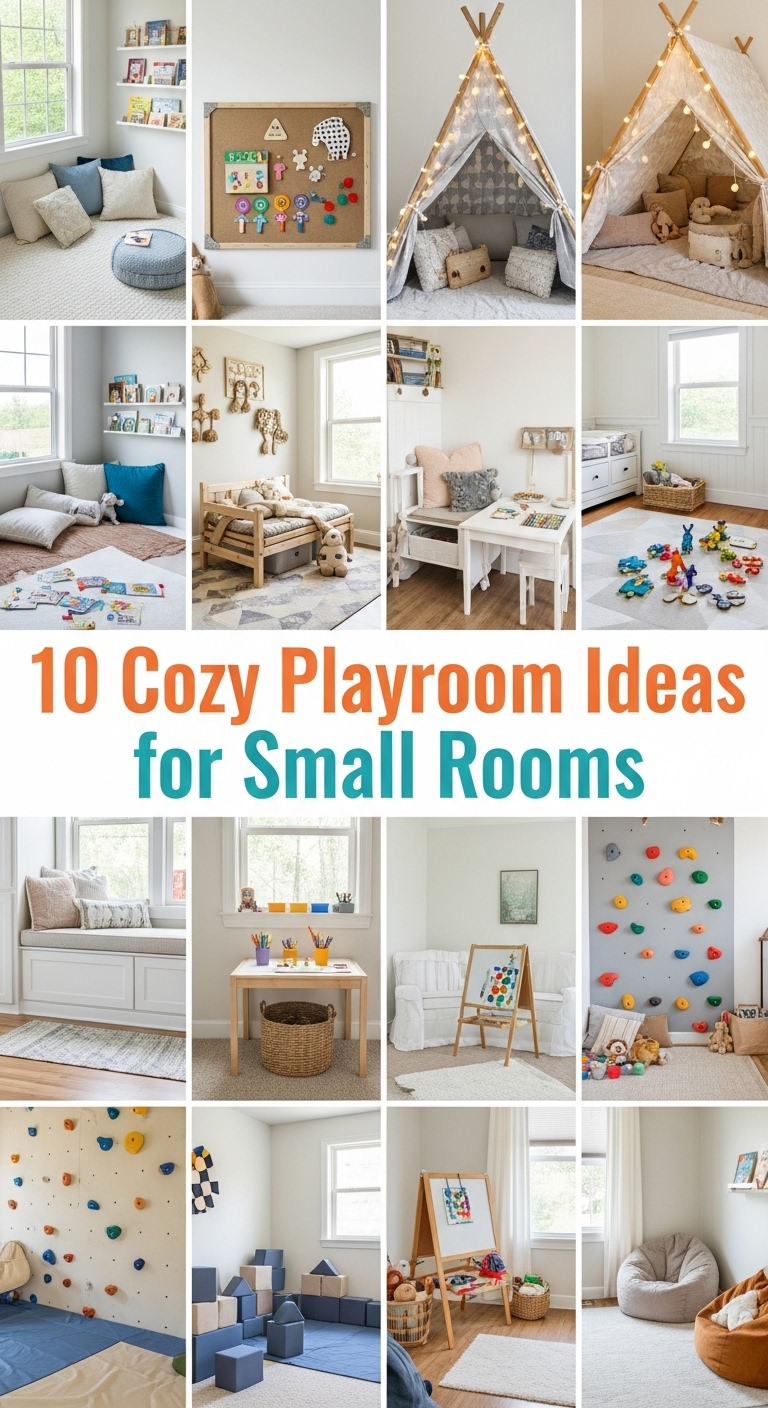
My daughter’s playroom in our flat is barely 3.2 by 2.8 meters — a former guest corner that used to hold nothing but a folding bed and a laundry rack. When we finally gave it to her, I stood in the doorway and honestly could not see how a single Lego set was supposed to fit. So I spent three weekends rethinking every centimeter, drilled more holes in those walls than I can count, and learned which “clever” ideas survive a real four-year-old and which ones don’t. These ten are the ones that survived.

1. Utilize Vertical Space

The floor in a tiny playroom is precious, so my first move was to stop thinking about it and start looking at the walls instead. I mounted two 80 cm floating shelves at her eye level — about 90 cm off the floor — and a third one higher up for the craft supplies I don’t want her reaching alone, like scissors and glitter glue. The piece that made it all work was a simple pegboard from the hardware store (60 × 90 cm, cost me around 14 euros) that I screwed into the wall next to her little desk; her scissors, washi tape rolls, and dress-up headbands all hang on hooks there, and it took an afternoon to paint it sage green with the leftover paint from our hallway. One thing I got wrong first: I mounted the lowest shelf too low, and she kept pulling the whole row of books down like dominoes. Raise it to shoulder height for their age and the problem disappears. Wall-mounted storage honestly freed up nearly a full square meter of floor, which in this room is enormous.
2. Incorporate Multi-Functional Furniture

In a room this small, every single piece has to earn its place twice, so I only bought furniture that does at least two jobs. The centerpiece is a 100 × 50 cm storage bench that holds all the Duplo in three big fabric bins inside and doubles as her reading seat and a step up to the high shelf — it cost about 60 euros flat-packed and took me one evening to assemble with a very patient approach to the instructions. Next to it sits a fold-down wall table (roughly 70 × 50 cm when open) that I flip up for painting sessions and fold flat against the wall when she’s doing floor play, which is most of the time. I also grabbed two stacking stools in mustard yellow that nest inside each other; one stool is her chair, two stools become a side table for her tea-party setup, and when her cousin visits there’s seating for everyone. My rule now: if a piece can’t store something AND be sat on or folded away, it doesn’t come into this room.
3. Create Zones for Play and Learning

When everything in a small room melts into one big toy puddle, nobody can concentrate — I watched my daughter sit in the middle of her toys looking overwhelmed instead of playing. So I carved the room into three tiny zones using nothing but a rug and a low shelf, and the change in her play was immediate. The round rug (about 120 cm diameter) marks the building zone where all the Lego and Duplo live. A low two-cube shelf turned sideways acts as a divider between that and the art corner, holding paper and crayons on her side and puzzles on the other. The third zone is just the reading corner by the window, defined by a cushion and a wall lamp. The trick that made it stick was rotating the toys every two weeks: the box of farm animals disappears for a while and comes back like a brand-new gift. She now walks to a zone and plays instead of circling the room, and cleanup takes five minutes because each zone has its own bin.
4. Use Cozy and Comfortable Textiles

A small playroom can feel cramped and echoey, all hard surfaces and sharp corners, so I softened everything I could and it completely changed the feel of the room. The base layer is a low-pile washable rug (160 × 120 cm, about 45 euros) that covers most of the laminate floor — I chose one in a muted terracotta pattern that hides crumbs and crayon marks remarkably well, and it goes straight in the washing machine on a 30-degree cycle whenever it needs it. On top of that live two floor cushions I sewed from an old duvet cover (free, one Sunday afternoon) and a small beanbag she dragged in from her bedroom and never gave back. The window seat got a folded wool blanket and a long cushion so it’s actually comfortable to sprawl on with a book. Everything is machine-washable because anything that isn’t will be ruined by applesauce within a month — that was my expensive lesson with a lovely cream cushion that lasted exactly eleven days. Soft surfaces also mean I worry less when she inevitably topples off the beanbag.
5. Incorporate Smart Storage Solutions

Storage is where small playrooms live or die, and I went through three systems before finding one that actually works with a child instead of against her. The winner is a set of open fabric bins on low cube shelves, each labeled with a photo of what’s inside — a picture of blocks on the block bin, a picture of crayons on the crayon bin — because at four she can’t read labels but she absolutely understands pictures. Sorting happens at cleanup time, which takes her about ten minutes now and used to be a forty-minute negotiation. I also keep a shallow rolling cart (three tiers, around 25 euros) parked under the fold-down table for the current week’s art project; when she starts something, everything she needs rolls to her, and when she’s done it rolls away. The bins that never worked were the pretty lidded boxes — lids are just an excuse to never put anything back. Open tops, photo labels, everything at her height: that’s the whole system, and it’s held up for eight months now.
6. Use Wall Décor for Fun and Inspiration

Walls are free real estate in a small room, so I treated them as part of the play, not just background. One wall got a coat of chalkboard paint (two coats, 24 hours drying time between them — don’t rush this or the chalk ghosts permanently), and it’s now the daily menu board, the drawing wall, and the place where she practices writing her name ten feet tall. Opposite that, I hung a string of her own artwork on two rows of wire with tiny wooden clips, gallery-style, and swapping the pictures has become a little ceremony she looks forward to. The growth chart on the doorframe is a simple wooden ruler I painted with her handprints at each mark — practical and sentimental in one. I kept it to two decorated walls and left the other two plain, because I tried the all-walls-covered look first and the room felt like it was shouting at us. One interactive wall plus one display wall is the sweet spot for a small space.
7. Maximize Natural Light

Our playroom window faces the courtyard and it’s small, so I had to be deliberate about squeezing every bit of daylight out of it. First I moved the tall shelf that was blocking the left side of the window — instant improvement, and I can’t believe I didn’t see it sooner. Then I swapped the dark roller blind for a simple white linen curtain that diffuses the light instead of killing it; it cost me 12 euros and an hour with the sewing machine to hem it. The reading cushion went directly under the window where the light falls strongest in the morning, which is when she actually reads. For the dark winter afternoons, I added a warm-white LED string light along the top shelf (battery-powered, with a timer so it switches itself off at 7 pm) and a small mushroom lamp on the cube shelf for the art corner. The string lights were meant to be temporary, but she loves them so much they’ve earned permanent status — the room glows like a little cave in December and she calls it her “star room.”
8. Incorporate a Small Reading Nook

Even in a 9-square-meter room, I managed a reading nook, and it’s the corner she uses most — which tells you something about how little space “enough” actually is. It’s just 80 cm of wall under the window: a low cushion, a small triangular pillow she picked herself, and a forward-facing book display I built from two 60 cm picture ledges (about 8 euros each). The forward-facing display was the key insight — when she can see the covers, she chooses books herself; when books were spine-out in a basket, she ignored them entirely. I keep only eight to ten books out and rotate them from the hallway shelf every couple of weeks, so the selection always feels fresh. A clip-on reading light means she can look at picture books on grey winter mornings without me switching on the ceiling light. My mistake early on was making it too elaborate with a canopy — she couldn’t see out of it and abandoned the whole thing. Simple, open, and by the window is what worked.
9. Keep Toys Accessible but Organized

There’s a tension every parent of a small-room kid knows: if the toys are put away properly, she can’t reach them and doesn’t play; if they’re all out, the room is a hazard zone. My compromise is low, open, and limited. Everything she plays with daily lives below 70 cm — open bins, a low tray for the current puzzle, the art cart — so she can get it all herself without climbing. But I also capped the quantity: roughly twenty toys out at a time, with the rest stored in two boxes in our bedroom closet and rotated monthly. The first time I tried the rotation, I felt guilty, like I was depriving her. Then she played with the “new” old toys for three hours straight, and the guilt evaporated. Cleanup has a rule we both follow: one activity gets put away before the next comes out. It sounds strict, but in a room this size it’s just physics — there’s literally no floor left otherwise. She learned it in about two weeks, and now she enforces it on her stuffed animals.
10. Use Creative and Compact Furniture

The last piece of the puzzle was choosing furniture sized for the room instead of fighting against it. The art table is 60 × 60 cm — big enough for two kids to paint at, small enough to tuck against the wall — with rounded corners because square corners at toddler-head height are a bruise factory. The chairs are 26 cm seat height, light enough for her to carry herself, and they stack when her friends come over and the floor needs to become a dance floor. I added a small easel that folds completely flat and slides behind the door; it comes out for painting sessions and disappears after, which means paint only exists in this room in a controlled, time-boxed way (a lesson learned after the Great Blue Handprint Incident on the hallway wall). The bookshelf is a low two-tier unit she can reach entirely, bolted to the wall with a 3-euro anti-tip strap because she will absolutely climb it. Everything is light, low, and either stackable or foldable — and nothing in this room is precious, because nothing in a playroom stays precious.
Conclusion
That 3.2 × 2.8 meter corner went from a storage dumping ground to the room my daughter asks for by name, and it took less money than one weekend trip — most of it went on the rug, the bench, and a truly unreasonable number of fabric bins. If I had to start over, I’d do the walls and the light first, because everything else got easier once the room felt bigger than it is. Small rooms don’t need less thought; they just need every decision to pull double duty.