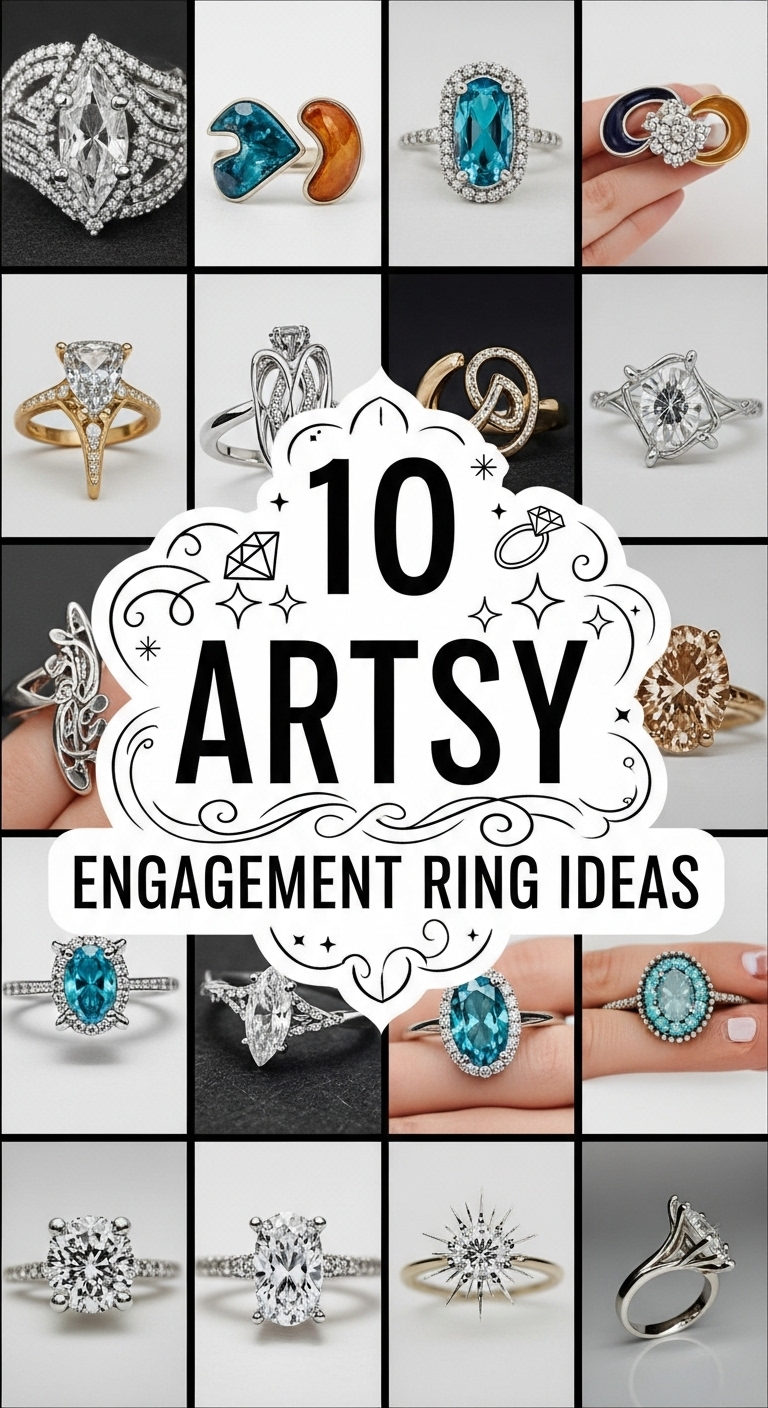
When my husband and I decided to get engaged, we did the deeply unromantic thing first: we made a spreadsheet. Then we spent three Saturdays visiting goldsmiths around Munich, from the workshops near Viktualienmarkt to a tiny atelier in Glockenbach, and I tried on roughly forty rings. I am not a jewelry person by trade, but I am a person with strong opinions, and somewhere around ring number twenty-five I stopped seeing sparkle and started seeing design. These are the ten artsy styles that actually stuck with me after all that trying-on, with the prices and pitfalls included.

1. Vintage Art Deco Rings

The first ring that made me gasp was a 1920s-style piece at an antique jeweler near Odeonsplatz: step-cut diamonds set in crisp geometric rows, all symmetry and angles, nothing soft about it. Art Deco rings are for people who love order — baguette diamonds, angular patterns, glamour with a ruler. At the shops I visited, genuine vintage Deco pieces started around 900 EUR and climbed fast, while good reproductions ran about half that. My hard-won advice: ask outright whether you are buying vintage or vintage-style, because the word gets thrown around loosely, and on a genuinely old ring have the goldsmith check the settings under magnification before you pay — ninety years of wear can loosen stones in ways you cannot see with the naked eye. I loved the look but passed, because my hands are always in soil or paint and I wanted something I would not have to baby.
2. Nature-Inspired Rings

My best friend chose a nature-inspired ring and I watched her whole selection process with envy: delicate leaf engravings wrapping the band, tiny vines climbing toward the stone, a peridot the exact green of new beech leaves. These rings suit people whose idea of romance involves actual outdoors rather than candlelight — floral motifs, branch-shaped bands, petals carved into the metal. She paid about 1,200 EUR for hers in white gold, which felt fair for hand engraving. The thing I learned from her jeweler, and now pass on to everyone: fine engraved detail wears smooth over decades of daily wear, so ask for the carving to be cut deep rather than etched shallow, or the leaves will blur into nothing by your tenth anniversary. She also chose a bezel setting after the jeweler warned her that high prongs plus gardening equals a lost stone, which, coming from a fellow gardener, I respected enormously.
3. Bohemian and Free-Spirited Rings

My cousin is the free spirit of our family and her ring looks it: a rough-cut moonstone on a hammered rose-gold band, slightly irregular, completely her. Boho rings play by different rules — turquoise, opals, raw uncut stones, mismatched textures, engraved symbols instead of perfect symmetry. I adored them in the case and very nearly talked myself into an opal, until a goldsmith in Glockenbach gave me the talk: opals sit around 5.5 to 6.5 on the Mohs scale, which means they scratch if you look at them firmly, and I am someone who pries open paint tins with her hands. Moonstone was his suggested compromise — still dreamy and boho, noticeably tougher. If your life involves your hands the way mine does, take the durability question seriously before falling for the prettiest stone in the tray; a ring you are afraid to wear is just an expensive worry.
4. Vintage Floral Halo Rings

I tried on a floral halo ring with a cornflower-blue sapphire center and understood the appeal within seconds: the ring of small stones around the center is arranged like petals, and the whole thing reads as one flower rather than a stone with a frame. Halos are also the cleverest budget move in the jewelry case — the surrounding stones make a modest center stone look nearly twice its size, so a 0.5-carat stone carries the presence of a full carat. The jeweler quoted me around 1,500 EUR for the sapphire version I tried, versus nearly double for the equivalent visual impact in a solitaire diamond. One honest maintenance note she gave me, which I appreciated: halos set with very small pavé stones need their settings checked and re-tightened every few years, roughly 50 EUR a visit, or you risk losing a tiny stone without noticing. I still think about that blue sapphire sometimes.
5. Minimalist Art Rings

This was almost my ring. Clean lines, a single stone held in a tension setting with empty space around it, nothing to hide behind — minimalist art rings are for people who find beauty in restraint. I tried a floating-diamond design where the stone appears suspended between the two ends of the band, and it looked like a small piece of sculpture on my hand. The goldsmith talked me through the practical side: the simplest settings start around 400 EUR before the stone, which makes this one of the more affordable artsy routes, but very thin bands under 2 millimeters bend and dent with normal life, so he recommended at least 2 millimeters or a slightly domed profile for a ring you will wear every day for decades. In the end I wanted a little more ornament, but if your taste runs modern and quiet, this is the style that ages best — there is simply nothing in it to go out of fashion.
6. Alternative Gemstone Rings

My sister has an aquamarine engagement ring the pale blue of glacier ice, and it suits her so completely that a diamond would have looked like a costume. Sapphires, emeralds, rubies, morganite, aquamarine — stepping away from diamonds opens a whole color wheel, and colored stones photograph beautifully and cost a fraction of equivalent diamonds. The single most useful thing I learned during our ring Saturdays: hardness matters more than color for a ring you wear daily. Sapphires score 9 on the Mohs scale, just below diamond, which makes them the practical champion among colored stones. Emeralds are softer and very often oil-treated to hide their natural inclusions — not a dealbreaker, but you should know what you are buying and pay accordingly. My sister’s aquamarine needed a slightly protective setting because it is softer than sapphire, and three years in it still looks perfect, so the right setting solves most of it.
7. Art Nouveau Inspired Rings

Art Nouveau rings are the romantics of the jewelry world: flowing vines, whiplash curves, dragonflies and lilies, everything organic and a little dreamy, a world away from Deco’s geometry. I fell for a reproduction piece with a moonstone cabochon cradled in curling gold tendrils, and the jeweler told me it was his favorite style to make because every curve is different. Genuine Art Nouveau pieces are antiques now, which means antique prices and antique fragility, so most of what you will try on are modern pieces in the style — nothing wrong with that, but look closely at how the detail is made. Hand-engraved lines are crisp and vary slightly along their length; cast reproductions of engraving look softer and uniform. The hand-worked ones cost more, usually starting around 1,000 EUR in the shops I visited, and in this style the difference is visible on the hand, so it is worth paying for if the look is what you love.
8. Eclectic Mixed-Metal Rings

One of the most striking rings I tried combined yellow gold, rose gold, and white gold in a single twisted band — three colors of metal braided together like a rope, modern and a little bit rebellious. Mixed-metal rings are for people who cannot commit to one aesthetic, and I mean that as a compliment; the contrast gives the design a depth that single-metal rings do not have. The jeweler gave me two practical warnings I now repeat to everyone. First, white gold gets its bright finish from rhodium plating, which wears off and needs redoing every year or two, about 40 EUR a time — factor that into the romance. Second, mixing very different metals in one band, especially platinum with gold, can cause uneven wear over decades because the metals have different hardness. His advice: keep the combination to the gold family and you will be fine, which is what I would do.
9. Vintage-Inspired Cushion-Cut Rings

The cushion cut is a square with softened, rounded corners — it has the geometry of a modern cut with the warmth of an antique one, and on the hand it glows rather than flashes. I tried a vintage-inspired version with milgrain beading around the stone and a hand-engraved shank, and it felt like something inherited from a glamorous great-aunt. The jeweler shared the insider angle that sold me on the cut itself: cushion cuts are brilliant at hiding inclusions, which means you can comfortably drop a clarity grade or two compared to what you would need in a round brilliant, and pocket the meaningful difference. The engraved-shank version I tried was around 1,600 EUR with a modest diamond, which felt like a lot of old-world charm for the money. If you love vintage but want a stone cut for modern light performance rather than candlelight, this is the sweet spot.
10. Custom Sketch Engagement Rings

A friend of mine went fully custom: she brought a folder of sketches, Pinterest boards, and one very specific idea about a wave motif to a goldsmith in Haidhausen, and six weeks later she had a ring nobody else on earth owns. Custom is the answer when you have looked at forty rings, like I did, and keep thinking “almost, but…”. Her piece cost around 1,800 EUR all in, which was less than several off-the-shelf designer rings we had seen, because you are paying for craftsmanship rather than a brand name. Her one strong piece of advice, earned the hard way: insist on seeing the design as a wax or CAD model before anything is cast in gold. Her first wax version sat too high and caught on every sleeve and pocket; the lowered second version is the ring she wears daily. Never skip the fitting stage — it is the difference between a beautiful object and a wearable one.
Conclusion
After forty rings across three Saturdays, I chose a low-set blue sapphire in a brushed yellow-gold band — not the flashiest ring in any case, but the one I have never once taken off except to garden. If you take one thing from my spreadsheet era, let it be this: shortlist three, then live with the finalists in your mind for a week before deciding. The right ring is the one you stop noticing because it simply belongs.