
I hung my first birdhouse on the old apple tree behind our garden in spring 2021, using a crooked box my son had nailed together from offcuts and half a metre of rusty wire. Three weeks later a blue tit moved in, and I have been building birdhouses every spring since. These are the ten designs I have tried, with what I learned from each and which ones the birds actually chose.

1. Simple Wooden Bird House

I always tell people to start here, because the classic box with a round entrance hole is the one design that has never let me down. My first one went up in March 2021 on our old apple tree, built from 2 cm thick spruce offcuts with a front panel that lifts off for autumn cleaning, and a blue tit inspected it within a fortnight. Since then I have built four more of exactly this shape, and every single one has been occupied each spring.
The details matter more than the carpentry. I drill the entrance hole 28 to 32 millimetres for tits and widen it to 45 millimetres for sparrows, and I never add the little perch under the hole, because all it does is give magpies and cats something to hold onto while they reach inside. Mine hang two to three metres up, facing southeast so the morning sun warms the box and rain rarely blows in. One refinement doubled my occupancy: I cut three shallow grooves inside the front panel below the hole so fledglings can climb out on their first big day. Untreated spruce lasts three to four seasons here, and the whole thing cost under five euros in screws and wire.
2. Upcycled Teapot Bird House

This one started life as a chipped enamel teapot I bought for four euros at the flea market in Giesing, and it is still the piece visitors ask about first. I removed the lid, hung the pot sideways from the pergola beam on sturdy wire threaded through handle and spout, and painted white flowers on the belly with outdoor acrylic. My daughter named it the tea shop, and honestly the name stuck.
A sideways teapot collects rain, so drainage is the whole project. I drilled two 8 mm holes at the lowest point of the belly with a masonry bit, going slowly so the enamel would not shatter, and I check them every spring for leaf litter. Hang it on thick galvanised wire rather than string, because a wet teapot full of nesting material is surprisingly heavy. A blue tit raised six chicks in ours the first year. I keep it in the pergola’s dappled shade, because enamel gets hot in full sun, and a layer of dry moss inside gives the birds something to build on.
3. Log Bird House

My father-in-law felled a birch and gave me a 35 cm section of trunk, which became the most natural-looking birdhouse I own. I hollowed it out with a long drill bit and a chisel over a rainy Saturday, though a naturally hollow piece of fallen timber works just as well. I capped it with a slice of the same trunk as a slanted roof and drilled a 30 mm entrance hole on the shaded side. It looks like it simply grew there.
The thick wood insulates noticeably better than my thin spruce boxes, staying cooler on hot afternoons and holding warmth in early spring. It hangs at the edge of the garden where hedge meets fence, and nuthatches inspected it within weeks. Two lessons from my mistakes: let fresh-cut wood dry under cover for a few months first, because I hollowed mine too soon and had to fill drying cracks with wood filler; and sit the log on bricks rather than damp ground so the base does not rot through in one wet season.
4. Hollowed-Out Gourd Bird House

Mine is the only birdhouse on this list that I grew rather than built. I planted bottle gourds along the south fence in 2022, left three fruits on the vine until the stems browned, then dried them in the garage for four months until they rattled when shaken. A properly cured gourd is light, hard as wood, and lasts for years. I drilled a 30 mm entrance hole near the top of the bulb with a hole saw and shook out the seeds.
The grandkids decorated ours with outdoor acrylic dots, and it hangs from the rose arch on garden twine. A house wren moved in that first May and sang from the arch every morning. The curved shell insulates as well as timber. I added two drainage holes at the base and ventilation holes near the top, drilled slowly to avoid cracking. One improvement after a storm twisted the twine loose: now I thread wire through a wooden toggle inside the neck, which holds through any weather.
5. Repurposed Bird House from an Old Birdcage

I found a decorative wire birdcage at a flea market, the kind nobody would keep a real bird in, and saw its second life immediately. An open wire cage is useless as a nest site, so the cage is decoration and nothing more. I built a small wooden nest box, 15 by 15 by 25 cm with a 30 mm entrance hole, and mounted it inside on the back panel with short bolts. From the outside it looks like a charming cage under the shed eave; from the inside it is a perfectly ordinary, functional birdhouse.
I left the box front facing outward through the cage door, which I wired open, and left a few centimetres between the box roof and the cage top for ventilation. Great tits claimed it the first spring and ignored the scrollwork entirely. I hang it under the shed eave where it stays dry, and I sleeved the hanging chain in old garden hose where it meets the beam to stop it creaking in the wind. It is the most commented-on object in my garden and one of the most practical, a combination I rarely manage on purpose.
6. Painted Mason Jar Bird House

I will be upfront about this one: a painted mason jar is more garden art than serious nest box, but it earns its place because the birds do visit and it is the prettiest thing hanging in my cherry tree. I used a big 1.5 litre preserving jar, painted the outside with white and yellow glass paint in a flower pattern, and hung it sideways from a branch with wire around the neck. On late afternoons it glows like a lantern.
Glass has no insulation, so placement is everything. Mine hangs in the cherry tree’s dappled shade, never in open sun, and I drilled six small ventilation holes in the upper half with a glass bit under a trickle of water, plus two drainage holes at the lowest point. Blue tits raised young in it in 2023. Choose the largest jar you can find, since the standard litre size is cramped, and rough up a patch inside below the mouth with sandpaper so fledglings can climb out on smooth glass. Build it for the joy of it and consider any tenant a bonus.
7. Cardboard Bird House

This was my daughter’s design, not mine. She was eight and wanted a birdhouse covered in polka dots, so we built it from double-wall corrugated cardboard, painted it with waterproof acrylic, and hung it under the porch roof where rain never reaches. A cardboard birdhouse is a craft project, not a permanent nest site: ours lasted one season, April to September, which was exactly long enough.
She cut a 30 mm entrance hole with a craft knife, learned to score and fold the cardboard so the roof shed splashes, and painted every dot herself over two afternoons. I sealed it with two coats of outdoor varnish, especially the cut edges where cardboard drinks water fastest. Sparrows nested in it for a few weeks in May, and her pride at the first fledgling on the porch rail is something I will remember for years. When it finally sagged in autumn rain we composted it, and she immediately started planning the wooden one for this spring.
8. Clay Pot Bird House

I had terracotta pots left over from repotting the patio plants, so one wet afternoon I threaded four onto a bamboo cane with knots of garden twine between them, and capped the stack with an upturned saucer as a roof. Twenty minutes of work. I painted swirls in the same terracotta-and-cream palette as the patio, and it now hangs from the balcony beam, gently turning in the breeze, matching the other pots so well that guests assume I bought it as a set.
I knot the twine below each pot so they sit about 8 cm apart, creating sheltered ledges, and the second pot from the top has its drainage hole facing outward as the entrance. Terracotta is heavy, so it hangs from a proper hook screwed into the beam on thick braided twine. A wren moved into the middle pot in May 2023 and filled it with twigs within days. Terracotta breathes, staying cooler than metal and drying fast after rain. I bring it into the shed over winter, since a hard freeze can crack a wet pot, and rehang it in March.
9. Wooden Pallet Bird House
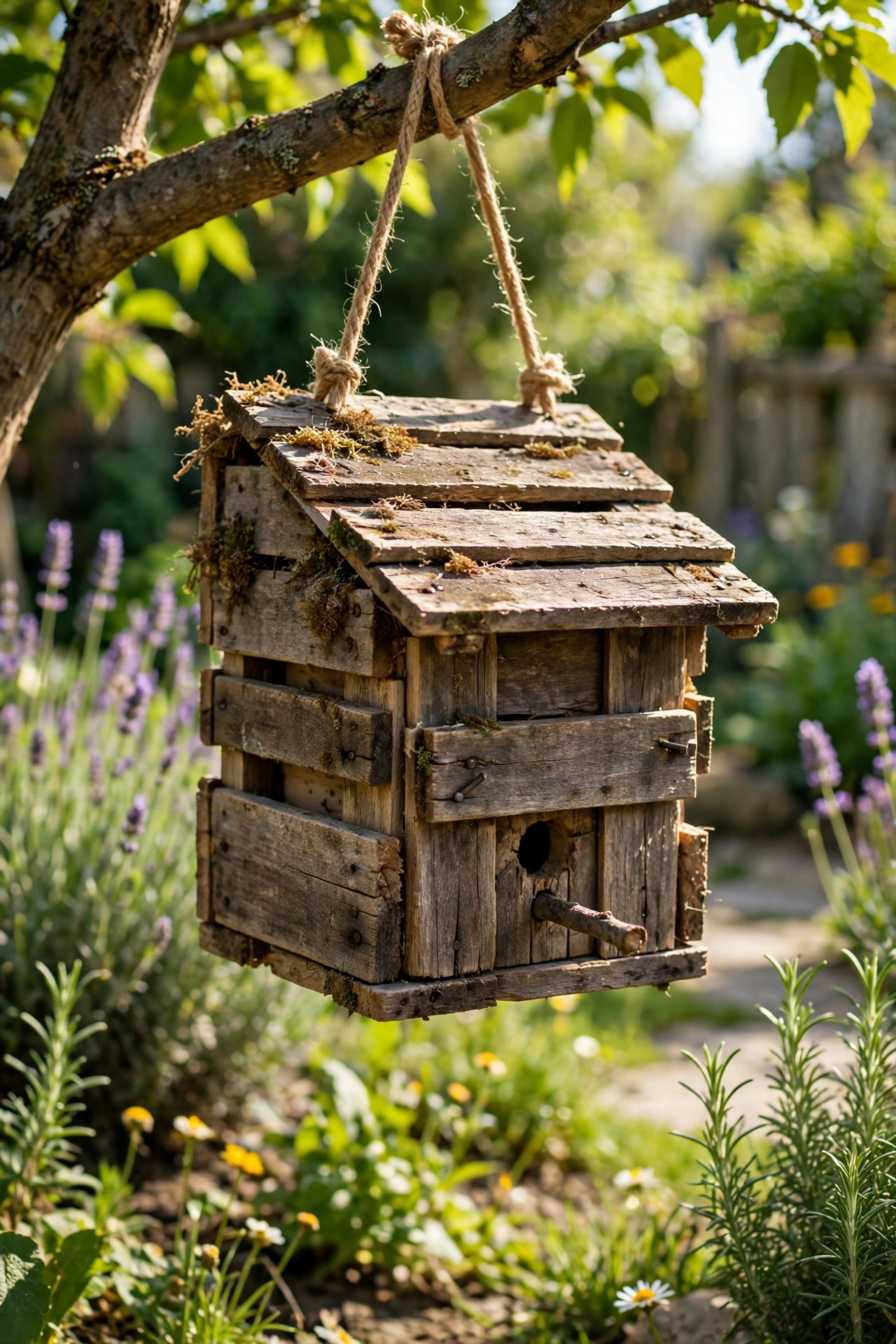
There is a hardware store near us that leaves broken pallets by the loading bay for the taking, so my pallet birdhouse cost exactly nothing but a Sunday afternoon. I pried apart the soundest slats, sanded off the splinters while keeping the weathered grey character, and built the classic box shape, just rougher. The slats were different widths, which I decided was a feature, and the finished house has a lovely uneven texture that looks like it belongs on an old farm.
I only use pallets stamped with the HT mark, meaning heat-treated rather than chemically fumigated, and I sand every surface the birds will touch, especially around the entrance hole, since pallet timber splinters badly. Pre-drill every screw hole, because the dry old wood splits otherwise. Mine went up on the back fence, and a robin nested in the ivy beside it that same spring. I built a second for our community garden shed, occupied two years running. The wood needs no finish; it simply silvers further each year.
10. Wine Cork Bird House

This birdhouse took a full year to finish, because it is clad in wine corks and I refused to buy them. Every cork came from a bottle opened in this house or donated by friends who laughed at my collecting jar until they saw the finished box. It sits on the fence post by the vegetable bed, and it makes people laugh out loud before they admire it.
The corks are cladding, not structure; the wooden box underneath does the real work of holding the nest and taking the mounting screws. I pressed the corks tight with generous glue so spiders cannot colonise the gaps, and I give the whole thing a coat of clear outdoor varnish once a year to stop the corks crumbling. Around 300 corks went into it. A great tit raised a brood in the spring of 2024, its first full season up. Cork insulates beautifully and gives fledglings excellent grip. If you drink wine, or know people who do, start the jar now.
Conclusion
Ten birdhouses later, what I have learned is simple: birds are not picky, but they notice everything. Build the box right, with the right hole size, no perch, and proper drainage, and they will come. Build it from a teapot or three hundred wine corks and they will come anyway. I still think the plain wooden box is the finest place to start, and I still check that apple tree every March with the same ridiculous excitement as the first year.