
For years my evenings ended the same way: laptop open on the sofa, half-watching something I didn’t even like, and then wondering why I was wired until midnight. Last autumn I finally claimed the dead corner between my bedroom window and the wardrobe — all of about two square meters — and turned it into a small wind-down spot with a secondhand armchair and a lamp that cost less than a pizza. It changed my sleep more than any supplement ever did. Here are ten corners that can do the same for you, from reading nooks to tiny tea stations.
1. Cozy Reading Corner Setup

Reading before bed is the single habit that made the biggest difference for me, and it costs almost nothing to set up. I found my armchair at a flea market in Glockenbach for 25 EUR, and with a boucle throw from a home sale it’s genuinely the most comfortable seat in my flat. What matters is the light: I use a simple swing-arm reading lamp with a warm 2700K bulb clipped to a small side table, because overhead light keeps my brain in daytime mode. My side table holds a stack of three to four books so I always have a choice, a glass of water, and a small basket underneath with two extra blankets for winter nights. I read paper books only in this corner, never my phone, and about twenty minutes in I can feel my shoulders drop. If you buy nothing else, buy the warm bulb — a decent LED reading light runs under 15 EUR and it’s what turns a chair into a ritual.
2. Meditation and Breathwork Corner

I’ll be honest: I bought a meditation cushion with great intentions and used it as a footstool for six months before it clicked. What finally worked was keeping the corner so simple that sitting down in it took zero effort. A flat zabuton-style mat about 90 by 90 centimeters, the round cushion on top, and a small low table beside it for a candle — that’s the whole setup, roughly 60 EUR total if you shop around. I keep the décor deliberately plain: one framed print, nothing else on the wall, because visual clutter pulls my thoughts back to tomorrow’s to-do list. A Himalayan salt lamp gives off a soft amber glow that doesn’t fight with the candle, and a cheap ultrasonic diffuser with lavender oil runs for the ten minutes I sit there. My routine is nothing fancy — ten slow breaths, then five minutes of just sitting — but since I started, the racing-thoughts phase before sleep has nearly disappeared. If your mind resists meditation, start with the breathwork only; the cushion will wait patiently.
3. Journaling and Reflection Corner

My journaling corner is a folding writing desk barely a meter wide, wedged between the bookshelf and the wall in my bedroom, and I love it more than any proper desk I’ve owned. A good journaling spot needs three things: a surface you can write on comfortably, warm light that doesn’t glare on the page, and everything within arm’s reach so there’s no excuse to get up. I keep a lined notebook, a fine-tip pen, and a small tray with washi tape and sticky notes for the occasional brain-dump page. The lamp is a small brass-style desk light with a warm bulb — I tried writing under cool white once and my handwriting looked like a prescription. What goes into the journal changes nightly: sometimes three gratitudes, sometimes a full page about a conversation that bothered me, sometimes just a list of tomorrow’s worries so they stop circling in my head. Getting the worries onto paper is the real sleep trick here; once they’re written down, my brain seems willing to let go of them. Calm colors help too — my corner is all beige and sage, mostly by accident, and it photographs terribly but feels wonderful.
4. Aromatherapy Corner

Scent is the fastest shortcut to a calmer evening that I know, because smell bypasses all the rational chatter and goes straight to the mood center. My aromatherapy setup lives on a small wooden tray on top of my dresser, about 40 centimeters wide, and it holds a diffuser, three essential oil bottles, two soy candles, and a little brass lighter. Lavender is my workhorse — the plain, honest lavender, not the perfume version — and chamomile oil joins it on particularly wired nights; a drop of sandalwood rounds the two out. I start the diffuser about half an hour before bed so the room is already scented when I walk in, which costs me roughly one euro-cent of oil per evening. Dried lavender bundles tucked into a small vase double as decoration when they’re not being used. One word of caution from experience: skip the cheap synthetic fragrance oils; they gave me a headache for a week before I realized they were the cause. Good quality essential oils cost 8 to 12 EUR a bottle and last months, so the investment is tiny compared to the nightly payoff.
5. Skincare and Self-Care Corner

My skincare corner is the top of my bedroom vanity, arranged on a single mirrored tray about 35 centimeters across, and the arrangement itself is what turned a chore into a ritual. Before, my products lived in a jumble in the bathroom cabinet and I’d rush through cleansing like it was a task on a list. Now everything sits in a row — cleanser, serum, moisturizer — in decanted amber glass bottles with handwritten labels, next to a small stack of soft cotton cloths and a candle I light only during the routine. The mirror has a warm backlight strip behind it, which makes the whole thing feel like a hotel bathroom instead of a rented flat in Munich. I keep the routine to four steps and about ten minutes: the limitation matters, because twenty products turn self-care into decision fatigue. A small hand towel in a warm color and a dish of lip balm and hand cream complete the tray. What I didn’t expect is how much the visual order affects my mood — seeing everything tidy and beautiful signals that this time is mine, and the products themselves work exactly the same as they did in the messy cabinet.
6. Plush Bedside Corner with Soft Lighting

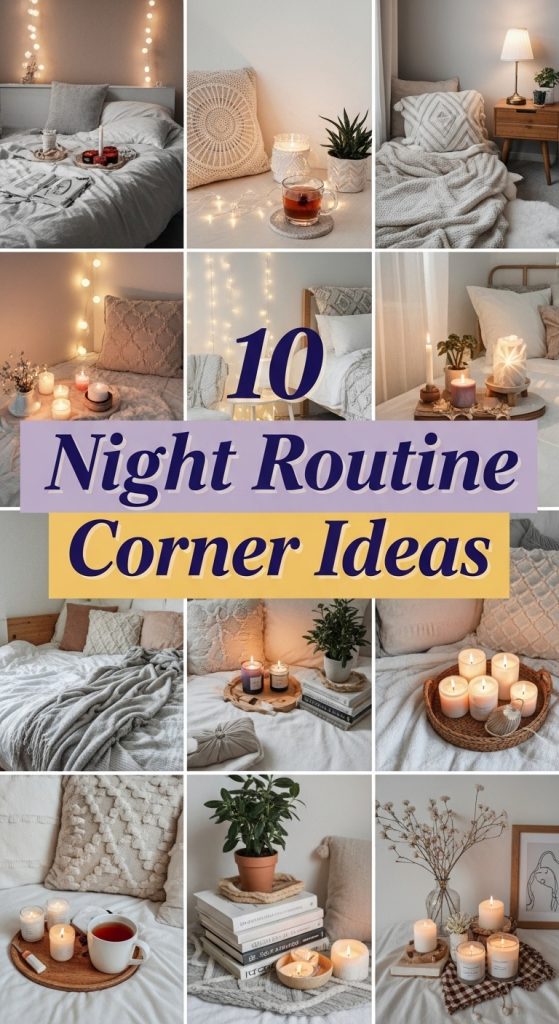
Not everyone has a spare corner for a reading chair, and honestly, for two years my entire night routine happened within arm’s reach of my pillow. The key insight is that bedside lighting is a sleep technology, not decoration: one warm lamp at 2200 to 2700K on your nightstand, switched on at a fixed hour, teaches your body that bedtime is coming. My setup is a squat ceramic lamp with a linen shade on the nightstand, plus a string of twenty warm fairy lights draped over the headboard for the last half hour before sleep — the combination costs under 20 EUR and feels surprisingly luxurious. Beside the lamp I keep a small tray with lip balm, hand cream, earplugs in a tin, and the current book face-down at the right page. A pouf tucked next to the bed gives me somewhere to sit for the skincare steps without perching on the mattress edge. The fairy lights are the real star: they give just enough glow to move around the room safely but never enough to wake my brain up. When friends ask what one thing to buy for better evenings, I always say the warm bedside lamp — it’s the highest return on the smallest investment in this entire list.
7. Minimalist Corner for Calm Minds

My sister’s flat is the inspiration for this one: her night corner is literally a single armchair, a floor lamp, and a side table, and it’s the calmest room I’ve ever sat in. Minimalism works for winding down because every object in your line of sight at night is one more thing your brain has to process, so fewer objects means a quieter head. The formula is strict: one comfortable seat, one lamp with warm light, a soft rug underfoot, a neutral palette of white, beige, and gray, and hidden storage so nothing accumulates on surfaces. My version adds exactly one living thing — a small snake plant in a matte pot — because a completely lifeless corner started to feel like a waiting room. I keep a lidded box on the shelf for the night essentials so the tabletop stays empty, and everything that doesn’t belong in the corner gets walked back to its home each evening as part of the routine. The discipline sounds annoying but takes ninety seconds, and sitting down to a cleared surface is genuinely restorative. If your mind spins at night, try removing five objects from your wind-down spot and see what happens; the effect is disproportionate to the effort.
8. Cozy Boho Corner

Boho is my natural decorating language — my flat is full of thrifted textiles — so this corner was the most fun to build and the hardest to stop building. The danger with boho is layering until the corner becomes visual noise, so I set myself a rule: layered rugs (a flatweave under a smaller shag, about 160 by 100 centimeters total), a macramé hanging on the wall, one floor pouf or low lounge chair, and warm earthy colors throughout. Lighting is a rattan lantern with a warm LED inside plus a strand of twinkle lights woven through the macramé — at night it glows like a campfire, which is exactly the point. I added a small low table for tea and a woven basket holding exactly three throws, because five throws migrate to the sofa and never come back. Textures do the heavy lifting here: nubby wool, smooth rattan, soft cotton, rough jute. My total spend was around 90 EUR, almost all of it secondhand, and the corner photographs beautifully if you care about that. The real test, though, is that I end up here every single evening instead of scrolling on the sofa — the textures invite touching and settling in, which is the whole job of a night routine corner.
9. Luxury Spa-Inspired Corner

You don’t need a hotel budget to steal the hotel feeling; you need restraint and good lighting, which is what makes a spa corner different from just a nice bathroom setup. My version centers on a low bench draped with a plush robe, a tray with rolled hand towels, and a cluster of unscented pillar candles in glass hurricanes on a marble-look tray — the whole arrangement sits in the bedroom corner near the window. The palette is strict: ivory, warm gray, and one metallic accent, in my case brushed gold from a thrifted tray that cost 4 EUR and looks like 40. I keep a carafe of cucumber water on the tray in summer, which is a two-minute prep that makes me feel absurdly pampered, and a small stack of magazines I’ve been meaning to read. Lighting stays low and warm — candlelight with one dimmed lamp — because spa atmosphere is mostly about what you can’t quite see. The robe is the secret weapon: I bought a thick waffle-weave one for 35 EUR, and putting it on is now the physical signal that the day is over. Everything here works because it feels deliberate; a few well-chosen pieces arranged with care read as luxury even when the receipt says otherwise.
10. Night Tea and Warm Drink Station

My tea station is a small bar cart parked between the bedroom door and the reading chair, and it’s the corner I use most consistently because it serves the whole routine. The setup is simple: an electric kettle with a one-liter capacity, a wooden box with six loose-leaf compartments, a row of five favorite mugs, and a small tray for honey and a spoon. I standardized on three night blends — chamomile-lavender, valerian-lemon balm, and a rooibos vanilla — because decision-making at 10pm is a losing game. The kettle has a keep-warm function, which sounds extravagant but means I can fill it once and have hot water ready through the whole evening wind-down. A string of warm lights around the cart and a candle make it feel like a little café counter, and keeping it within a few steps of the reading chair means the tea actually gets drunk while it’s hot. The ritual of boiling water, choosing the blend, and waiting for the steep is itself a mindfulness exercise — five slow minutes where nothing else happens. Loose-leaf tea in bulk costs a fraction of bagged premium blends, so this might be the cheapest corner on the list per evening.
Conclusion
My corner started as a flea-market chair and a cheap lamp, and two years later it’s still the best money I’ve ever spent on my flat. Pick the one idea that matches how you actually wind down — reader, writer, tea drinker, candle person — build it this weekend, and give it a week before you judge it. The corner doesn’t need to be perfect; it just needs to be yours.