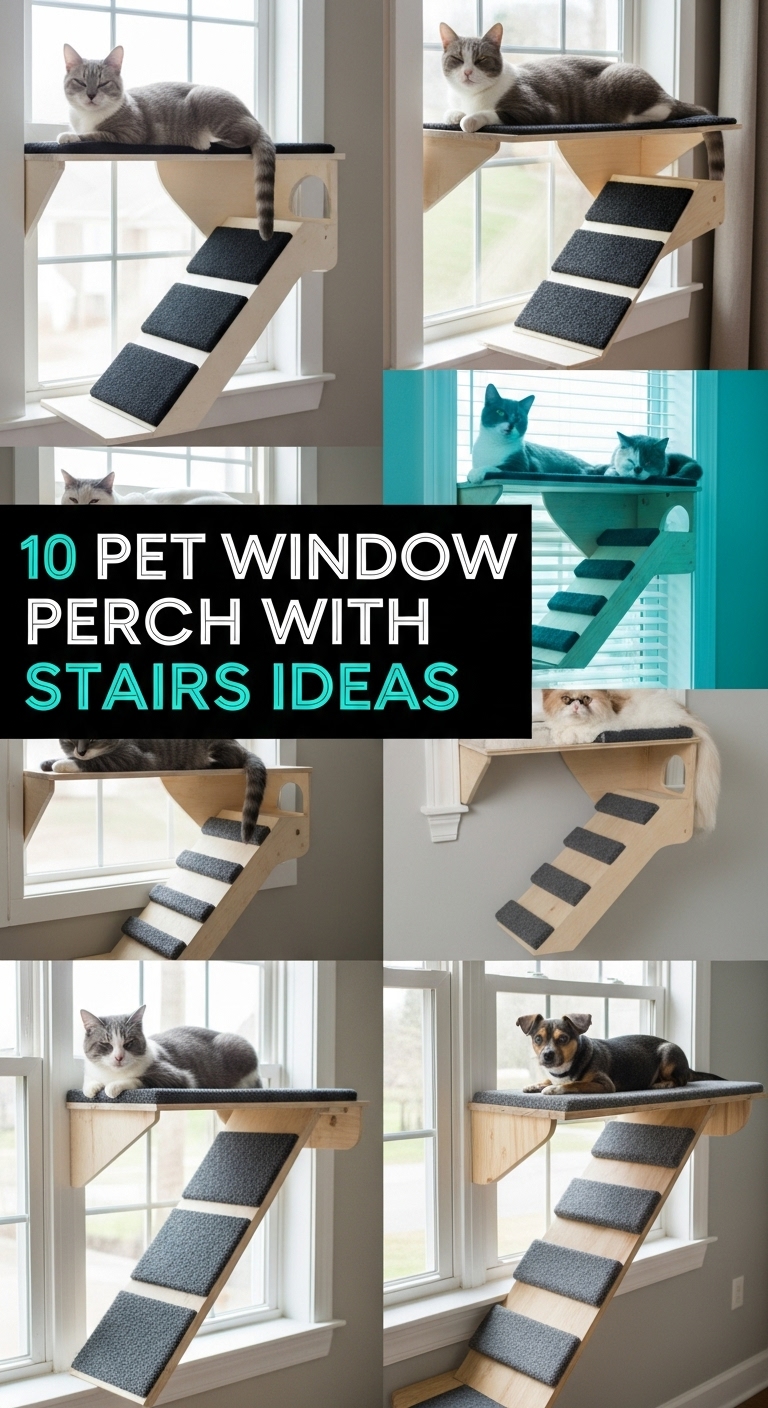
Our living room has the kind of deep, sunny windowsills that look made for a cat — except they’re a full meter off the floor, and Miso, who is not the most athletic animal, used to launch herself at them with a commitment that worried me. She made it most of the time. The times she didn’t, she took a potted succulent with her. So I started building her a proper route up: perches with real stairs, not a hopeful leap. What I learned is that a window perch lives or dies on the stairs — get the steps right and the perch becomes the cat’s favorite spot in the house; get them wrong and you’ve built very expensive wall art.

1. Floating Window Perch with Zig-Zag Stairs

This is the setup I built first: a wide perch on the windowsill with zig-zag steps climbing the wall beside the window. The zig-zag matters more than you’d think — straight vertical stairs are steep and cats hesitate, but a gentle zig-zag with landings feels like a staircase they’d choose themselves. I made the steps from pine boards, each about 25 cm deep, screwed into wall plugs (not just drywall anchors — find the studs or use proper cavity fixings, because a 5 kg cat landing mid-jump generates real force). Miso learned the route in a day. The landing halfway up became her second-favorite napping spot, which I hadn’t planned but fully endorse. Sand the step edges smooth; I didn’t on the first one and she avoided that step for a week.
2. Multi-Level Staircase Perch System

When my brother adopted a senior cat with stiff joints, the zig-zag wasn’t gentle enough, so we built her a proper multi-level staircase: four wide, shallow steps with a low rise, like a staircase designed by someone who actually thought about knees. The rule we worked out is that no step should rise more than 15 cm if an older or chubby cat needs to use it — young cats will bound up anything, but the cats who need stairs most are the ones who can’t. We carpeted each step with offcuts, which gives grip and makes the whole thing look intentional rather than improvised. His cat took three days to trust it, lured upward with treats on each step, and now she does the whole staircase without thinking. For senior cats, this design beats every other option on this list.
3. L-Shaped Window Perch with Corner Stairs

Corners are dead space in most rooms, and an L-shaped perch turns one into prime cat real estate. I built this version in the bedroom corner: the perch runs along the window in an L, and the stairs climb the adjacent wall, so the whole thing tucks into a corner that previously held nothing but a sad plant. The L-shape gives the cat two viewing angles — street one way, courtyard the other — and Miso rotates between them through the day like she’s on neighborhood watch. Corner construction is actually easier than a straight run because the two walls brace each other; I used half the fixings I expected. The one mistake I made was making the corner seat too narrow — 20 cm felt generous on paper but a sprawled cat needs 30 cm minimum. Measure your cat stretched out, not curled up.
4. Floating Ladder-Style Stairs to Window Perch

Ladder-style steps — narrow rungs rather than full shelves — look fantastic and take up almost no visual space, which is why I tried them in the hallway window. They work, with a caveat: they’re for confident, agile cats only. Miso uses them fine, but my brother’s senior cat looked at them once and walked away, and I don’t blame her — rungs demand balance and precision. If your cat is young and athletic, ladder stairs are the sleekest option here; wrap the rungs in sisal rope and they double as scratching posts, which is genuinely clever design. Space the rungs about 20 cm apart vertically and keep each rung at least 8 cm deep so paws land securely. Mount them absolutely rock-solid — a wobbling rung teaches a cat to distrust the whole structure in one bad experience, and trust is hard to rebuild.
5. Built-In Window Seat Perch with Stairs

If you have a bay window or a deep sill, the built-in seat is the luxury option: a proper upholstered window seat with stairs up one side, looking like it was always part of the architecture. I didn’t build this one — I don’t have a bay window — but I helped a friend fit one into hers, and the result is stunning. We built a plywood box seat, topped it with a custom cushion in washable fabric (essential: cat hair, sun-fading, the occasional hairball), and added two wide steps up the side. The inside of the box is storage for cat supplies, which solved her “where do I keep the litter scoop” problem elegantly. It cost more than the floating options — around 200 euros in materials — but it reads as furniture, not pet equipment, and her landlord actually complimented it. If you own your place and have the right window, this is the one.
6. Spiral Staircase to Elevated Window Perch

A spiral staircase for a cat sounds absurd until you see one — it’s compact, it’s sculptural, and cats genuinely enjoy the climb. I built a small spiral from stacked round plywood platforms around a central post, leading up to a perch above the wardrobe in the study, facing the window. The footprint is tiny, maybe 40 cm square, which makes it perfect for small flats where a zig-zag would eat a whole wall. The engineering detail that matters: each platform must overlap the one below enough that the cat always has a secure landing — I used 28 cm discs with a 10 cm overlap and it feels completely safe. Miso treats it like a personal elevator and I treat it like the most charming thing in the flat. It’s more work to build than straight stairs, but for tight spaces nothing else climbs that much height in that little floor area.
7. Modular Cat Steps Leading to Wide Window Perch

Modular steps are the renter’s answer: stackable, movable cubes or boxes that form stairs to the sill, no drilling required. I keep a set in the spare room for when Miso’s niece-cat visits (long story), and they assemble in minutes. What matters most is weight and grip — lightweight cubes slide on wooden floors when a cat launches off them, which is alarming for everyone involved. I put non-slip pads under mine and the problem vanished. Stack them as a proper staircase with each cube set back from the one below, not as a wobbly tower; stability beats height. The bonus is flexibility: rearrange them when you move furniture, lend them to a friend, or reconfigure into a play structure. They’re not the prettiest solution, but a throw blanket over the top cube makes them look deliberate, and your deposit stays intact.
8. Corner Stairs with Tiered Perches

This is the multi-cat version of the corner setup: stairs climbing the corner with a perch at every landing, so each cat gets a territory. I built this for a friend with three cats who were queuing — actually queuing — for the single windowsill. Three tiered perches, one per cat, and the politics of the household visibly relaxed. Each perch needs to be genuinely separate: cats sharing a staircase will tolerate each other, but they want their own seat, so I made each tier a full 35 cm square with a raised edge. The top perch gets the sun and therefore the dominant cat; that’s just physics and hierarchy, plan for it. Stagger the perches so a cat on the middle tier isn’t directly under the top one’s tail. It sounds fussy, but anyone with multiple cats knows that sightlines and escape routes are the entire basis of feline diplomacy.
9. Wall-Mounted Floating Staircase to Window Ledge
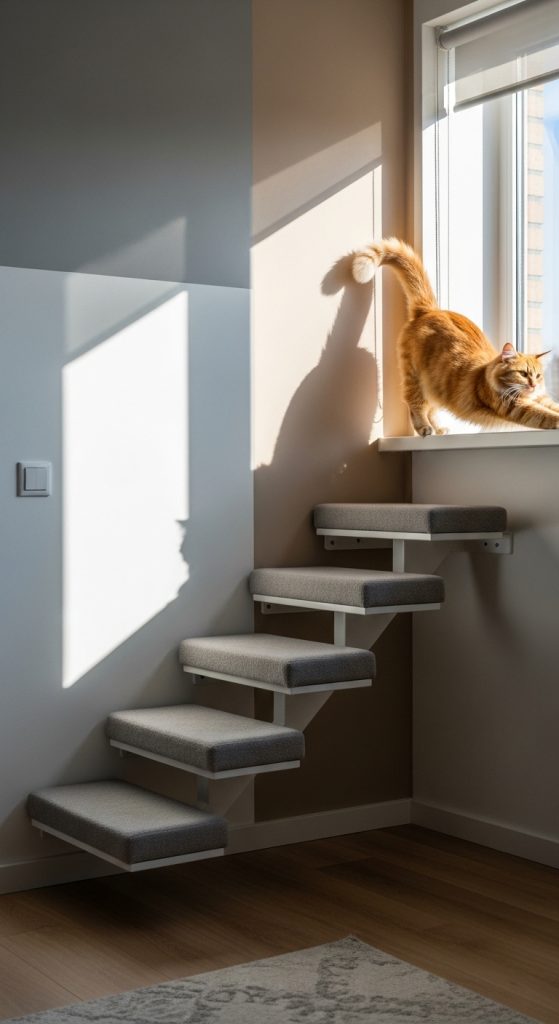
Floating shelves as stairs — no visible brackets, just clean wooden steps emerging from the wall — is the most architectural look on this list, and it’s the one guests ask about. I installed a floating run in the living room using concealed steel brackets rated for 30 kg each, because the only thing worse than ugly brackets is a shelf that fails. The invisible-mount look demands perfect leveling; a floating shelf that’s visibly tilted looks broken rather than minimal, so I spent an embarrassing amount of time with a spirit level. Each step is solid oak, 30 cm deep, and they double as display shelves for small plants and books — the cat weaves between my things like it’s all hers, which I suppose it is. This is the option for people who want the stairs to look like interior design first and cat furniture second.
10. Curved Staircase Leading to Wide Perch

The curved staircase is the showpiece: steps that sweep in a gentle arc up to a wide, cushioned perch, like a tiny grand staircase for a very small aristocrat. I built one from bent plywood — which sounds harder than it is; thin ply layers laminated over a curved form — and it’s the most complimented thing I’ve ever made. Functionally, the curve is gentle on joints because the rise per step stays low, and the wide final perch (I made it 60 by 40 cm with a proper cushion) fits a fully sprawled cat, which is the whole point of a window perch. It took a weekend and some patience with the glue-up. Was it more work than straight steps? Absolutely. Does Miso care about the curve? Not even slightly. But I care, it looks wonderful, and the wide perch is genuinely the best napping spot in the house by any measure.
Conclusion
Two years and several staircases later, Miso hasn’t attempted a flying leap at a windowsill since — the stairs worked. Whatever style you pick, the rules are the same: solid fixings, steps a tired cat can manage, and a perch wide enough for a proper sprawl. Build the stairs right and the perch takes care of itself.