I first wrestled with round wedding tables when a friend asked me to help dress twelve of them for her reception in a Munich garden venue, and I arrived with tall vases that looked lovely in my flat and completely blocked every conversation across the table. By the end of that afternoon I had learned the lesson that now shapes everything I do with round tables: the middle of the table belongs to the guests as much as to the decoration, so whatever sits there has to stay low, look finished from every chair, and leave room for plates and elbows. These ten are the ones I tested on my own dining table first and would happily use again, and each one keeps the dense part of the arrangement under about 30 centimetres.
1. Floating Candle Trio with Ruscus Ring
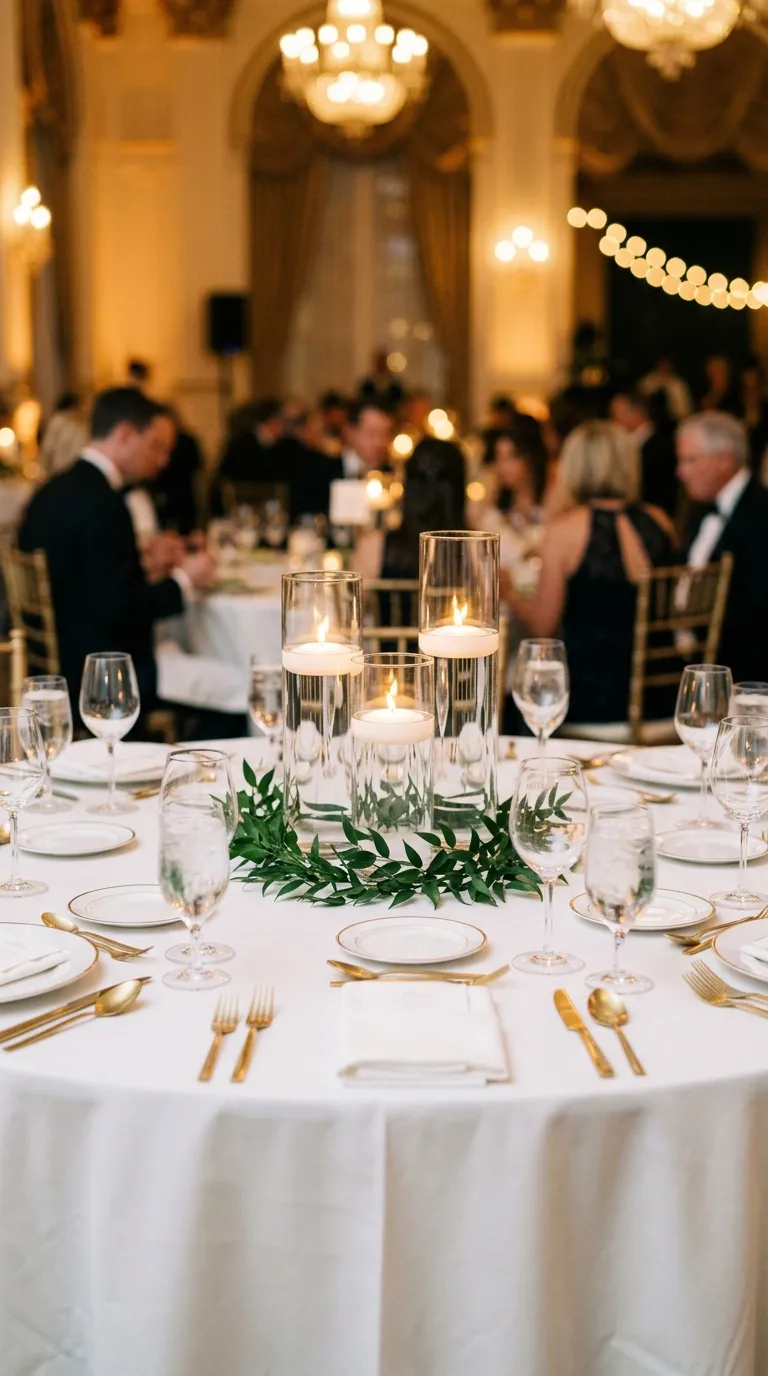
I tried this one first because it was the cheapest way to make a bare round table feel like a wedding, and it still surprises me how much light three little candles throw across a room once the sun goes down. I used three clear glass cylinders in staggered heights of about 15, 20, and 25 centimetres, filled each with room-temperature distilled water to about four centimetres below the rim, and floated a plain white disc candle on top of each one. Around the base I wove two or three stems of fresh Italian ruscus into a loose ring, which hides the bottoms of the cylinders and gives the whole thing a soft green edge without adding any height. I learned the hard way to use distilled water rather than tap water, because my first test left tiny bubbles clinging to the glass, and I light the candles about half an hour before guests arrive; four small votives around the ring finish it off for roughly 18 euros a table, with the glass reusable for the next party.
2. Single Statement Compote Floral Bowl
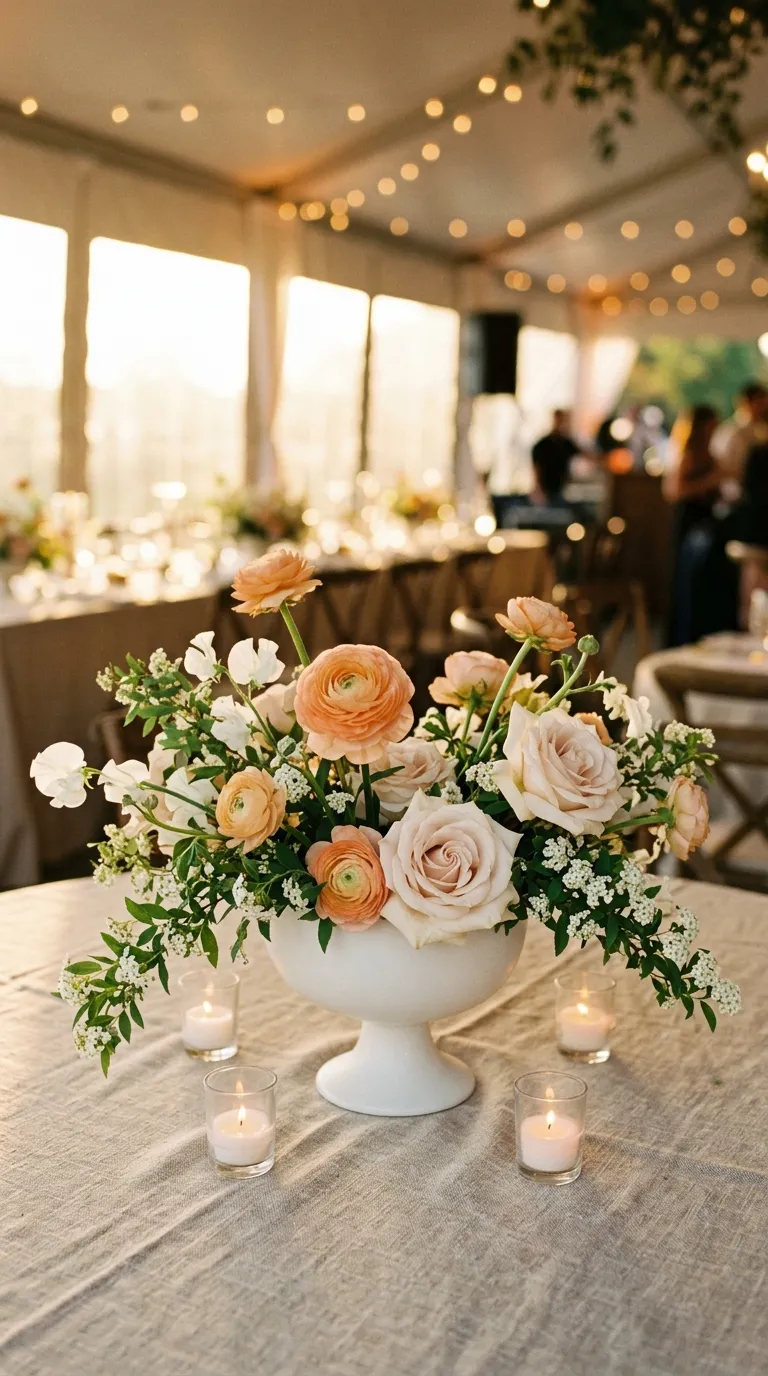
This is the arrangement I reach for when the couple wants real flowers but no fuss, because one low bowl does the work of a whole runner and still leaves the table feeling open. I fixed a metal pin frog to the bottom of a wide ceramic compote bowl, about 18 centimetres across, with floral adhesive clay, then filled it halfway with water and flower food. I built the shape with greenery first, a few spiraea branches and olive twigs at slight angles, then anchored garden roses near the centre and filled the gaps with ranunculus and sweet peas, letting the stems spill over the rim instead of forcing them upright. My firm rule is to keep the highest bloom below 30 centimetres, which I check with a ruler before the bowl leaves my kitchen. Four slim votives around the foot give the evening light; the bowl cost 12 to 20 euros at a flea market and the flowers about 25 euros per table bought in bulk and conditioned overnight in cool water.
3. Minimalist Ceramic Bud Vase Cluster
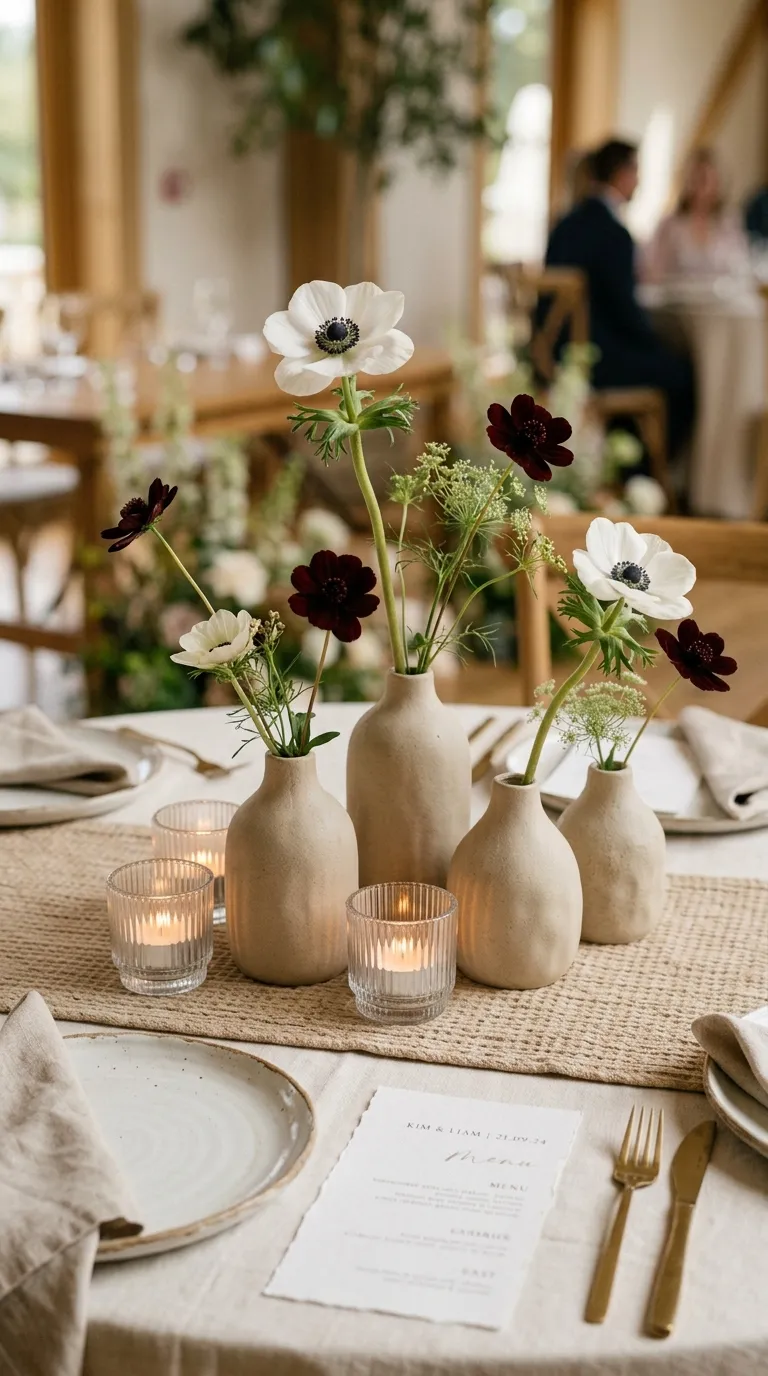
I put this cluster together for a friend who said she hated fussy flowers, and it turned out to be the easiest centrepiece I have ever set up on the day itself because there is almost nothing to go wrong. I grouped three to five small matte ceramic bud vases in ivory, sand, and pale taupe, between 10 and 18 centimetres tall, in a loose, uneven cluster in the middle of the table. Each vase got just one or two stems, a Japanese anemone here, a chocolate cosmos there, a scabiosa in the tallest one, each with a thin sprig of greenery alongside. I vary the stem lengths deliberately and mix narrow necks with one slightly wider vase, so the group reads like a collection rather than a matching set. I strip the lower leaves off every stem so the water stays clear, tuck three small tea light holders among the vases, and fill them on site with a small jug; the whole table cost under 20 euros, with thrifted vases at 2 to 4 euros each.
4. Wreath Halo with Hurricane Pillar Center
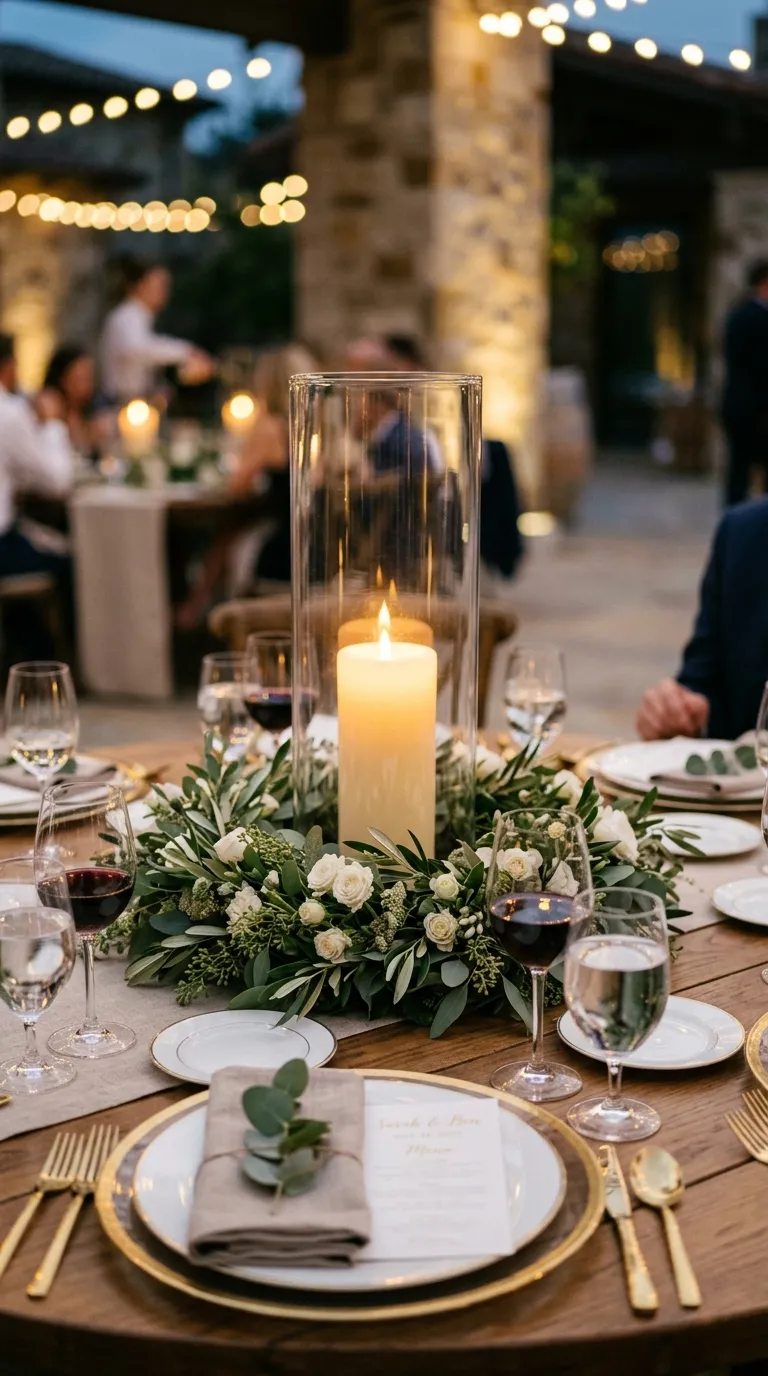
This one feels old-fashioned in the best way, and I used it for an outdoor evening reception where every exposed flame kept blowing out until I gave the candle a glass home. I set a clear glass hurricane cylinder, about 28 centimetres tall, in the centre, dropped a thick unscented ivory pillar candle inside, and laid a ready-made 35-centimetre greenery wreath around the base like a halo. Into the wreath I wove seeded and silver dollar eucalyptus with a few bay leaves, then tucked five to seven white spray rose heads in at even intervals so the white blooms echoed the candle. I check twice that no leaf leans over the rim, because a singed leaf smells awful, and I melt a few drops of hot wax onto the glass to hold the pillar steady during transport. Most venues want an open flame enclosed a few centimetres above the wick, and this satisfies that rule while still giving a warm, steady glow; the hurricane and wreath cost around 30 euros, the pillar another 6, and the whole thing assembles in about ten minutes per table.
5. Sculptural Taper Candles & Fresh Fruit
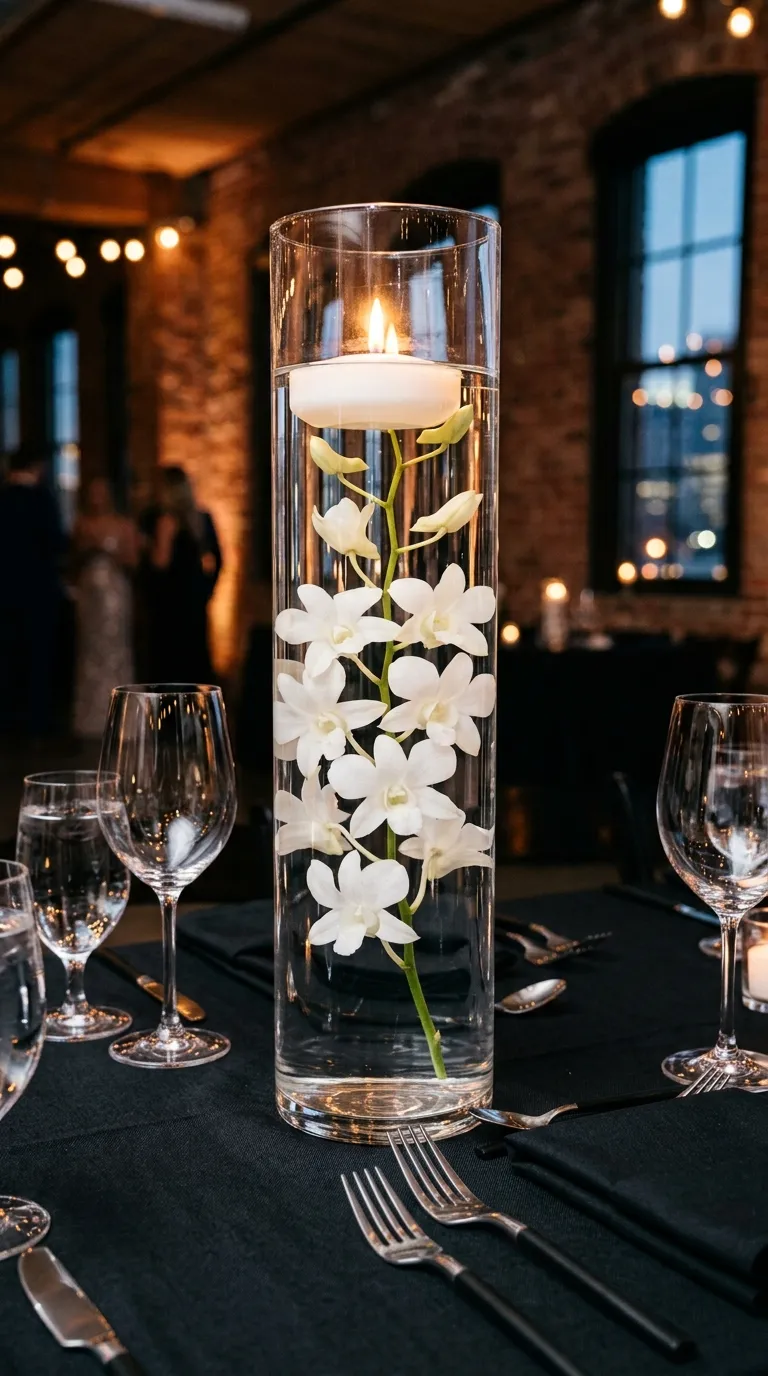
I first saw this idea in a Dutch still-life painting and thought it would look too precious on a real table, but with fruit from the Viktualienmarkt it became the centrepiece guests photographed most. I arranged three antique brass taper holders at different heights in the centre, pushed dripless beeswax tapers in ivory, taupe, and deep olive into them with sticky wax dots, and scattered halved figs, sliced pomegranates, green pears, and grapes around the bases on a loose linen runner. Between the fruit I tucked olive leaf sprigs and rosemary, which smells wonderful without competing with the food, and dotted small brass tea light holders around the edge for low light. I slice the fruit no more than an hour before the reception, because my first attempt, cut hours early, looked tired, and I always choose unscented candles because a strongly scented one fights with dinner. Brass holders were about 5 euros each at a flea market and fruit and tapers roughly 12 euros per table, and nothing was wasted: guests ate the pears and figs before the dancing started.
6. Submerged Orchid Stems in Tall Glass
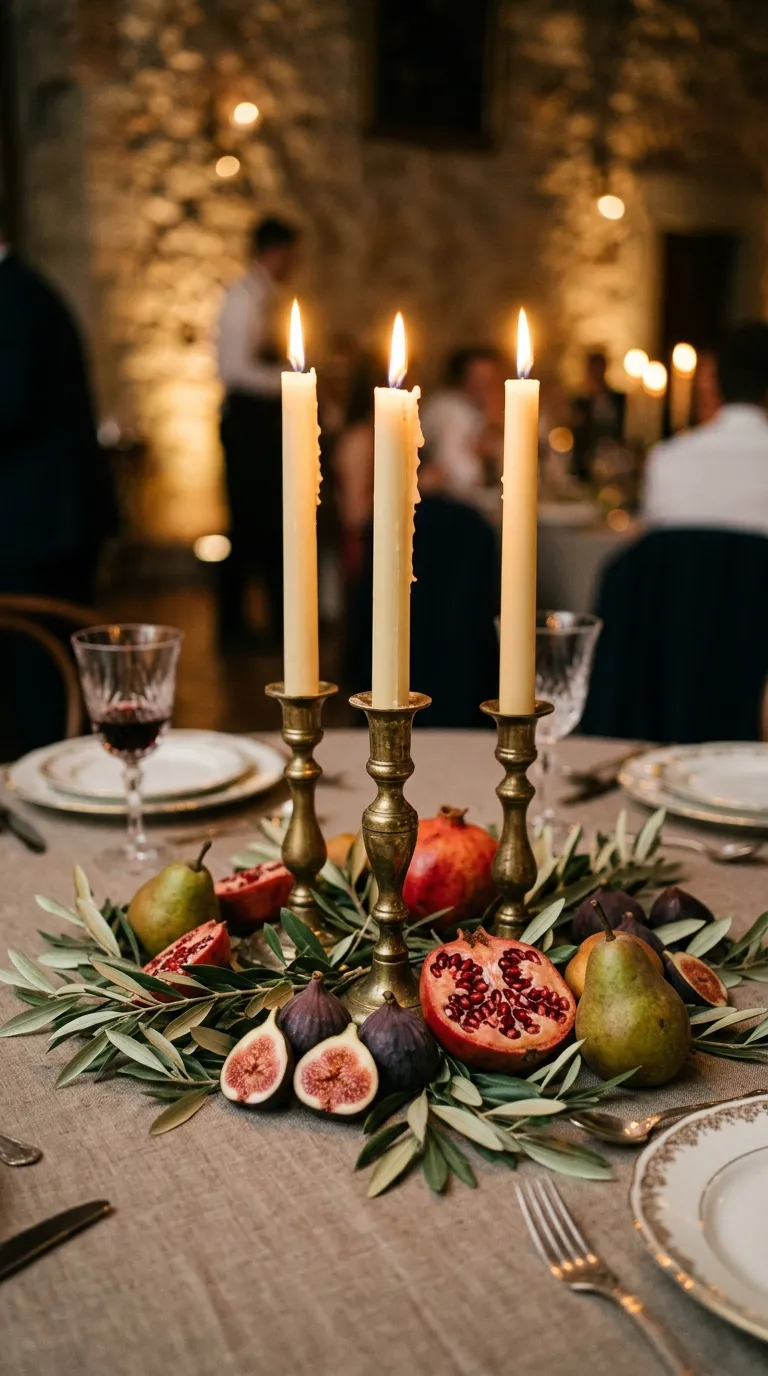
This is the most dramatic centrepiece on the list and also one of the simplest to build, which is a combination I rarely trust until I have tested it myself. I took a straight-sided clear glass cylinder, about 28 to 35 centimetres tall, trimmed a stem of white dendrobium orchids so it sat five centimetres below the rim, and anchored it with clear glass marbles so the stem stayed upright. I poured in room-temperature distilled water very slowly until the orchids were completely underwater, tapped the glass gently to release trapped air bubbles, and floated a single white disc candle on top. The water magnifies the petals so it looks far more expensive than it is, and the flowers stay fresh for hours: a test vase I built six hours before dinner still looked perfect at midnight. Three small votives at the base soften the tall glass, the table cost about 22 euros, and I carry the cylinders dry and fill them on site, because a full one is heavy, slippery, and exactly the sort of thing I would drop on a stone floor.
7. Petite Eucalyptus & White Rose Low Bowl
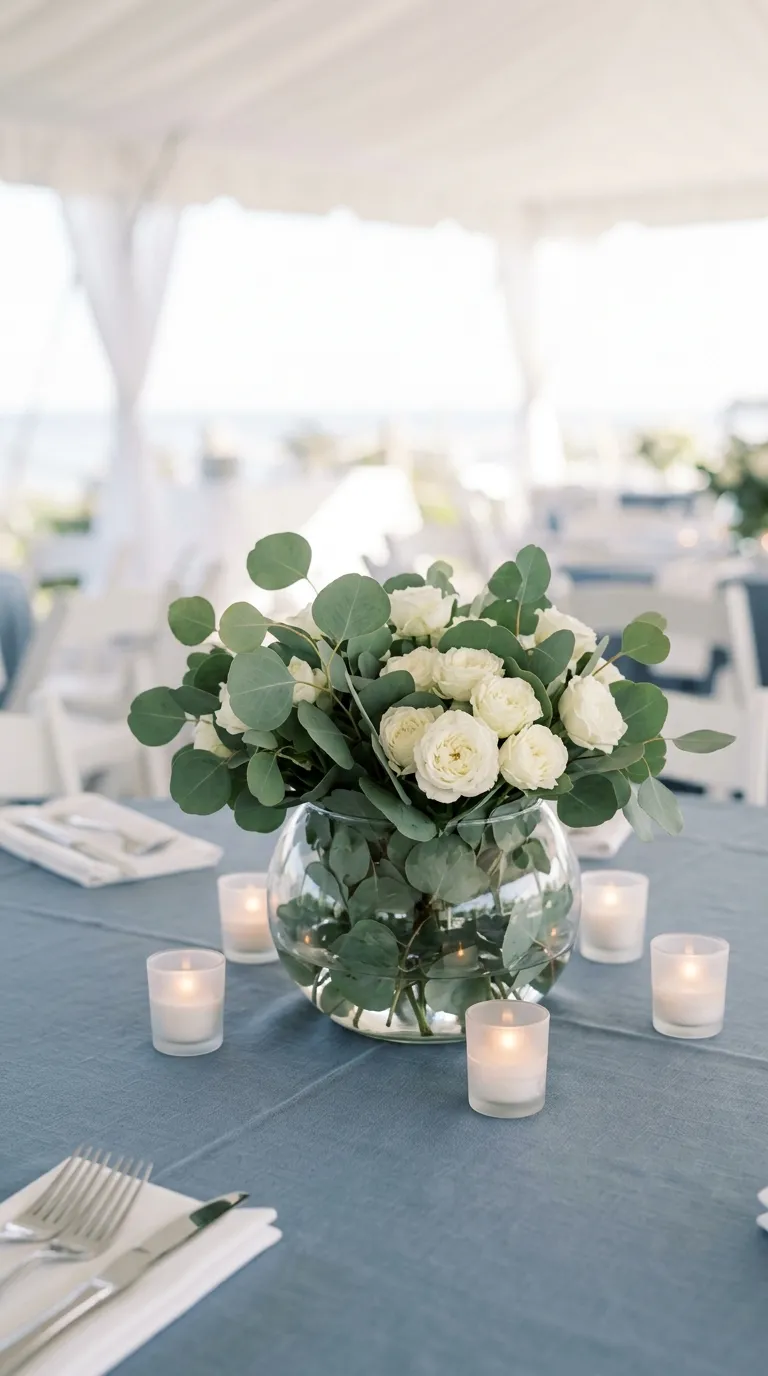
If a couple tells me they want something timeless that will suit any linen colour, this low bowl is the one I suggest, because silver dollar eucalyptus and white roses simply do not argue with anything. I tape a grid of clear floral tape across a low dish about 15 centimetres across, fill it with water and flower food, and build a broad collar of eucalyptus and salal leaves around the rim so the bowl has a soft, rounded edge. Then I push four to six quicksand or ivory roses tightly into the centre, nestle white majolica spray roses and waxflowers into the gaps, and keep the whole thing dome-shaped and no wider than 35 centimetres so it never crowds the plates. Before I insert each rose I fold its outer petals back gently with my fingertips, which makes every bloom look fuller and means I need fewer stems per table. Three low frosted votives finish the base; the flowers cost roughly 20 euros per table ordered with the rest of the wedding flowers, and the dish and tape under 10, and the arrangement holds up well because eucalyptus is forgiving and roses kept in cool water stay firm all evening.
8. Geometric Brass Lantern with Fairy Glow
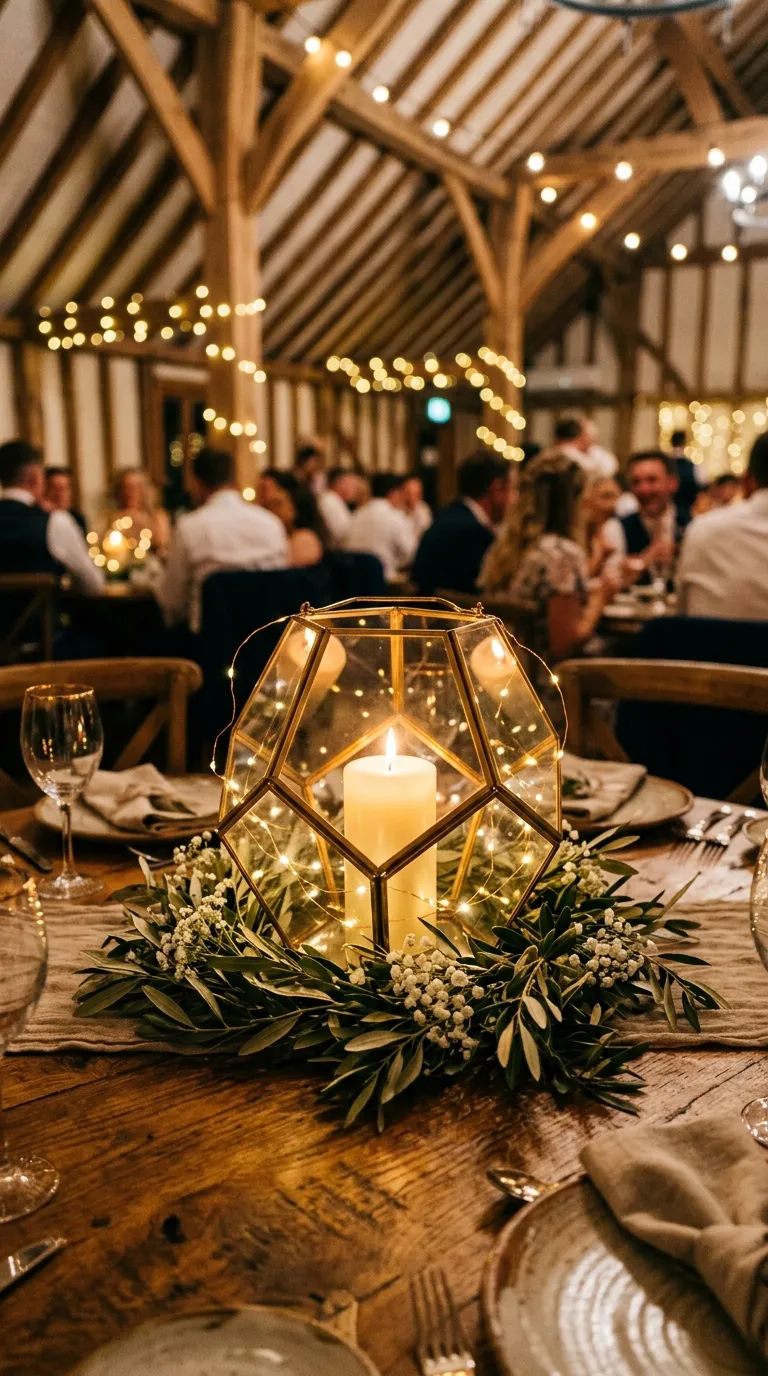
I used this lantern on a barn reception where the tables were bare wood and the couple wanted candlelight without a single open flame near the linen, and it worked so well that I have kept one in my own cupboard ever since. I placed a faceted brass-and-glass lantern, about 20 to 25 centimetres tall, in the centre, set a battery-operated LED pillar candle inside, and wrapped a one-metre strand of warm-white fairy lights loosely around its base so the glow spilled through the glass panels. Around the outside I laid a loose collar of gunnii eucalyptus and olive branches, added three clear votives, and chose a candle with a built-in timer so it switched itself on at dusk without anyone having to remember. My advice is to test the timer the night before, because I once set one to the wrong hour and the lanterns stayed dark until dessert, and to keep spare batteries in the emergency kit I pack for every event. The lantern cost about 18 euros, the candle and lights another 8, and because nothing is perishable I assembled all twelve lanterns the day before the wedding and simply carried them to the tables.
9. Potted Organic Olive Tree Topiary
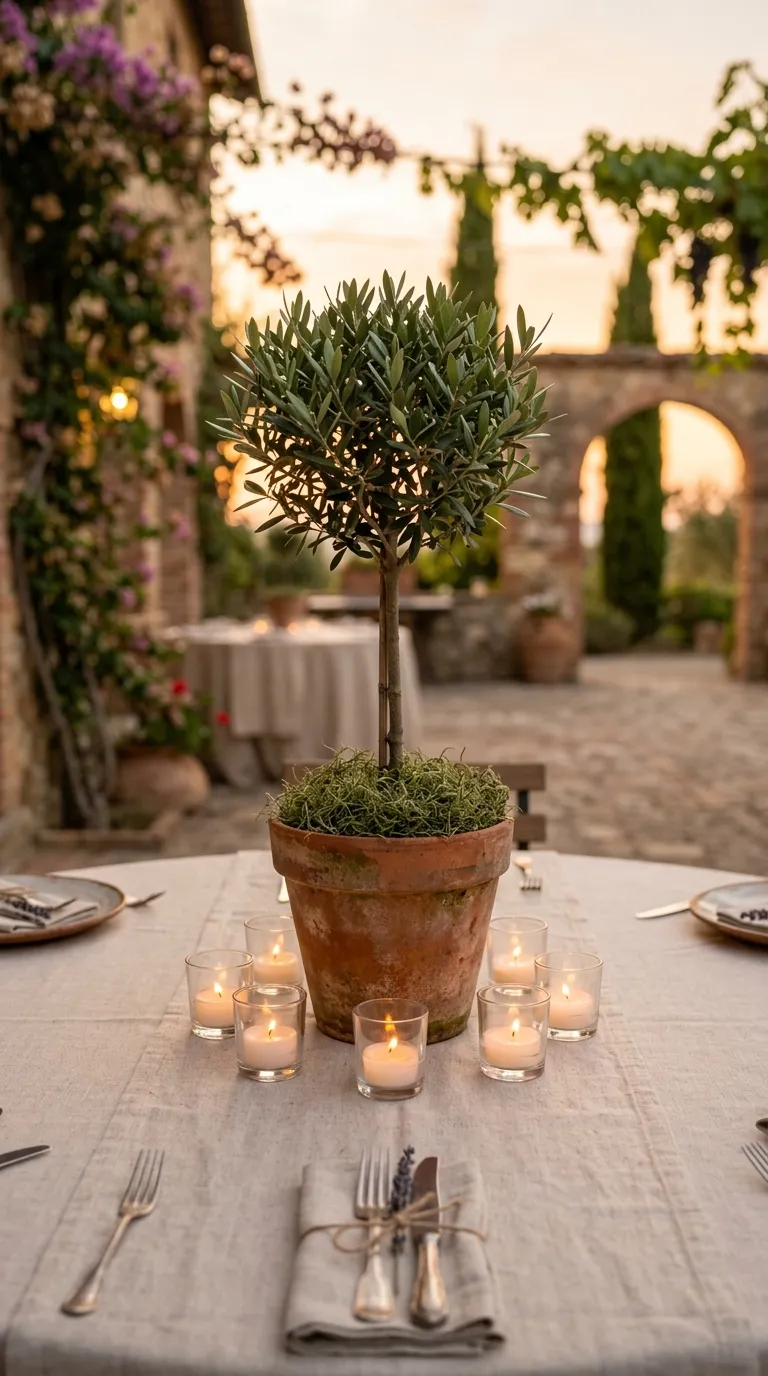
This living centrepiece is the one guests ask to take home, and I love it for that reason alone: long after the wedding, the little tree is still growing on someone’s balcony. I potted a healthy young olive tree topiary, about 25 to 30 centimetres tall, in a weathered terracotta pot with drainage, covered the soil completely with preserved green Spanish moss, and set it in the centre of a flowing neutral linen runner. Around the base I placed six small ribbed glass votives with tea lights, and I tucked three sprigs of fresh rosemary beside the place cards so the scent carried around the whole table. Before the wedding I wiped each pot down with a damp cloth, because terracotta sheds a fine dust that looks terrible on a white tablecloth, and I watered the trees the morning of the event so the soil was damp but not dripping. The trees cost me about 10 euros each from a garden centre, the pots 4 to 6 euros at a flea market, and if a guest does not want theirs I replant it in my own garden; two of the trees from that first wedding are now taller than I am.
10. Monochromatic Baby’s Breath Cloud Dish
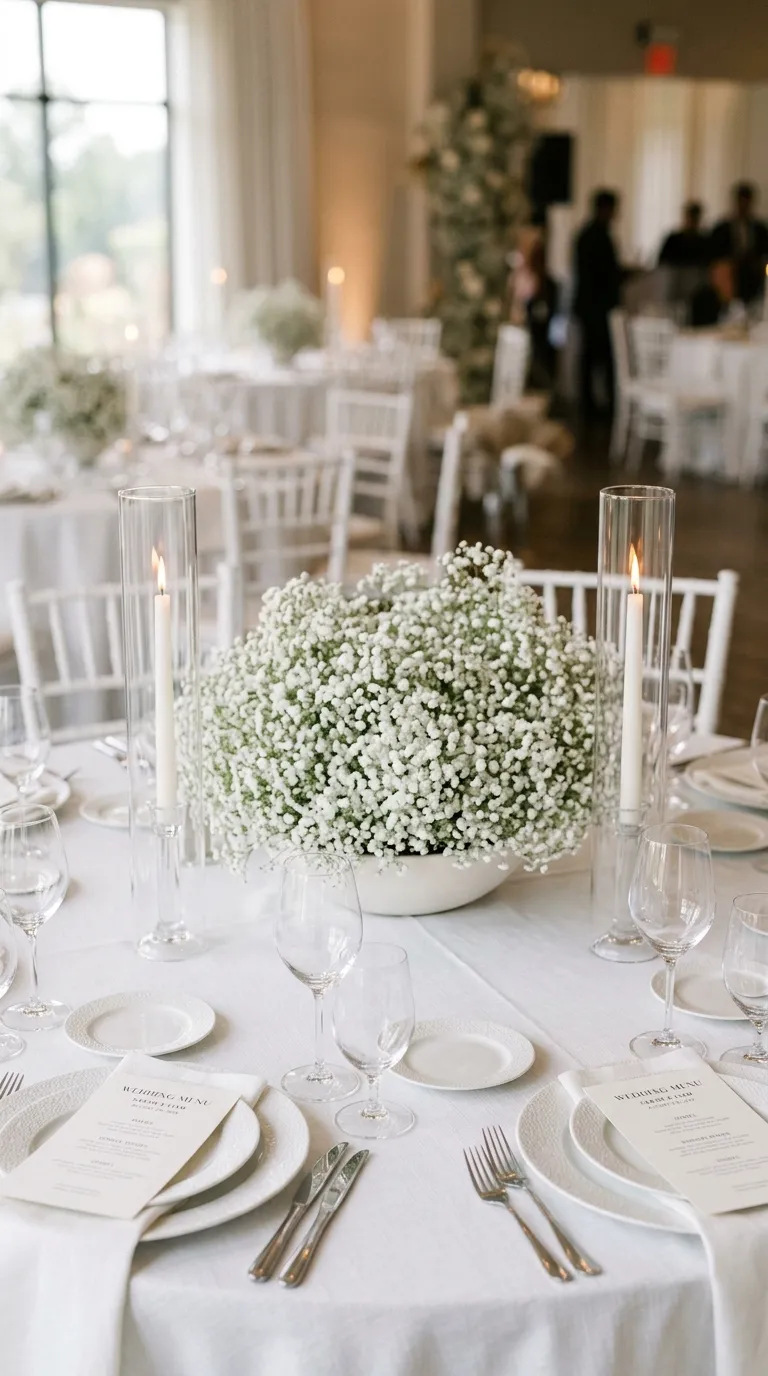
I saved this one for last because it looks like the most delicate idea here and is actually the toughest, which is exactly what you want for a warm outdoor reception where other flowers would wilt by the first course. I set a floral frog or a taped grid inside a shallow white ceramic bowl about 15 centimetres across, filled it with water, and trimmed baby’s breath into short sprigs of 8 to 10 centimetres. Working from the outside edge toward the centre, I pushed the sprigs in densely until they formed a rounded, seamless cloud, making sure every cut stem stayed submerged so the florets kept their bright white colour. On either side I placed tall, clear glass holders with slender tapers, which give the soft cloud a bit of height without blocking anyone’s view, and I misted the finished arrangement lightly with water to keep it fresh. A single large bunch, about 8 euros, fills one bowl generously, so a whole table costs under 15 euros including the bowl and candles, and I assemble these on the morning of the wedding, because the cloud looks its fullest when the sprigs are freshly cut and packed tight.
Conclusion
After testing all ten on my own table and then at real receptions, my honest advice is to pick the one that matches your venue’s light and your own patience on the day, and to keep it low, keep it simple, and light the candles half an hour before your guests sit down. A round table does its best work when people can see each other across it, and a centrepiece that respects that will look beautiful in every photograph because the people in it are actually talking.