My bathroom is 4.2 square meters. That’s not a typo — four point two. It’s a rental, so I couldn’t move walls, change the tiles, or replace the ancient sink. For two years I treated it as a purely functional room: get in, get out, don’t look too closely at the grout. Then a friend with an even smaller bathroom showed me hers, and it felt like a little spa. Same size, same rental constraints. The difference was entirely in ten decisions she’d made, and over the following month I made most of them myself.
This isn’t a renovation guide. Everything below is renter-friendly, nothing required a drill into tile, and the total was under 150 euros. The goal isn’t to make a small bathroom look big through trickery — it’s to make it feel calm and intentional, which reads as spacious all on its own. I did the work over three weekends: paint and mirror first, then storage, then the details. That order matters, by the way — do the big visual changes first, because they change how you see everything that comes after.
1. The Mirror Trick: Go Bigger Than Feels Reasonable
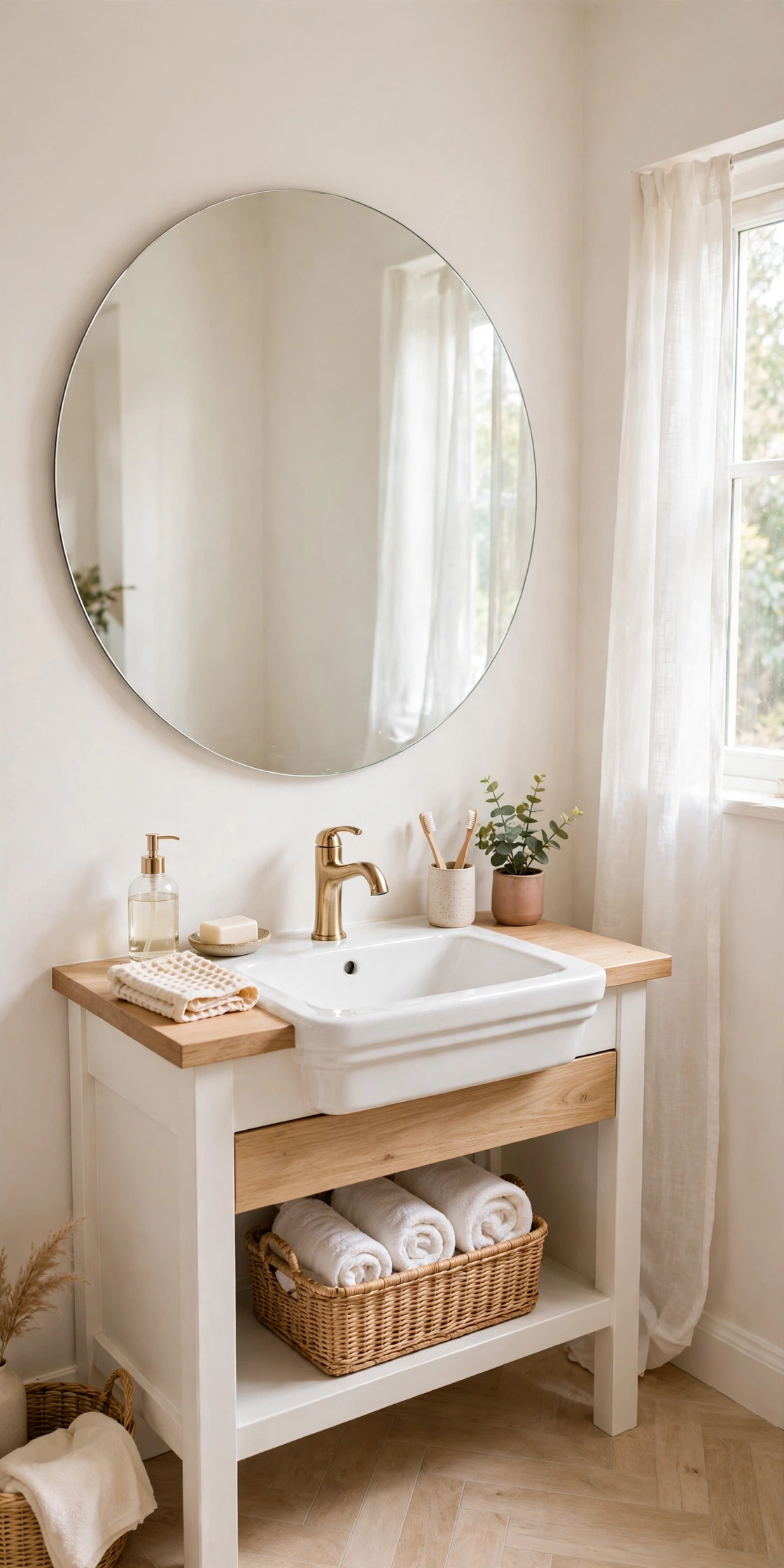
The old mirror was a 40-centimeter square that came with the apartment, and it made the room feel like a cupboard. I replaced it with a 70-centimeter round mirror — no frame, just clean glass — and the effect was absurd. The room didn’t just look bigger; it looked like a different room. Mirrors don’t just reflect the room, they reflect the light, and in a small bathroom light is everything.
Idea 1: Hang the largest mirror the wall allows. Round softens all the hard rectangles of a bathroom; frameless keeps it visually light. Mine cost 35 euros. Hang it so the center sits at about 150 centimeters from the floor — eye level for most adults — and if you can position it opposite the window or the light source, you double your daylight for free.
Idea 2: If you need storage, make the mirror a cabinet. I didn’t need one, but my friend did — she used a mirrored wall cabinet instead of a flat mirror, same large size, and gained two shelves of hidden storage without losing the mirror effect. Best of both worlds, and in a 4-square-meter room every hidden shelf counts.
2. Light Walls, Honestly Assessed
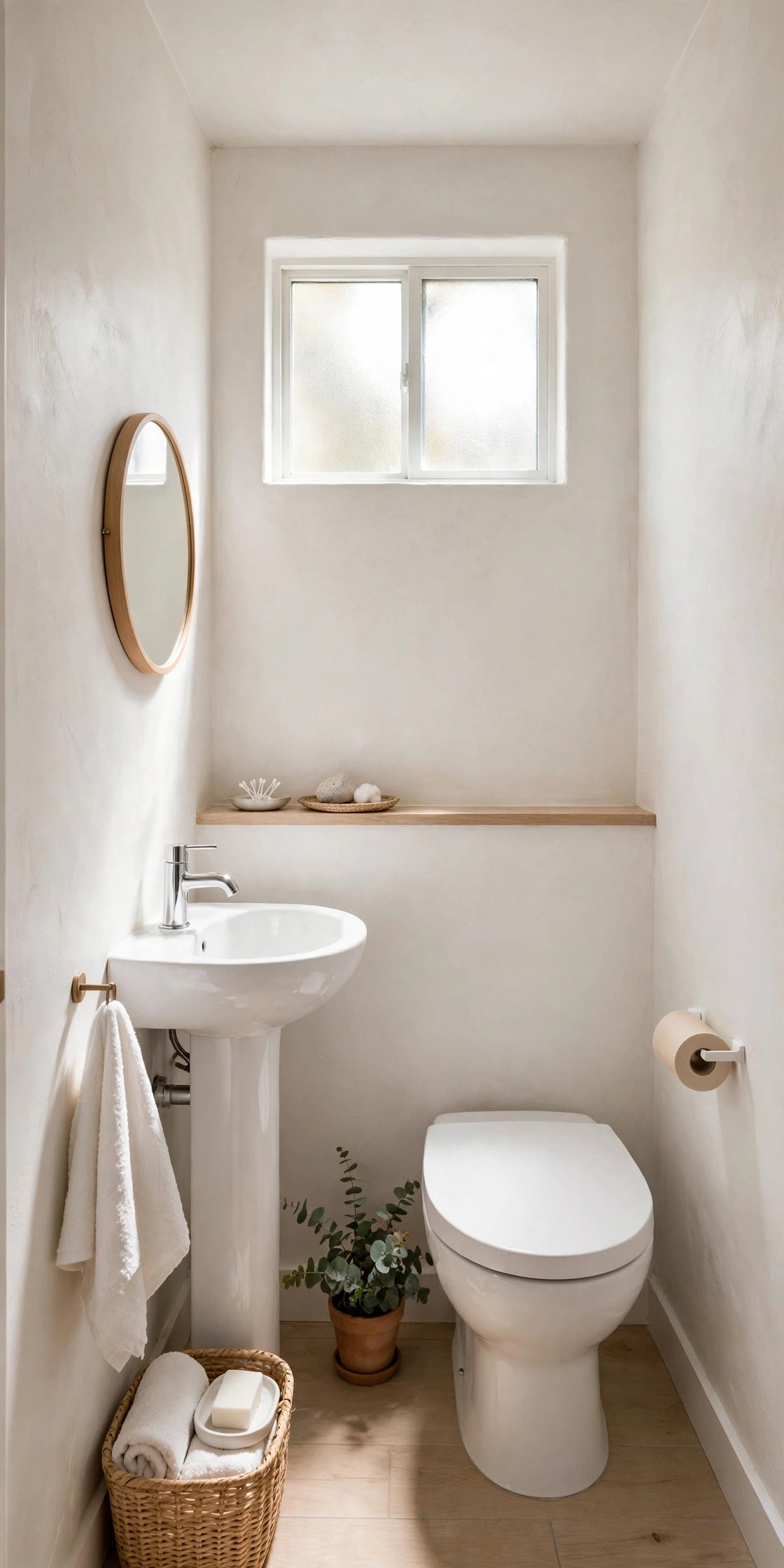
Everyone says “paint it white” for small rooms, and in a bathroom it’s actually true — but with a caveat I learned the hard way. My bathroom has one small frosted window facing north, so the light is cool and flat. I painted one wall bright white first and it looked grey and depressing. The paint wasn’t the problem; the undertone was.
Idea 3: Choose white with a warm undertone for north-facing bathrooms. I repainted in a warm white — the kind with a whisper of cream — and the grey cast disappeared. Two coats of bathroom-suitable paint (moisture-resistant, this matters) cost me about 30 euros and one Saturday. If your bathroom gets warm southern light, a cooler white works fine. Match the white to your light, not to a Pinterest photo taken in someone else’s house.
3. Go Vertical: The Walls Are Your Floor Space
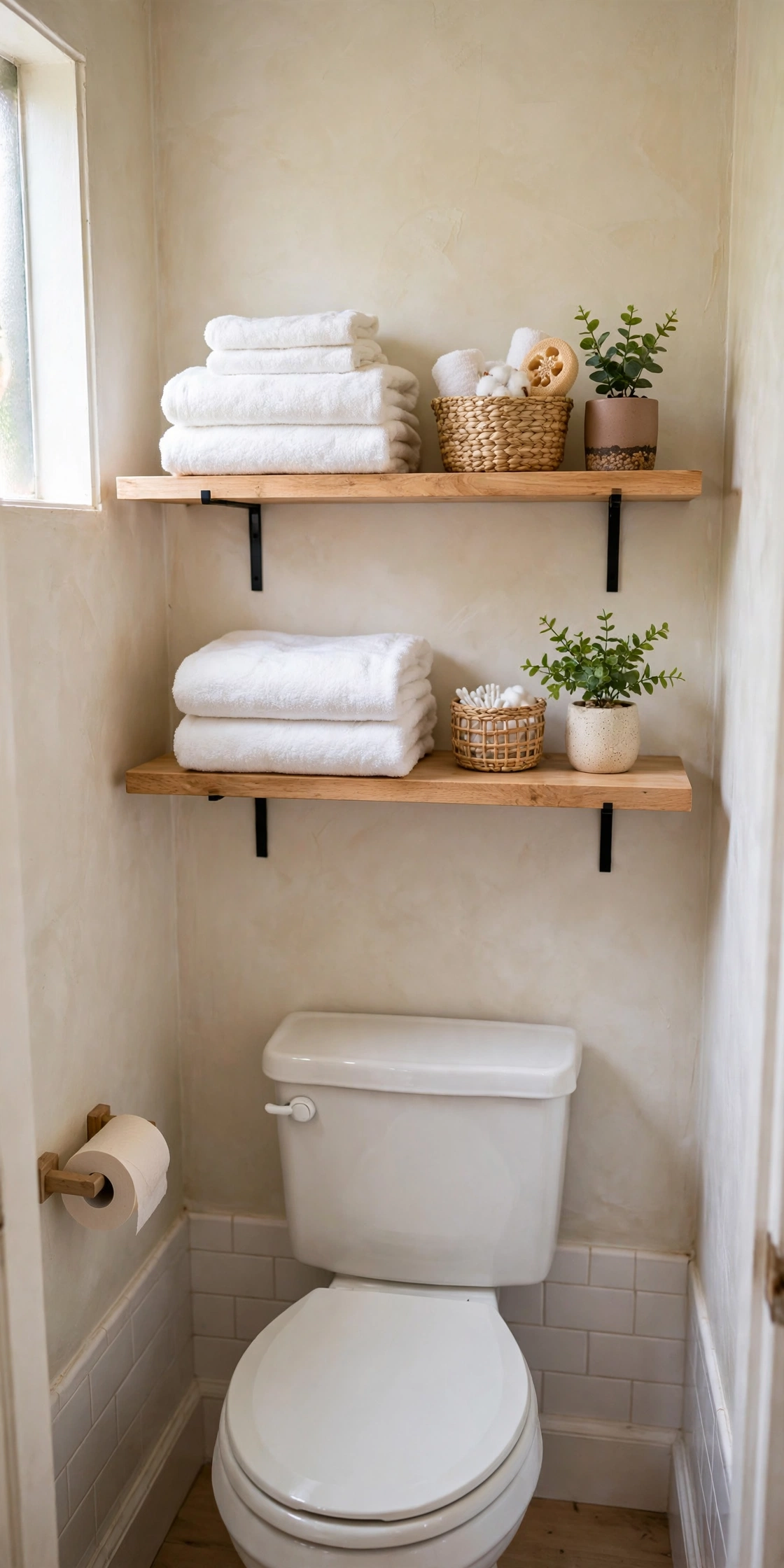
The floor of my bathroom fits exactly one person and a bath mat. So I stopped thinking about the floor entirely and looked up. The wall above the toilet was completely empty — dead space in a room that has no space to waste.
Idea 4: Put open shelves above the toilet. Two simple wooden shelves, 60 centimeters wide, mounted with adhesive strips rated for the weight (no drilling, landlord happy). Folded towels, a small basket of toiletries, one plant. It turned dead wall into the room’s main storage and its main decoration at the same time. Cost: about 20 euros for the shelves.
Idea 5: Add one tall, narrow cabinet if you have 30 centimeters to spare. I had a dead strip of wall between the door and the sink — 28 centimeters wide, useless for anything else. A tall narrow cabinet (25 cm wide, 170 cm tall, 25 euros secondhand) swallowed all my cleaning supplies, spare toilet paper, and medicines. Measure your dead strips; almost every small bathroom has one.
4. Glass and Clear Lines in the Shower
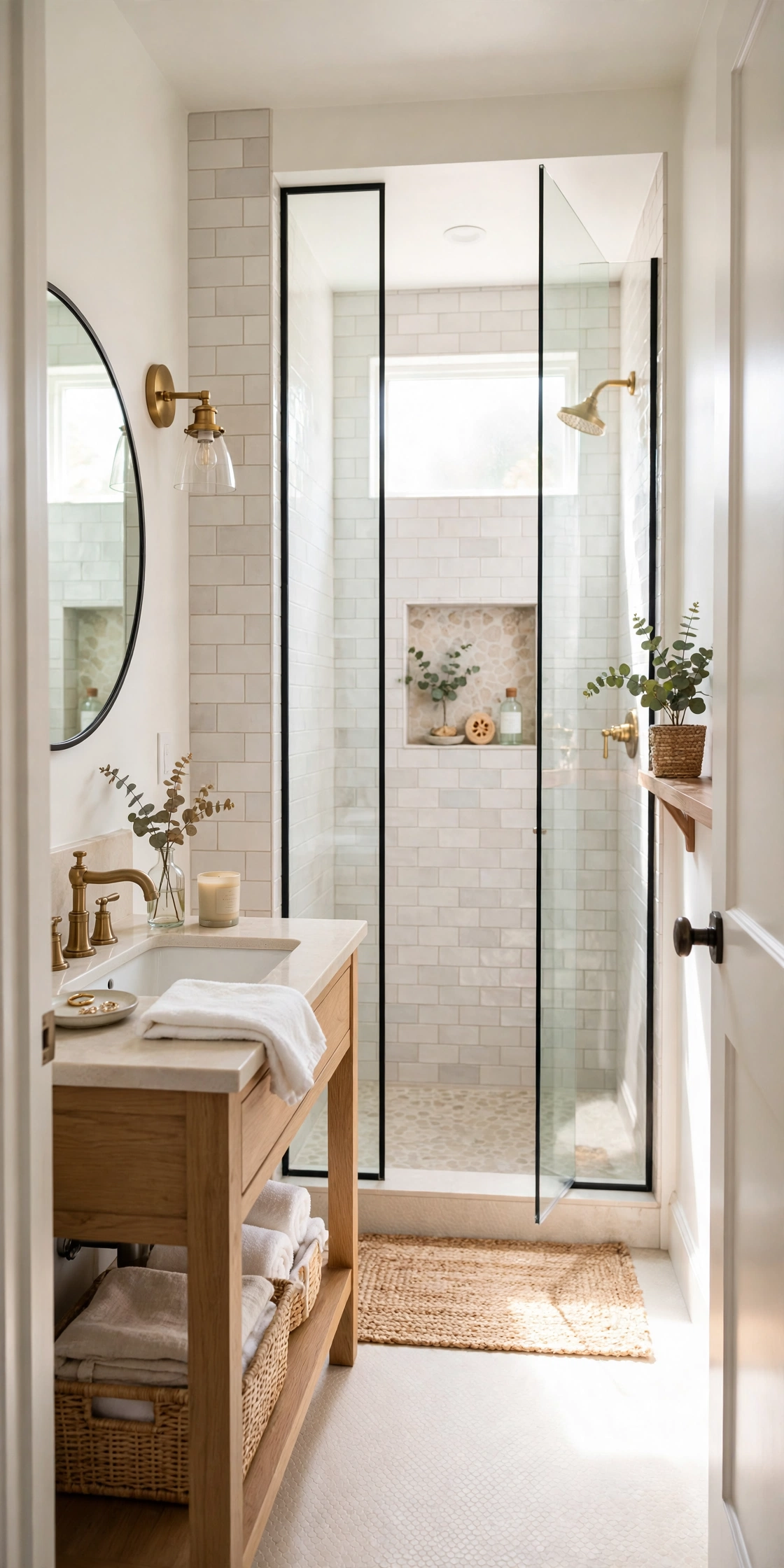
My shower had a frosted plastic curtain that cut the room visually in half. You couldn’t see past it, so the bathroom always felt like two tiny rooms instead of one small one. I replaced it with a clear shower curtain — the cheapest possible version of this idea, 8 euros — and the room instantly read as one continuous space.
Idea 6: Use a clear shower curtain or glass door. Anything that lets the eye travel to the back wall makes the whole room feel deeper. If you own the place, a frameless glass panel is the dream version. As a renter, the clear curtain gave me 90 percent of the effect. Keep it clean, though — a clear curtain shows soap scum, so I wipe it down weekly. Two minutes, worth it.
5. One Statement, Not Ten Decorations
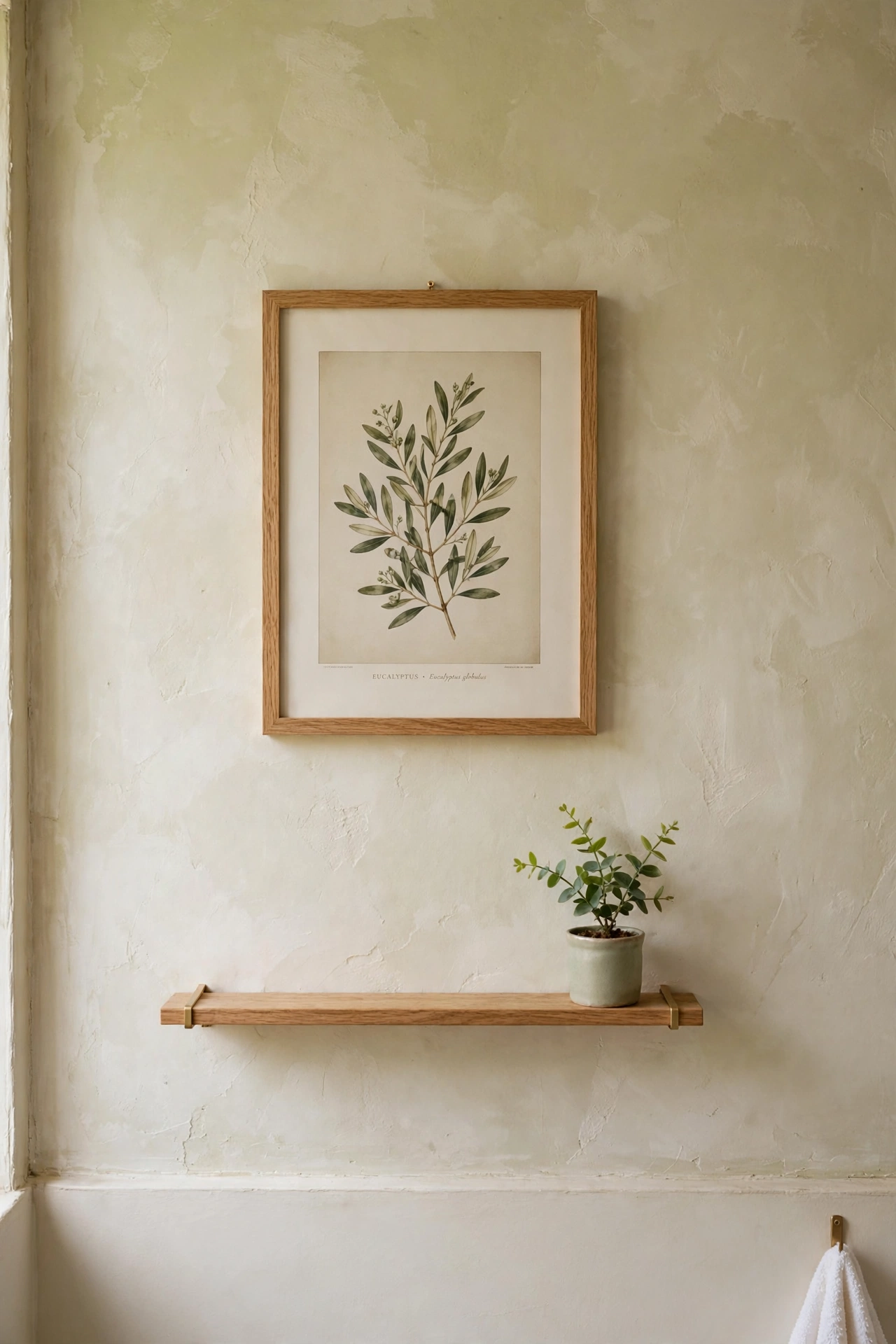
Small rooms punish clutter harder than big ones. My first attempt at “decorating” the bathroom was five small things — a candle, a tiny frame, a shell, a reed diffuser, a small plant — and the shelf looked like a jumble sale. My friend’s rule, which I stole: one statement piece per small room.
Idea 7: Choose one piece of art or one plant — not both, not five. I kept a single framed botanical print (30 by 40 centimeters, thin oak frame) and moved everything else out. One confident piece looks intentional; five small things look like clutter you haven’t put away yet. If your bathroom has no natural light, skip the live plant and go with the art — most plants will slowly die in a windowless bathroom and a dying plant is the opposite of decor. And hang it properly: center it at eye level, not up near the ceiling where small-room art tends to drift. A single piece hung with confidence anchors the whole wall.
6. Textiles That Earn Their Space
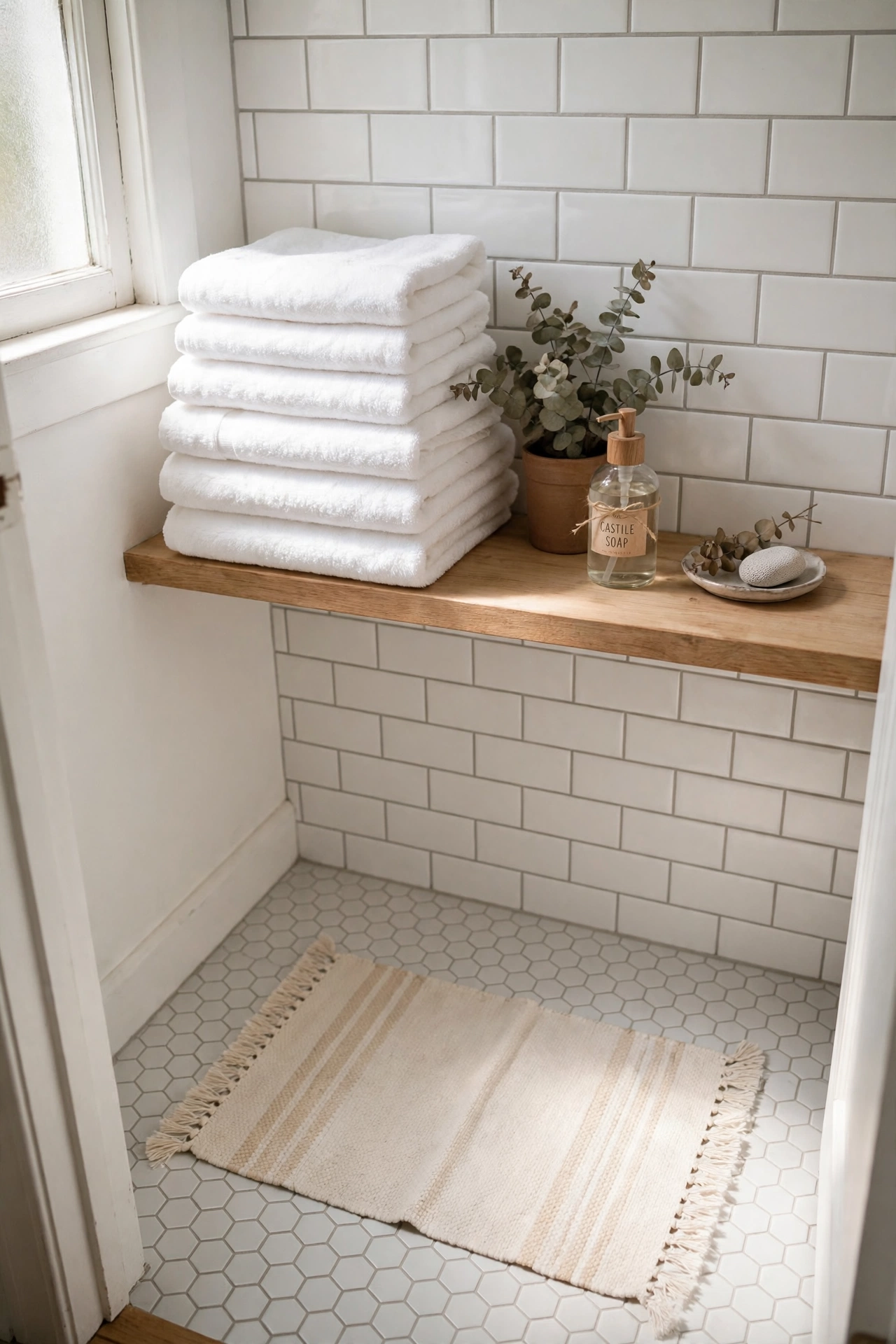
In a big bathroom, mismatched towels disappear. In mine, they were practically wall art — and not the good kind. I bought four bath towels in the same warm white as the walls, plus two hand towels in a soft sage green, and donated the rainbow collection to the animal shelter (they always need towels).
Idea 8: Match your towels to each other and to the room. Uniform towels read as calm; mixed towels read as chaos, especially when they’re on open shelves. White or cream towels in a light bathroom effectively disappear, which is exactly what you want.
Idea 9: Use one small washable rug, not a big bath mat. I swapped my large mat — which covered a third of the floor and chopped the room up visually — for a 50-by-80-centimeter washable cotton rug in front of the sink. More visible floor equals a bigger-feeling room, and it goes straight in the washing machine. Choose a low-pile rug in a light color; anything thick or dark becomes a visual anchor that shrinks the floor around it.
7. The Details: What Sits on the Counter
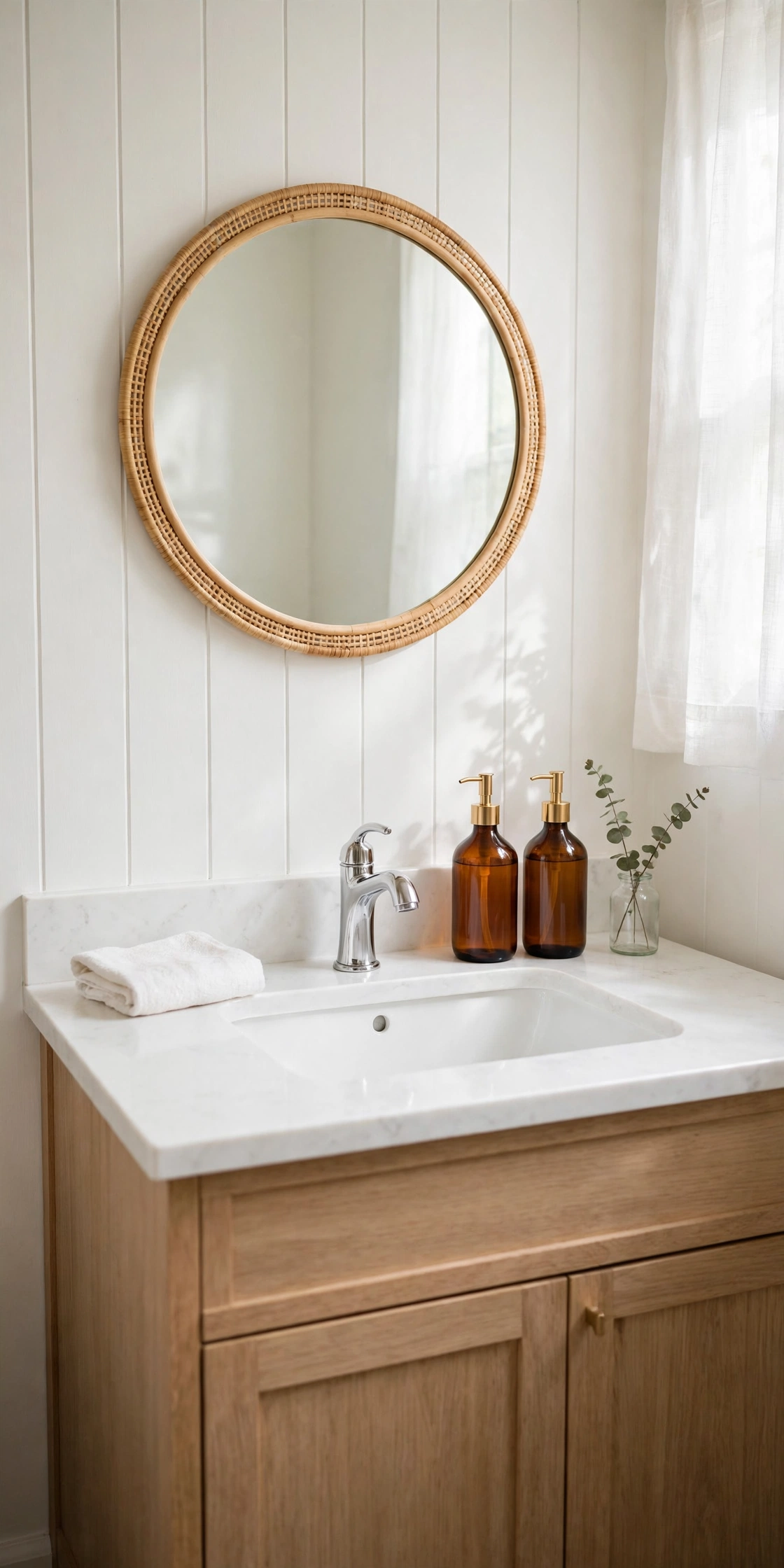
My sink is 45 centimeters wide. The counter space is a joke. For a long time it held seven bottles of various heights, and the whole room looked messy no matter how clean it was. The fix took one evening.
Idea 10: Decant into matching dispensers and hide the rest. One soap dispenser, one lotion bottle, matching — mine are simple amber glass, 12 euros for the pair. Everything else lives in the tall cabinet from idea 5. Two matching bottles on a tiny sink look deliberate; seven branded bottles look like a pharmacy shelf. This was the smallest change on the list and, honestly, one of the most satisfying. Every morning I see two amber bottles and a clear counter, and the room feels like it has its act together.
The ten ideas, quick recap: 1) the largest mirror the wall allows, 2) a mirrored cabinet if you need storage, 3) warm-white walls matched to your light, 4) open shelves above the toilet, 5) a tall narrow cabinet in the dead strip, 6) a clear shower curtain, 7) one statement piece, 8) matching towels, 9) one small washable rug, 10) matching dispensers and a clear counter.
Total spend: just under 150 euros. Total time: three weekends, mostly waiting for paint to dry and shelves to arrive. Nothing here required permission from my landlord beyond the adhesive strips, and all of it comes with me when I move. If your bathroom feels cramped, start with ideas 1 and 10 this weekend — the big mirror and the clear counter. They’re the two changes you notice every single time you walk in, which in a room you visit five times a day, matters more than you’d think.