Last spring I hit a wall with my bedroom. Not literally, though it felt like it. Every morning I woke up to a chair piled with clothes, a nightstand buried under books I’d already read, and walls painted a beige that somehow managed to look both dirty and boring. I’d been pinning Scandinavian bedrooms for years — all that pale wood, white linen, quiet light — and one Saturday I finally asked myself: what if I just did it? Not a full renovation. No contractor. Just me, two weekends, and a budget of about 400 euros.
What follows is exactly what I did, in the order I did it, with the mistakes included. There are twelve ideas here in total, and they build on each other. You don’t need all twelve to feel a difference — the first two alone changed how my room felt. But together, they turned the most neglected room in my apartment into the one I now spend the most time in.
1. I Started by Taking Everything Out (Ideas 1 and 2)
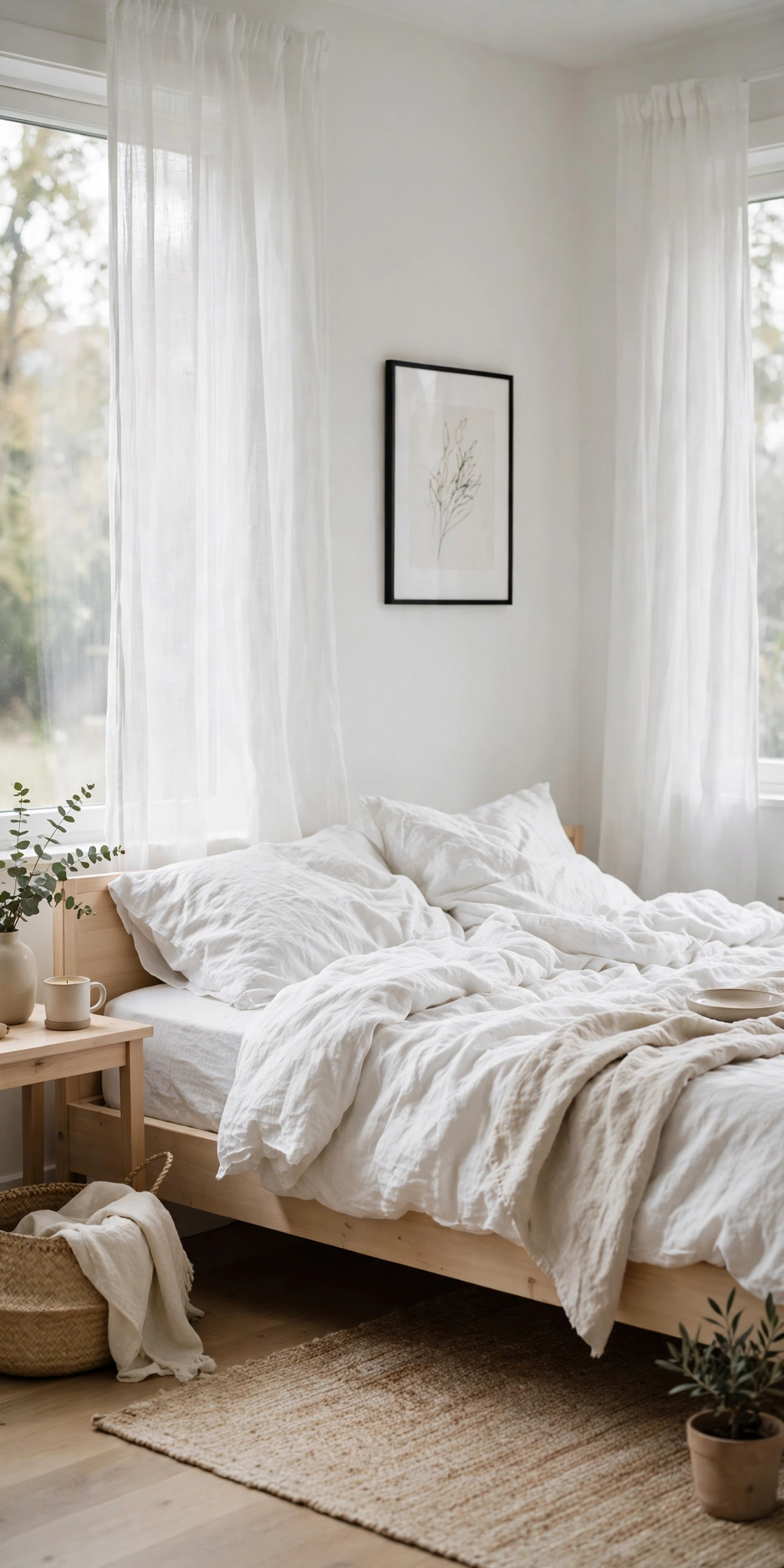
Scandinavian design starts with subtraction, not shopping. So on the first Saturday morning, I pulled everything out of my bedroom except the bed frame and one lamp. Everything. Clothes, books, the chair, the boxes under the bed, all of it went into the hallway. It looked ridiculous. My hallway looked like a yard sale.
Then I put things back only if they met one of two rules: I use it every week, or it makes me genuinely calm. That chair with the clothes pile? Gone — donated. Three of the five decorative pillows that spent every night on the floor? Gone. The box of cables I’d been “meaning to sort” for two years? Gone.
Idea 1: Declutter ruthlessly before you buy a single thing. The calm you’re chasing is mostly just the absence of clutter. I filled two donation bags and one trash bag, and the room already felt 30 percent bigger before I’d spent a cent.
Idea 2: Adopt a one-in, one-out rule going forward. I keep a small canvas bag hanging inside my closet door now. When something new comes into the bedroom, something old goes into the bag. When the bag is full, it goes to the donation box. This is the unglamorous idea that keeps the other eleven working.
2. The Color Palette: Warm White Walls and Pale Wood (Ideas 3 and 4)
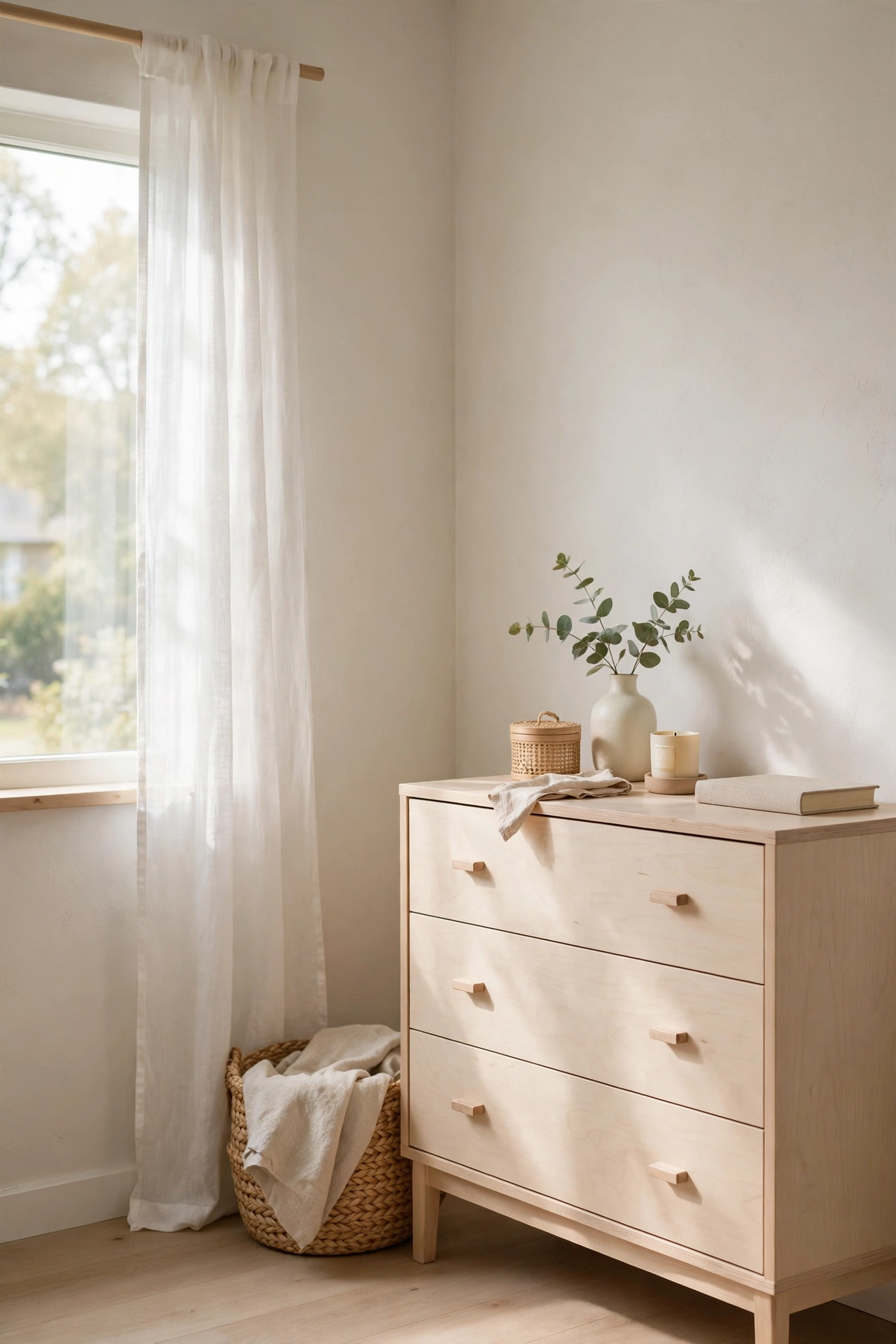
Here’s a mistake I almost made: I bought a can of pure, bright, blue-white paint because “Scandinavian = white.” I painted one test patch behind the door and it looked like a hospital corridor. Scandinavian white is never stark — it’s warm.
I went back and got a warm off-white (mine is close to what paint brands call “ivory mist” or “warm white” — anything with a hint of cream, LRV around 85). One coat over the old beige, cut in carefully around the trim, and the room changed completely. Warm white bounces daylight around without that cold glare.
Idea 3: Paint the walls a warm off-white, not a cold one. Test a patch first and look at it at 8 a.m. and 8 p.m. If it looks grey or blue in evening light, it’s too cold. Two coats, one weekend, roughly 60 euros for paint and supplies in my 14-square-meter room.
Idea 4: Let pale wood be your only “color.” Birch, ash, light oak — Scandinavian rooms get their warmth from wood tone, not from accent colors. I kept my old pine dresser but sanded off the orangey varnish and gave it two coats of white furniture wax. It looked like a different piece of furniture. If you’re buying, look for “natural,” “white-washed,” or “soap-finished” wood.
3. The Bed: Low, Simple, Made for Slow Mornings (Ideas 5 and 6)

The bed is the biggest object in the room, so it sets the tone. Mine was a tall, dark-stained frame with a bulky headboard that dominated everything. I sold it for 80 euros and bought a simple low platform bed in solid pine for 190 — no headboard, just clean lines, sitting about 25 centimeters off the floor.
The lower height was the revelation. The room suddenly felt taller, airier. A low bed also forces you to keep the floor around it clear, because anything on the floor is immediately visible. It was the single most impactful swap of the whole project.
Idea 5: Choose a low, simple bed frame in pale wood. Skip the tall headboard and the footboard. If a new frame isn’t in the budget, try removing the headboard from your current bed — I did this at my sister’s place and the difference was immediate.
Idea 6: Layer bedding in whites and naturals. I use white cotton sheets, a light duvet in a washed-linen-look cover, and one oatmeal-colored throw folded across the foot. No matching “bedding set,” no decorative shams standing at attention. The trick is texture, not color: linen, cotton, and one knit throw give you all the visual interest you need. And make the bed every morning — it takes ninety seconds and it’s the cheapest Scandinavian habit there is.
4. Light the Way They Do in Copenhagen (Idea 7)
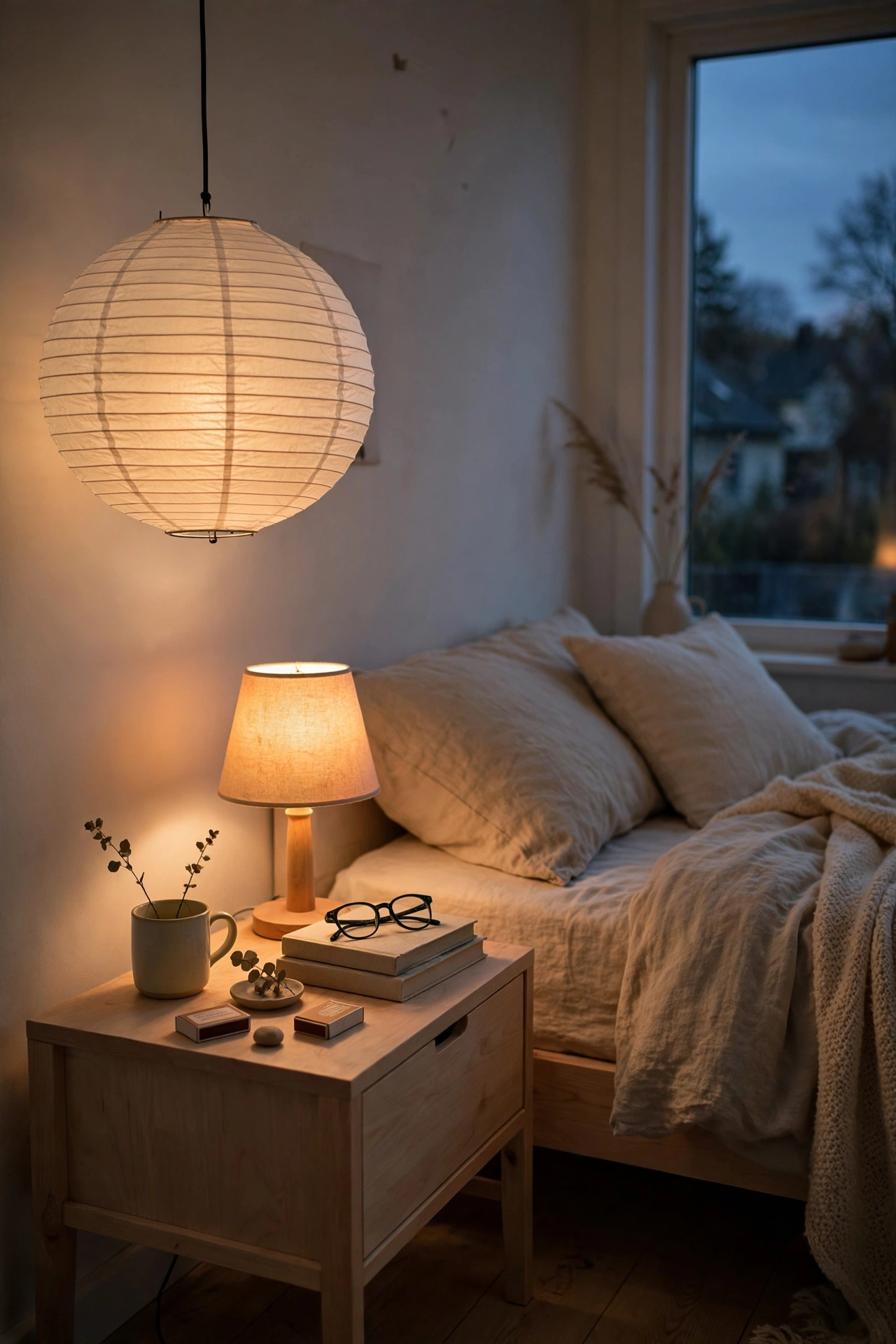
Denmark gets about seven hours of daylight in December. The Scandinavians responded by becoming the world’s best at cozy artificial light, and this is the idea I get the most compliments on. The rule is simple: no overhead light in the evening, ever.
I unplugged my ceiling light (it’s still there for cleaning day) and built the room around three warm pools of light instead: a paper lantern pendant hung low over one corner at about 150 centimeters from the floor, a small wooden table lamp on the nightstand, and a candle on the dresser. All bulbs are 2700K warm white — this matters more than the lamp design. A 4000K “daylight” bulb in a pretty lamp still feels like an office.
Idea 7: Layer three warm light sources and ditch the ceiling light. One pendant or floor lamp, one bedside lamp, one candle. All warm white (2700K). Total cost for me: a 25-euro paper pendant, a 30-euro secondhand lamp, and a 3-euro candle. In winter I light the candle at 4 p.m. and the whole room glows.
5. Storage That Disappears (Ideas 8 and 9)
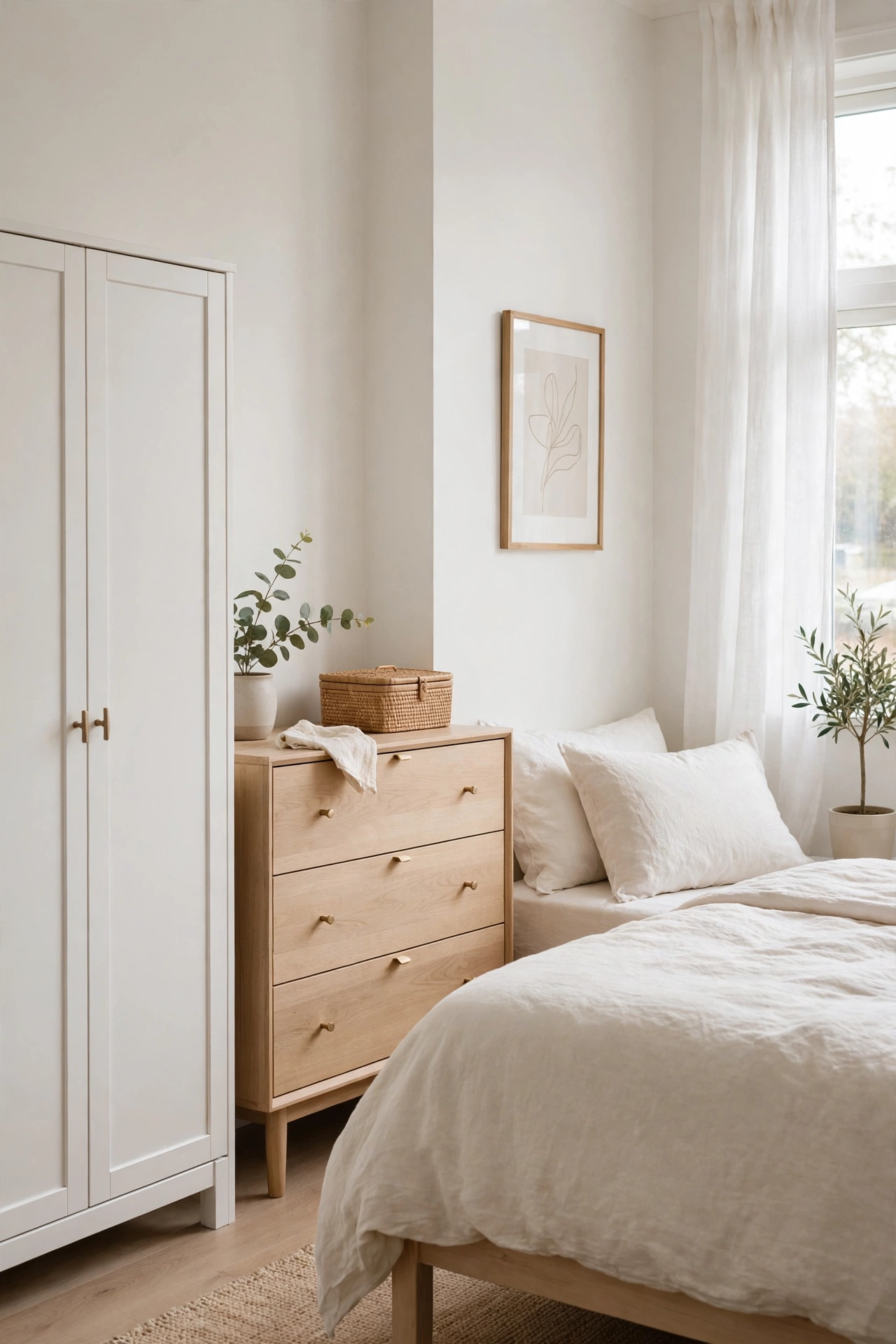
Scandinavian calm is impossible if your stuff is visible. My room had open shelving with folded sweaters that never stayed folded, and it always looked busy. The fix wasn’t more storage — it was closed storage.
I replaced the open shelves with a simple two-door cabinet (secondhand, 45 euros, painted the same warm white as the walls so it visually recedes). Everything that used to sit on open shelves now lives behind doors. Out of sight is genuinely out of mind here — I stopped thinking about the mess because there was no mess to see.
Idea 8: Prefer closed storage over open shelves. If you already own open shelving, try uniform baskets or boxes first — same color, no labels, nothing sticking out. It gives you 80 percent of the effect for the price of three storage boxes.
Idea 9: Use the under-bed space properly. A low platform bed still leaves about 20 centimeters underneath. I bought two flat wheeled boxes (about 15 euros each) for off-season clothes and spare bedding. They roll out easily, they stay dust-free, and they freed an entire shelf in my closet.
6. Textiles: The Cozy Layer (Ideas 10 and 11)
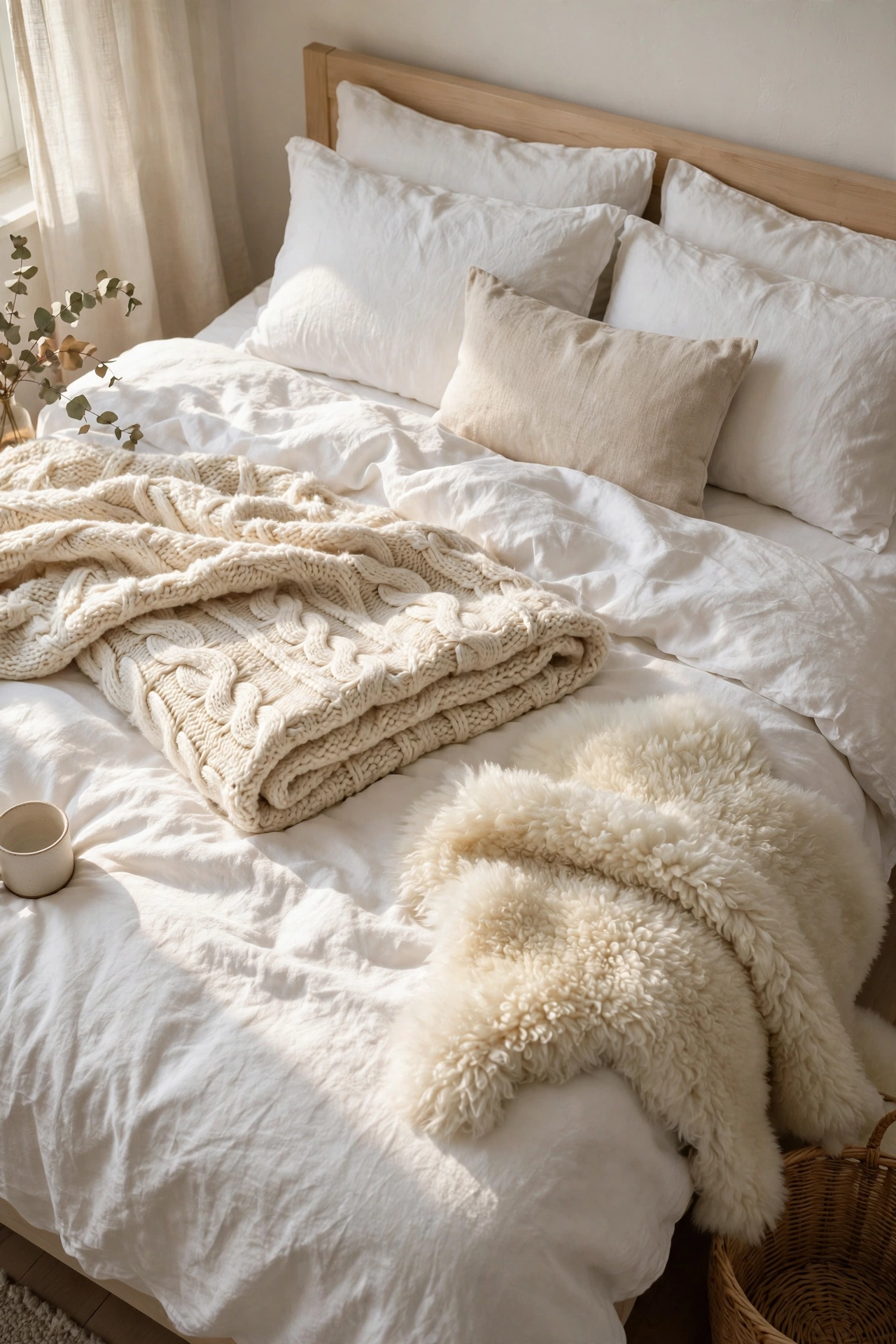
This is where the “cozy” comes from. Scandinavian bedrooms are visually quiet, so texture does all the emotional work. My rule: everything you touch should feel good.
I added exactly three textiles and stopped. A chunky wool throw across the foot of the bed (35 euros, the one real splurge, and worth every cent on cold mornings). A small sheepskin — actually a good faux one, 20 euros — draped over the reading chair. And a flat-weave cotton rug in undyed beige beside the bed, big enough that my feet land on it every morning (about 120 by 170 centimeters).
Idea 10: Add one wool throw and one soft rug. That’s it. Don’t layer five throws and four cushions — Scandinavian cozy is one good throw, not a textile avalanche. The rug matters more than people think: cold floorboards at 6 a.m. undo all the calm you’ve built.
Idea 11: Mix natural materials. Linen, wool, cotton, wood, a little leather if you like it. What to avoid: anything shiny or synthetic-looking. I had a polyester “satin” cushion cover that looked fine in the shop and cheap in the room — natural fibers photograph and feel better in this palette.
7. The Finishing Touches — and What I’d Skip (Idea 12)
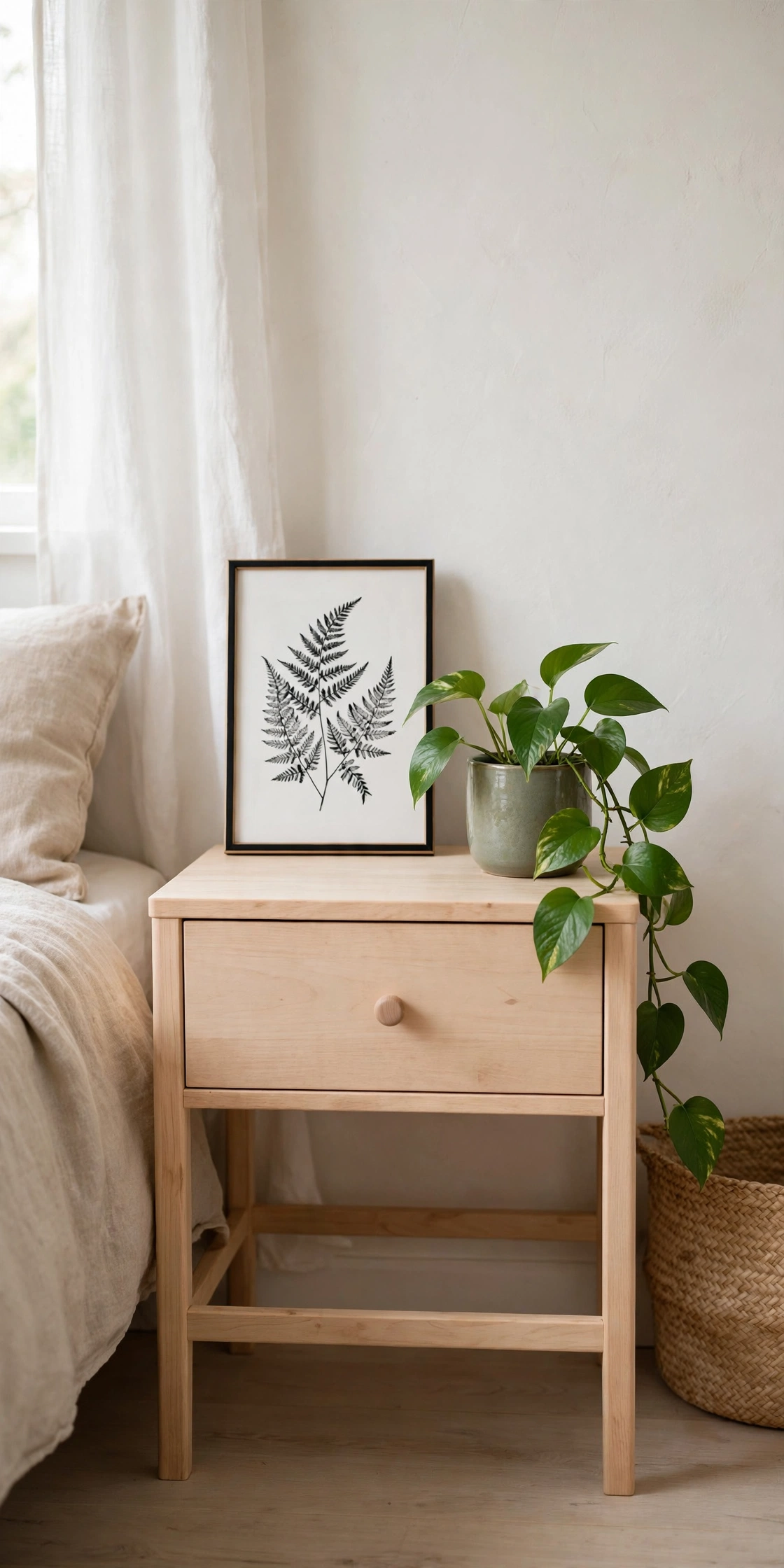
With everything calm, the last step is restraint. I hung one framed print above the dresser — a simple black-and-white botanical, 40 by 50 centimeters — and put one small green plant (a pothos, nearly unkillable) on the nightstand. That’s the entire decoration of the room. One art piece, one plant.
Idea 12: One piece of art, one living plant, then stop. A gallery wall is the opposite of Scandinavian calm. Pick the one print you love most, frame it simply in thin black or oak, hang it at eye level, and let it breathe. The plant adds the only real green in the room, which makes it feel alive rather than staged.
And what I’d skip, having done this once: the all-white everything look. My first attempt had white walls, white bedding, a white rug, white curtains — and it felt sterile, not calm. The wood tones and the oatmeal throw are what make it feel human. Also skip scented candles with overpowering perfume; a plain beeswax candle gives you the glow without the headache.
The 12 ideas, quick recap: 1) declutter ruthlessly, 2) one-in-one-out, 3) warm white walls, 4) pale wood as your color, 5) a low simple bed, 6) layered natural bedding, 7) three warm light sources, 8) closed storage, 9) under-bed boxes, 10) one wool throw and a soft rug, 11) natural materials only, 12) one art piece and one plant.
Total spend: just under 400 euros, spread over two weekends. Total time: maybe 20 hours, half of it painting and waiting for paint to dry. But the real cost was deciding what to let go of — the chair, the pillows, the beige. If your bedroom feels restless, start with ideas 1 and 7 this weekend. The decluttering and the lighting are the two that changed how the room felt, and feeling is the whole point.