10 Toca Boca Living Room Ideas
The living room in my niece’s Toca Boca house was the most boring room I had ever seen: four bare walls, one lonely sofa, and a rug that looked like it had given up. She was not impressed either. “Aunt Alex, fix it,” she said, and handed me the tablet like a client handing over a brief. So we did. We rearranged the sofa four times, argued about whether the rug should be pink or teal, and spent a solid twenty minutes deciding where the tiny plant goes. By the end of it, her characters had a living room that actually felt like someone lived there, and I had learned something useful: building a room in a game teaches you exactly the same lessons as decorating a real one. You need a place to sit, a place to put things down, a splash of color that makes you smile, and just enough mess to make it feel alive. These are the ten ideas that survived our very serious design sessions.
1. Bold Color Block Walls

The first thing we ever changed in a Toca Boca living room was the wall color, because a plain white wall in that game looks unfinished, like the room is still waiting for someone to move in. I showed my niece how to pick one big block of color for the wall behind the sofa, a deep teal or a warm mustard, and suddenly the whole room had a backbone. We tried a pink wall once and it swallowed the furniture, so now we stick to one bold wall and keep the rest quiet. She likes to add a couple of wall decals after that, a smiling sun here, a little framed doodle there, because in her words, “a wall with nothing on it is just a wall.” What surprised me is how much this habit has crept into my real decorating: I am far braver with a painted accent wall now than I was before I ever played a kids’ game.
Good to know: Pick the wall color before you place any furniture, and test it against the sofa color first — a bold wall works best in the main living room of the house, and it sets the mood for every family scene the kids will play out there.
2. Chunky, Oversized Furniture

Nothing in Toca Boca is delicate, and honestly that is half the charm. The sofas are big and round, the armchairs look like they could swallow a small character whole, and my niece always picks the biggest one she can find. I used to nudge her toward something daintier, and then I watched her arrange three characters on one chunky sofa for a movie night scene and realized the oversized furniture is what makes the room work for play. Big pieces anchor the layout, they leave room for the characters to actually sit together, and they look fantastic against a bold wall. The coffee table matters just as much: a thick-legged one in a bright color gives the characters somewhere to put their tiny cups and books, and it stops the middle of the room from feeling like an empty stage. I have started thinking about my own living room the same way, choosing pieces that invite people to pile on rather than sit politely apart, and a cozy reading corner works the same way in both worlds.
Try this: Place the biggest sofa first, facing the television or the window, then build everything else around it — this setup shines in the family living room where the kids stage their movie nights and lazy Sunday scenes.
3. Playful Rugs and Flooring
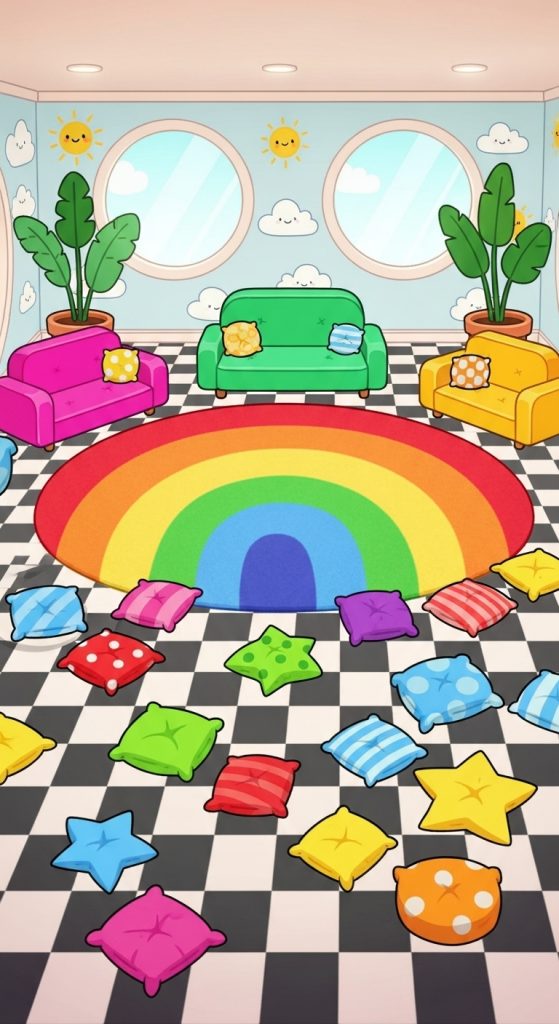
I will admit it: I used to think a rug was just something to keep feet warm. Then my niece showed me that in her Toca Boca house, the rug decides where the room actually happens. We put a big round rug in the middle of the living room and suddenly the sofa, the coffee table and the characters all had a reason to gather in one spot instead of floating around the edges. She loves a checkerboard pattern, I lean toward a soft pastel rainbow, and we usually compromise by layering a small bright rug over a bigger plain one, which looks surprisingly good and gives the floor some depth. The trick we learned the hard way is to keep the rug smaller than the room so the floor still shows around the edges, otherwise the whole space starts to feel crowded and the characters have nowhere to walk. A playful rug also hides a multitude of sins, like the fact that we moved the furniture eleven times before lunch.
Make it yours: Let the kids pick the rug pattern themselves and then build the room’s colors around it — a bold rug is perfect for a playroom-style living room where the floor is the main stage for games and stories.
4. Whimsical Wall Art

The walls in my niece’s Toca Boca living room are never bare for long, because she treats wall art the way I treat a gallery wall at home: every frame has to earn its place. We started with one framed print of a smiling piece of fruit above the sofa and it made us both laugh, so now there is a little collection up there, a cartoon animal here, a bright abstract doodle there, all slightly crooked in the way that only a kid would allow. I have learned to stop straightening things in the game, because the slightly chaotic arrangement is exactly what makes the room feel lived in rather than staged. The best part is that wall art is the easiest thing to change when the kids get bored, so we swap prints whenever the mood shifts, and the room feels brand new without moving a single piece of furniture. In my own home I have started doing the same thing, rotating a few prints seasonally instead of committing to one permanent arrangement.
Beginner tip: Start with one large framed print above the sofa and add smaller pieces around it — wall art like this suits any living room in the game, especially the one where the kids host their pretend dinner parties.
5. Functional yet Fun Storage

Every Toca Boca living room eventually hits the same problem my real living room has: too many things and nowhere to put them. My niece’s characters own an unreasonable number of books, toys and little treasures, and for a while they were scattered across the floor in a way that made the room look like a tornado had passed through. So we built storage into the design instead of treating it as an afterthought. A row of colorful cube shelves along one wall holds the books and the quirky knick-knacks, and a couple of stackable bins shaped like blocks sit under the window for the smaller bits. The rule my niece invented is that storage has to look good enough to be part of the decoration, not hidden away in shame, and honestly she is right. Now the room stays tidy between play sessions, and the shelves themselves have become one of my favorite parts of the whole setup, because a bookshelf styled with care turns clutter into character in a game just as it does at home.
Budget tip: Use the game’s existing shelves and bins before buying new furniture — colorful storage is ideal for the main family living room, where it keeps the play mess under control without killing the fun.
6. Character-Inspired Accessories

This is the part my niece cares about most, and I have stopped pretending otherwise. The accessories are where her characters’ personalities actually show up in the room. A pillow shaped like a cat on the armchair, a lamp with a funny face on the side table, a blanket in a loud cartoon pattern draped over the sofa arm: these are the details that make her stop and say, “Yes, this is THEIR room now.” I used to think accessories were the finishing touch, the thing you add last, but watching her build rooms has flipped that for me. She picks the accessories first sometimes, and then chooses the furniture to match them, and the rooms end up with far more personality than mine ever did. What I have learned is restraint, even if that sounds odd coming from someone describing a cat-shaped pillow. Two or three strong character pieces are plenty; any more and the room starts shouting instead of talking.
Where it works: Character accessories belong in the living room where the kids’ favorite characters spend the most time — they make birthday scenes and sleepover setups feel personal instead of generic.
7. Statement Lighting
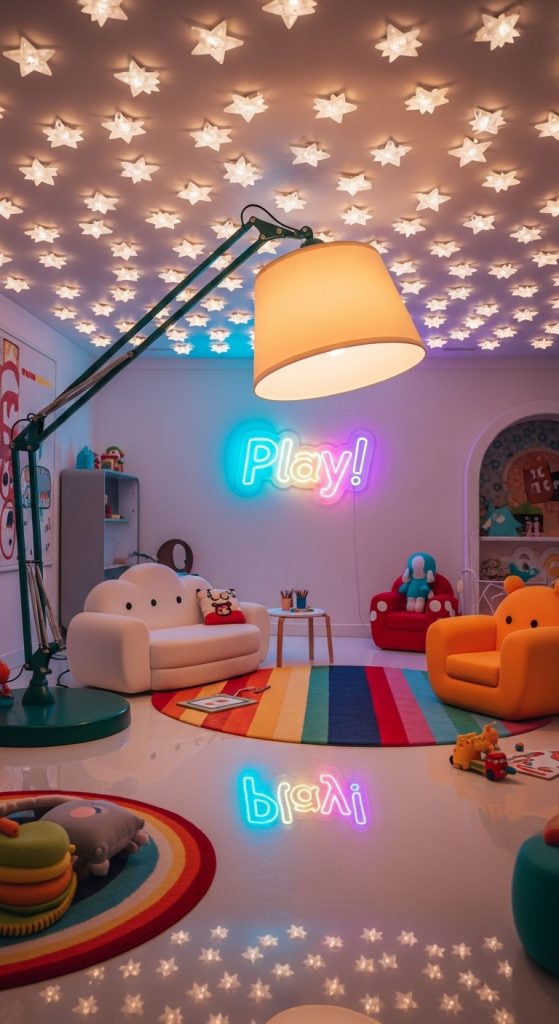
Lighting was the thing I never thought about in a game until my niece dragged a giant star-shaped lamp into the corner and the whole room changed. Suddenly the living room had an evening mood, and the characters’ bedtime stories and late-night snack scenes actually made sense. We tried a cloud-shaped pendant over the coffee table next, and then a string of little lights along the shelf, and I realized the game rewards the same instincts as a real room: one big statement light to anchor the space, plus a few small warm ones to make it feel cozy after dark. A neon sign with a fun word on it was my niece’s proudest addition, and I have to admit it looks brilliant against the teal wall. The only mistake we made was putting too many lights in at once, which turned the room into a disco, so now we pick the statement piece first and add the little ones sparingly.
Watch out: One statement lamp plus one or two small lights is enough — too many glowing pieces will wash out the colors, and this setup works best in the living room where the kids play out evening and bedtime scenes.
8. A Cozy Play Nook

Every good living room needs a corner that belongs to nobody in particular and everybody at once, and in my niece’s Toca Boca house that corner is the play nook. We carved it out of the space beside the sofa with a little canopy, a pile of floor cushions and a beanbag that has become the most fought-over seat in the house. She calls it the reading corner, but I have watched her characters use it for secret meetings, quiet time with a book, and once, memorably, as a hiding place during a game of hide and seek. The fairy lights strung along the canopy make it feel separate from the rest of the room without needing a wall, and a soft rug underneath keeps it feeling warm. I love this idea because it gives the living room a second purpose: it is not just where everyone sits together, it is where one character can slip away for a bit, which is exactly how a real living room should work too, especially when the whole family is home on a rainy afternoon and the cottagecore living room mood takes over.
Good to know: Build the nook in a corner the main sofa does not face, so it feels like its own little world — it is perfect for quiet reading scenes and rainy-day play in the family living room.
9. Mixing Old and New

My niece has a soft spot for the retro pieces in the game, the old-fashioned television, the patterned curtains that look like they came from her grandmother’s house, and at first I worried they would clash with all the bright modern furniture. Then we tried it: a vintage-style TV stand against the bold wall, a mid-century chair in a loud orange next to the chunky modern sofa, and somehow the room looked more interesting than it ever had before. The old pieces give the room a story, like the characters inherited something from a grandparent, and the new pieces keep it from feeling like a museum. I have noticed the same thing in real homes I love, the ones that mix a flea-market find with something brand new always feel more personal than a room bought in one trip. The balance that works for us is roughly three modern pieces to one vintage piece, so the room stays playful and bright while the retro touch keeps it from feeling like a showroom.
Try this: Add one vintage piece, like a retro TV stand or patterned curtains, to an otherwise modern setup — the mix works beautifully in the main living room when the kids want their house to feel like it has a history.
10. Themed Living Room Zones

The biggest lesson my niece taught me about Toca Boca living rooms is that one big open room does not have to do everything at once. We divided her living room into zones, and it changed how she plays in it completely. One corner is the lounge, with the chunky sofa and the television, where the characters watch movies and argue about what to watch. Another corner became a craft zone with a small colorful table and the cube shelves nearby, so the characters can make things without spreading glitter across the sofa. And the third corner is a little display space for the quirky art and the treasures they have collected, which my niece rearranges constantly. Giving each zone its own job means the room never feels messy even when a lot is happening in it, and the kids can play out three different stories in one room without tripping over each other. It is the closest thing to real life I have seen in a game: my own living room works exactly the same way, just with fewer tiny chairs.
Make it yours: Let the kids name each zone themselves — the lounge, the craft corner, the treasure shelf — because a zoned living room is made for big family play sessions where everyone wants their own little world.
Conclusion
We never did settle the pink-versus-teal rug debate, by the way. My niece picked teal, I still think pink would have been braver, and the sofa has been rearranged at least twice since. That is the whole point, though. A Toca Boca living room is never really finished, it just grows with the kids playing in it, and the best rooms are the ones that leave a little space for the next idea. Start with a bold wall, add furniture big enough to pile onto, and let the kids make it theirs. The rest will sort itself out, usually while you are busy arguing about a rug.