10 Study Space Ideas in Bedroom
For years my study setup was the kitchen table, which meant every evening I cleared away notebooks so we could eat dinner, and every morning I set the whole thing up again. When I finally claimed a corner of our bedroom for proper studying, I started with a wobbly second-hand desk shoved against the radiator and learned, slowly and expensively, what actually makes a bedroom study corner work. The room is small, the light is fickle, and the bed is always right there whispering that a nap would be nice. These ten ideas are the ones that survived real use in my flat, tested over long evenings of writing, planning and the occasional very late deadline.
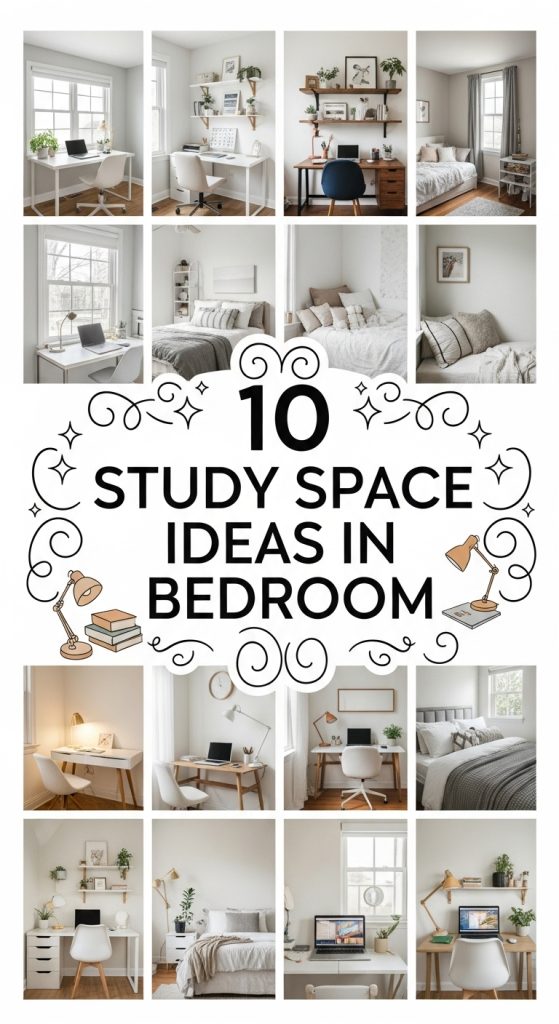
1. Minimalist Desk by the Window
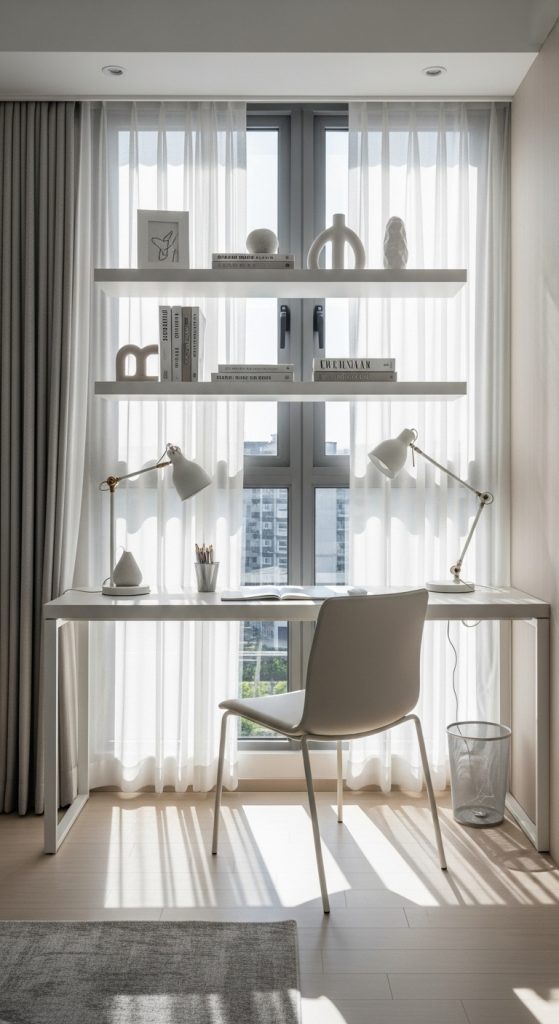
I moved my desk to the window after months of working with my back to it, and the difference surprised me more than any piece of furniture ever has. Daylight keeps me alert in a way no lamp manages, and looking up at the rooftops for thirty seconds genuinely resets my concentration. I chose a slim white desk, 120 cm wide, because anything deeper would have eaten into the walkway to the wardrobe, and I kept the surface almost bare: laptop, one notebook, a glass of water. A floating shelf above holds the books I reach for daily, and a linen curtain softens the afternoon glare without darkening the room. What worked for me was setting a rule that nothing lives on the desk overnight except the lamp, so every morning starts clean. I learned the hard way that a chair without lumbar support turns a two-hour session into a stiff back, so I swapped my pretty wooden chair for a simple ergonomic one from a flea market and never looked back.
2. Corner Study Nook
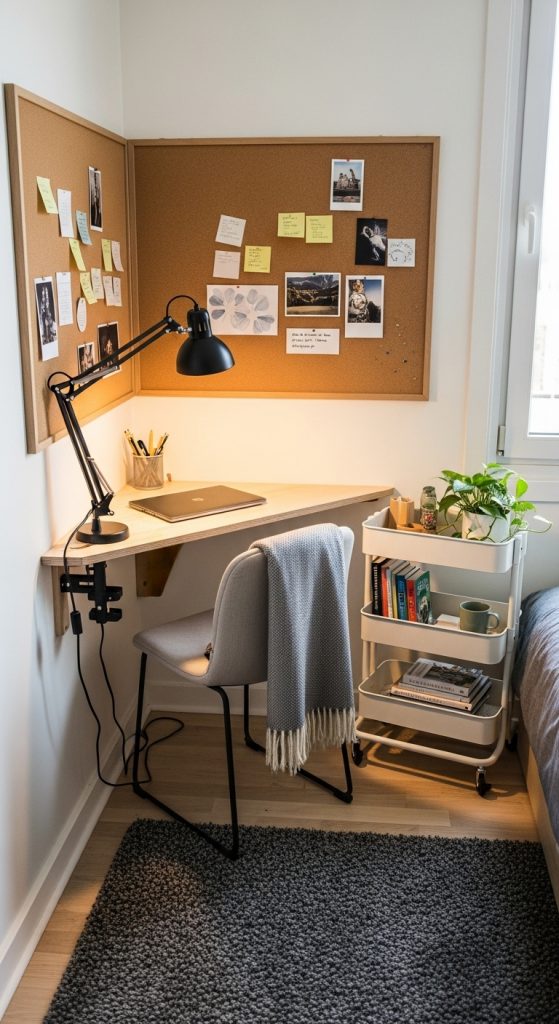
Our bedroom has one of those awkward corners where nothing quite fits, too narrow for a wardrobe and too dark for a plant, and for a long time it just collected laundry baskets. Fitting a small corner desk there was the best use of dead space I have found in this flat. I measured twice before ordering, because corner desks are unforgiving, and I picked one with a depth of 50 cm so my knees would not hit the wall. Above it I hung a corkboard for deadlines and a pegboard for scissors, tape and the chargers that used to vanish into drawers. A warm task lamp makes the corner usable after dark, which matters in Munich winters when it is pitch black by five. What I love most is the psychology of it: when I sit in that corner, my brain knows it is work time, and when I step out, the rest of the bedroom belongs to rest again. My one mistake was buying a rolling cart that was too wide to slide under the desk, so measure the clearance before you fall in love with any storage.
3. Loft Bed with Desk Underneath
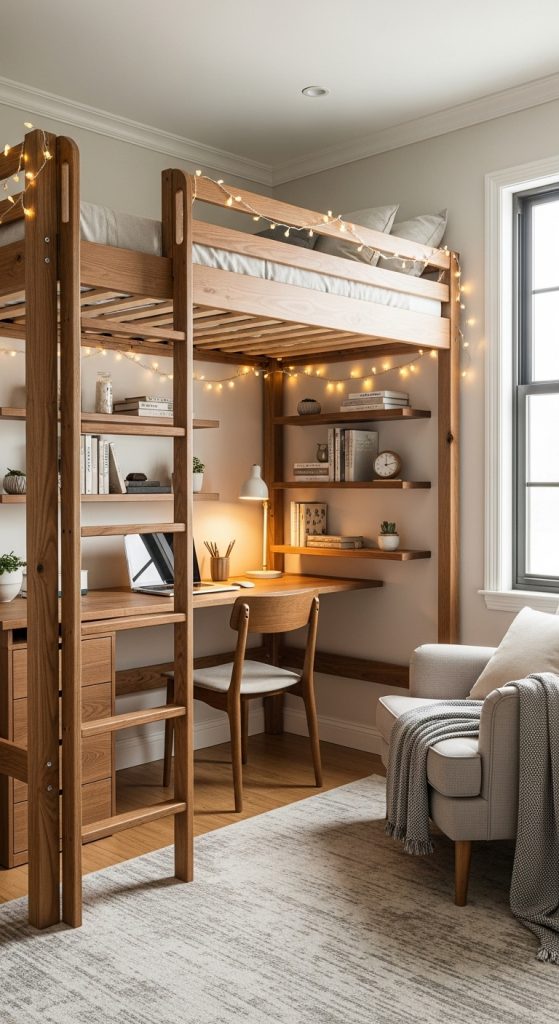
I will be honest: a loft bed is not for everyone, and I would not put one in a room with low ceilings. But in a small bedroom with decent height, tucking the desk under the bed genuinely doubles what the room can do. I tried this setup in my niece’s room when she moved into a tiny student flat, and the separation it created was remarkable. Up top is sleep, down below is work, and the ladder between them acts like a little commute that helps her switch modes. We chose a sturdy pine frame with a built-in desk and a shelf rail, and we spent an afternoon bolting everything properly and checking every joint, because a wobbling loft bed is no joke. A clip-on lamp and a cable tray under the desk kept the floor clear, and a chair that slides fully underneath means the space stays walkable. The mistake to avoid is skimping on the mattress and the ladder rungs: she tried a thin mattress first and woke up sore, and narrow rungs hurt bare feet at midnight.
4. Foldable Wall-Mounted Desk
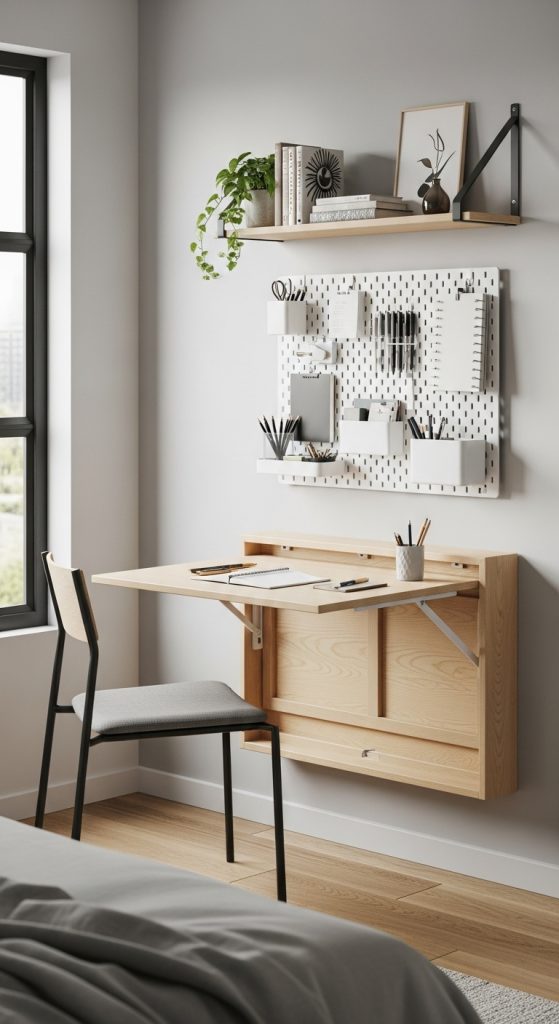
When a friend moved into a one-room flat and asked me how to study without a desk taking over her only living space, I suggested a fold-down wall desk, and I have recommended it ever since for the smallest bedrooms. The idea is simple: a solid oak-look panel hinged to the wall folds down into a desk about 80 cm wide, and folds back up when you are done, leaving the room free. We mounted ours into wall studs with proper heavy-duty brackets, not just plaster plugs, because a desk that rips out of the wall at midnight is a story nobody wants. Above it, one slim shelf holds the essentials, and a small stool tucks underneath so nothing blocks the walkway. What worked for me was keeping a little tray on the shelf with notebook, pens and laptop charger, so unfolding the desk takes ten seconds and there is no excuse to work from the bed instead. The one thing I would change is the hinge: buy the soft-close kind, because a panel that slams down startles everyone in the flat.
5. Built-In Study Unit
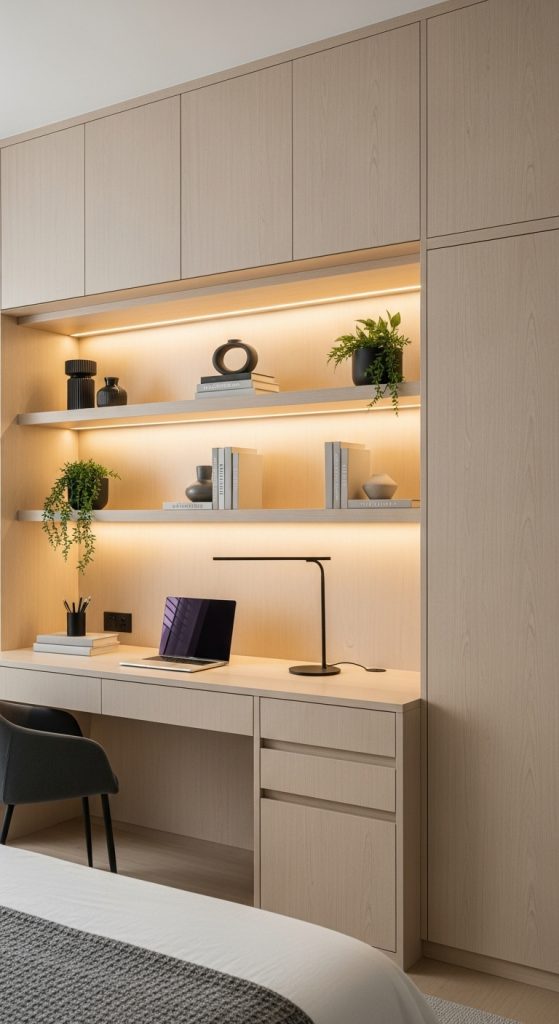
A built-in study unit is the most expensive idea on this list and the one I would only choose if you plan to stay put for a few years, but in my experience it is also the tidiest solution for a bedroom that has to work hard. I helped a neighbour plan one fitted between two wardrobes, and the carpenter built a desk, shelving and closed cupboards into a single run of pale birch. The closed storage is the real win: textbooks, files and the printer all disappear behind doors, so the room still looks like a bedroom when guests walk in. We added a warm LED strip under the top shelf, wired to a small switch, and that soft light is far kinder in the evenings than a bright overhead bulb. The desk depth is 60 cm, which fits a laptop and an open book side by side without elbows knocking into the wall. My advice is to plan the cable holes before the carpenter leaves, because drilling into a finished unit later is miserable, and to leave one shelf adjustable for the odd-sized books that never fit anywhere.
6. Cozy Window Seat with Desk Extension
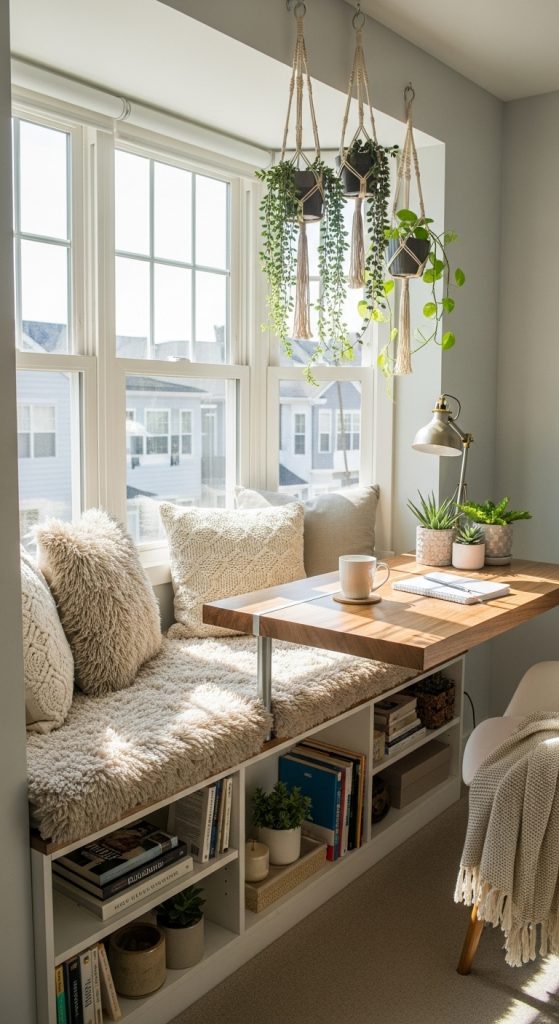
There is something about a window seat that makes even dull admin feel a little bit lovely, and adding a desk extension to one gave me the most-used reading and writing spot in my home. I built ours from a simple bench with a thick cushion in a washable linen cover, because anything that cannot be washed near a window will eventually regret it, and the desk surface extends from the bench at the same height so I can slide from reading to typing without standing up. Under the bench, open cubbies hold baskets for notebooks and the spare charger, which keeps the surface clear. A small shelf above holds a plant that somehow survives my neglect, and a string of warm fairy lights makes the corner inviting on grey afternoons. What I learned is that comfort needs a limit: if the cushion is too deep and too soft, I slide into a slouch and my neck pays for it within the hour, so I added a firm lumbar cushion and set a timer to stand and stretch every forty minutes.
7. Scandinavian-Inspired Study Space
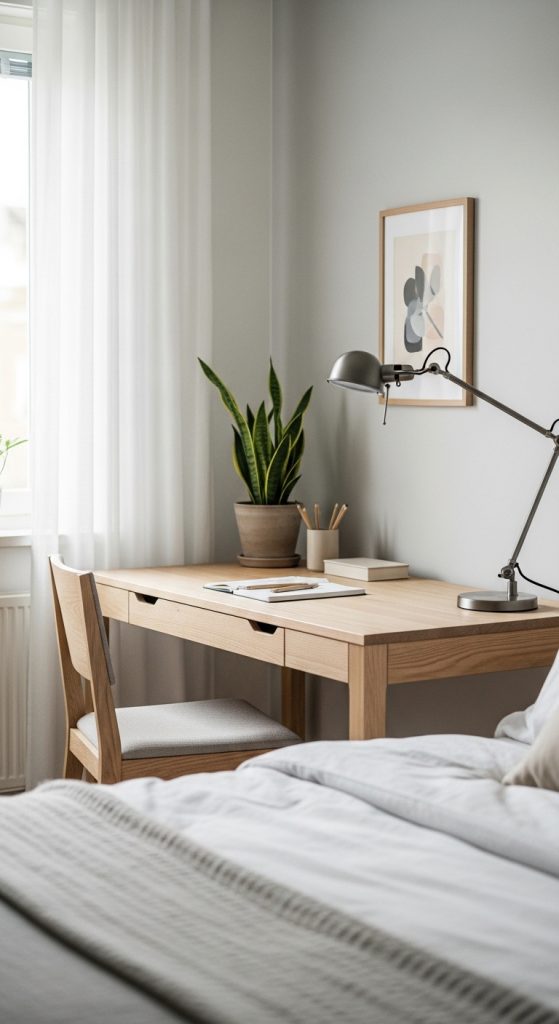
I have always been drawn to the calm, pale simplicity of Scandinavian rooms, and when I finally stripped my study corner back to that style, my concentration improved in a way I had not expected. The desk is light birch, the chair is white with a woven seat, and the walls are a soft warm white that bounces the daylight around the room. I kept decoration to almost nothing: one framed print, a small plant, a ceramic pen pot. That restraint is not about being strict for its own sake; every object I removed was one less thing my eyes wandered to when a sentence got difficult. The practical side matters just as much, so the lamp is adjustable and warm-toned, the cables run through a small tray under the desk, and the only colour comes from a sage green notebook and the plant. I made the mistake early on of buying a beautiful but shallow desk that could not hold my laptop and a book at once, so I replaced it with a 120 cm version and the frustration vanished overnight.
8. Vibrant Creative Study Zone
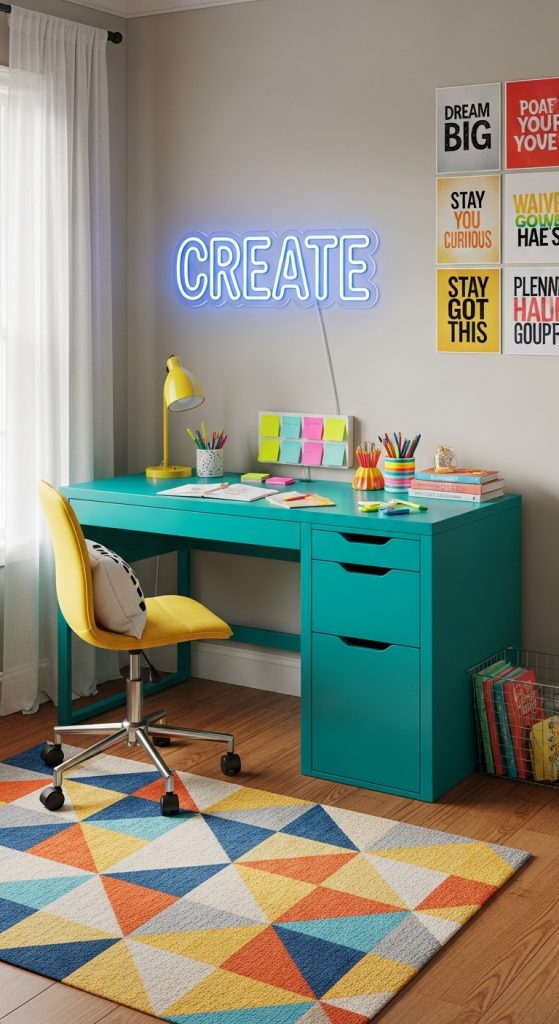
Not everyone focuses best in a calm pale room, and my niece is living proof: give her white walls and silence and she wilts, but give her colour and she writes for hours. Her study zone is the brightest corner of her bedroom, with a teal desk she painted herself, a mustard pinboard covered in photos and ticket stubs, and a patterned rug that marks out her territory on the floor. The colour is not random clutter; everything has a place, and the pinboard is her working memory, holding the deadlines, the ideas and the magazine cuttings that spark her projects. A neon-style LED sign over the desk gives a soft glow in the evenings, and a jar of coloured pens sits within reach because she genuinely thinks better with a pen in her hand. What worked for her was choosing two main colours and letting everything else stay neutral, so the room feels lively rather than chaotic. The mistake we made at first was covering every inch of wall, which felt exciting for a week and exhausting after that, so we took half of it down and left breathing room around the desk.
9. Double Duty Vanity and Desk
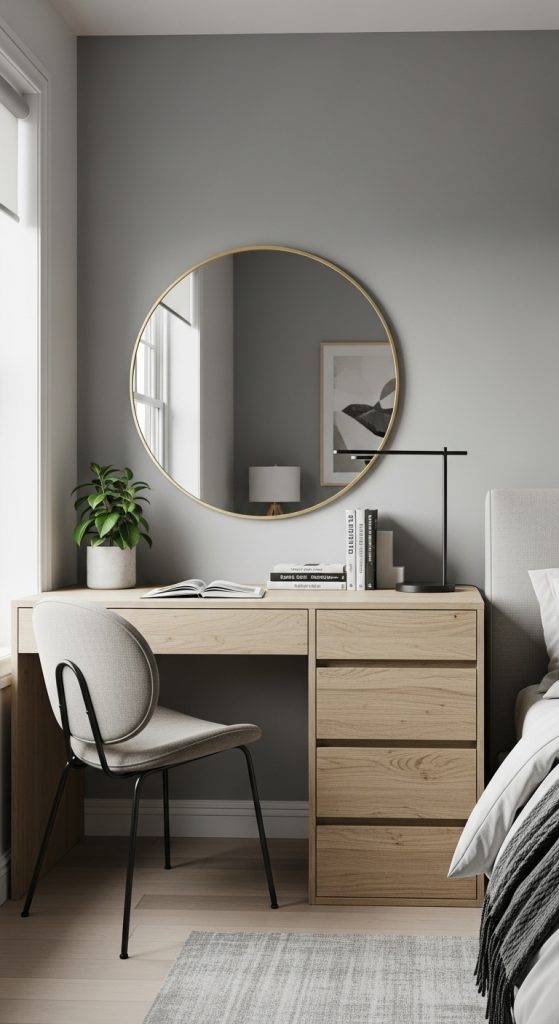
In a bedroom where every centimetre is already spoken for, asking one piece of furniture to do two jobs is not a compromise, it is common sense. I set up a vanity desk for a friend who works from her bedroom and gets ready there too, and the shared piece has held up beautifully for two years now. The desk is compact, 100 cm wide, with a round mirror that tilts and a drawer divided down the middle: one side for makeup and brushes, the other for pens, notebooks and the laptop charger. A slim stool slides underneath, and a small tray on the surface holds the three things she reaches for in the morning and the three she needs in the evening, so nothing else accumulates. The rule that makes it work is a five-minute reset at the end of each use: makeup goes back in its drawer, papers go back in theirs, and the surface stays clear for whichever job comes next. I learned the hard way that a mirror facing the bed can throw morning light straight into your eyes, so we angled the desk slightly and added a sheer curtain.
10. Zen-Inspired Study Space
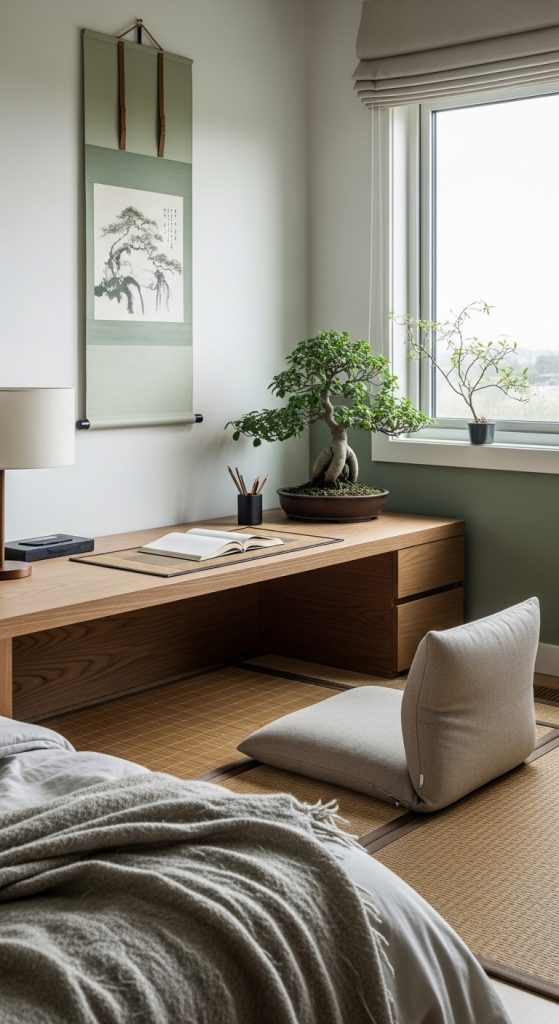
After a stretch of restless evenings when my mind would not settle enough to write a single clear paragraph, I tried the opposite of adding more things to my study corner: I took almost everything away. The result is a quiet, low setup with a natural wood desk, a bamboo mat underfoot, a small bonsai on the corner and soft warm light from a paper-shaded lamp. There is no pinboard, no stack of books in sight, just the one project I am working on and a closed drawer for the rest. The calm is practical, not just decorative: with fewer objects in my eyeline, my thoughts stop snagging on clutter, and the ritual of lighting the lamp and setting out my notebook has become a signal to my brain that it is time to focus. I keep a small succulent alive on the desk, which is about the level of plant care I can reliably manage, and the neutral colours mean the corner blends into the bedroom instead of shouting for attention. My one warning is that minimal only works if the storage behind it is honest, so I keep a proper drawer unit nearby and put everything away properly rather than hiding piles.
Conclusion
Looking back over these ten setups, the pattern is clear to me now: the best study corner is the one that fits your room, your habits and your budget, not the one that looks best in a photograph. Start with light and a decent chair, give everything a proper place to live, and let the corner earn its keep before you spend more on it. My own little desk by the window is still the place where most of my writing happens, and every small improvement I made there paid for itself in calmer, longer working evenings.