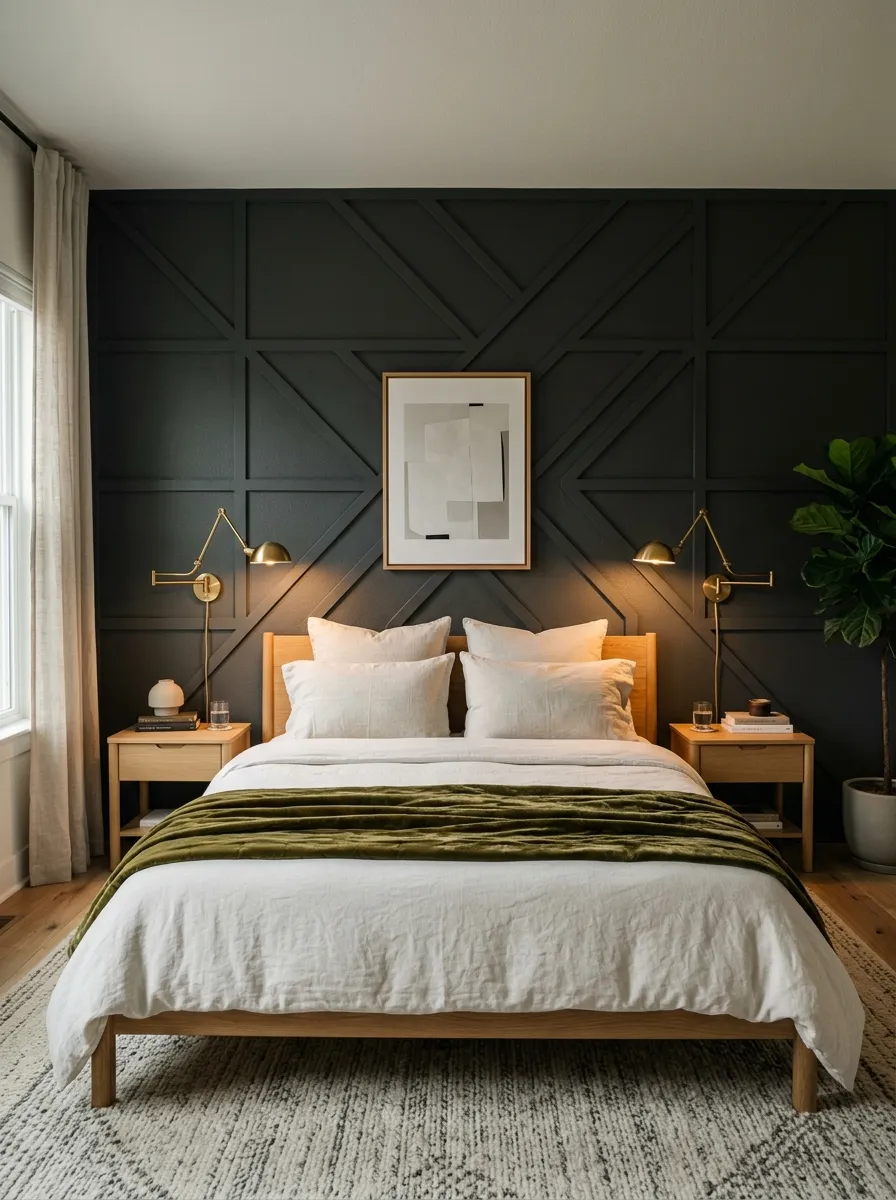
For years I painted every bedroom wall white and called it safe, and my bedroom looked like a hotel room nobody had ever slept in. Then one grey February afternoon in my Munich flat I stood in front of the wall behind my bed, roller in hand, holding a tester pot of near-black charcoal, and I thought: worst case, I repaint it. I did not repaint it. That one dark wall changed the whole room — the white linen suddenly looked crisp instead of washed out, the oak bedside tables finally had something to lean against visually, and the room felt like a proper place to sleep instead of a showroom. Since then I have tried dark accent walls in several forms, in my own bedroom and in friends’ flats, and I have learned which versions are worth the effort and which ones just eat your weekend. Here are the ten I would actually do again.
1. The Classic Midnight Charcoal Board-and-Batten Wall
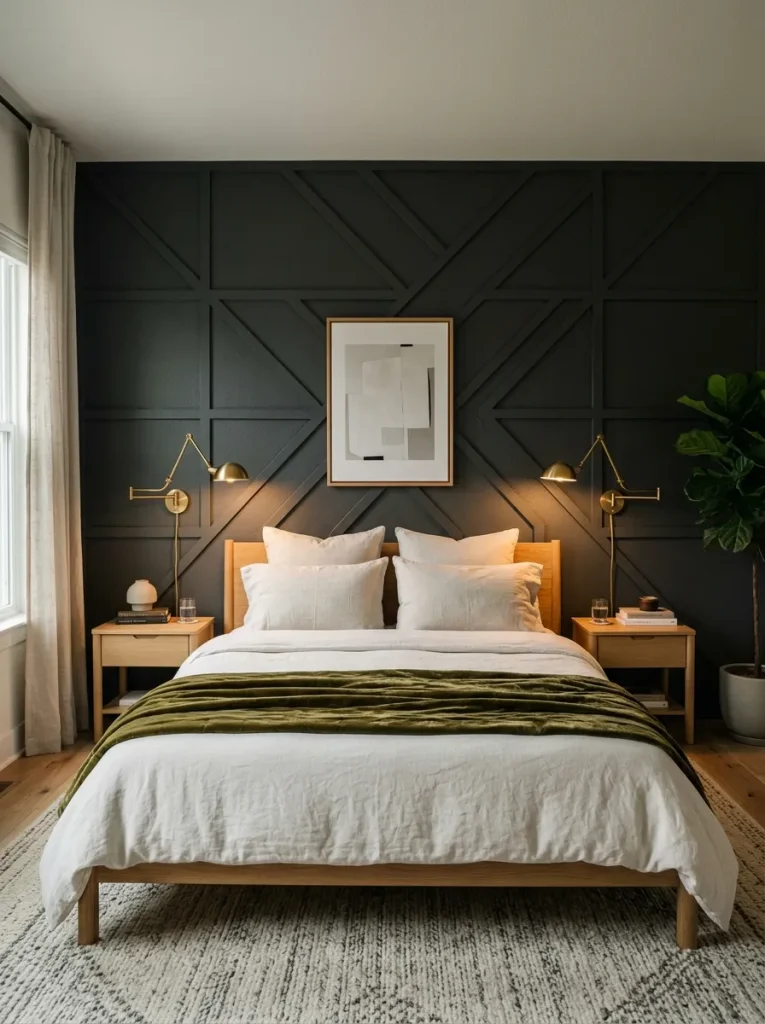
This was my first dark wall, and it is still the one I recommend to anyone who is nervous about going dark. I painted the wall behind the bed in a near-black charcoal — I used a tester of a deep charcoal first and lived with the swatch for a week before committing — and then I added a simple board-and-batten grid in thin MDF strips, about 8 cm wide, spaced in rectangles that matched the width of the bed. I primed with a grey-tinted primer and needed two coats of matte paint; a flat finish hides every little bump in old plaster, which matters in an Altbau flat like mine. Total cost was around 90 euros for paint, primer and strips, and the whole job took a weekend including drying time. My one mistake was spacing the grid by eye on the first rectangle — measure and mark every line with a spirit level before you glue or nail anything, because a crooked batten on a dark wall is the first thing your eye finds at 7 in the morning.
2. The Forest Spruce Vertical Slat Acoustic Wall
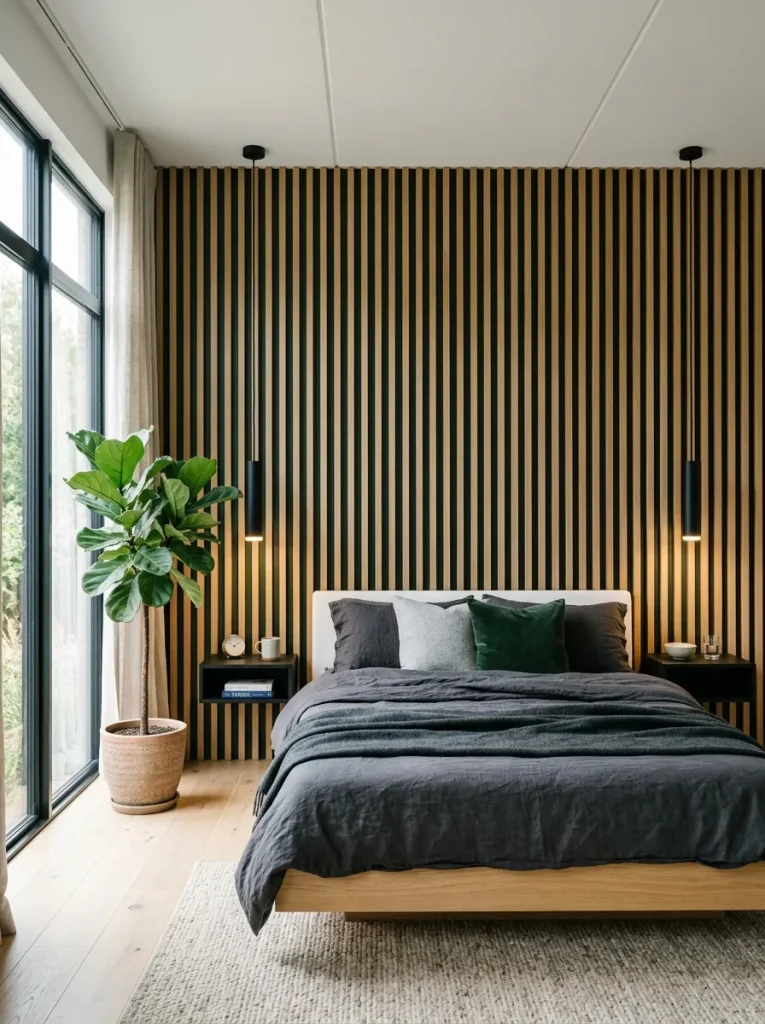
I tried this one in a friend’s bedroom with low ceilings, and the vertical lines genuinely made the room feel taller — it is not just a styling claim, you can feel it when you walk in. We painted the wall a blackened spruce green first, then fixed narrow vertical wood slats floor to ceiling, leaving a gap of about 2 cm between each one so the dark green showed through like a shadow. The slats were pre-cut pine battens from the Baumarkt, roughly 4 cm wide, and we stained them a warm mid-brown rather than painting them, because the wood grain softens the green and stops the whole thing feeling cold. It took us a full Saturday, most of it spent cutting and levelling, and we spent about 160 euros on battens, stain and fixings. If you do this, paint the wall behind the slats first and let it dry completely — touching up green paint between slats afterwards is a miserable job, and I know because I tried.
3. The Venetian Plaster Smoked Obsidian Wall
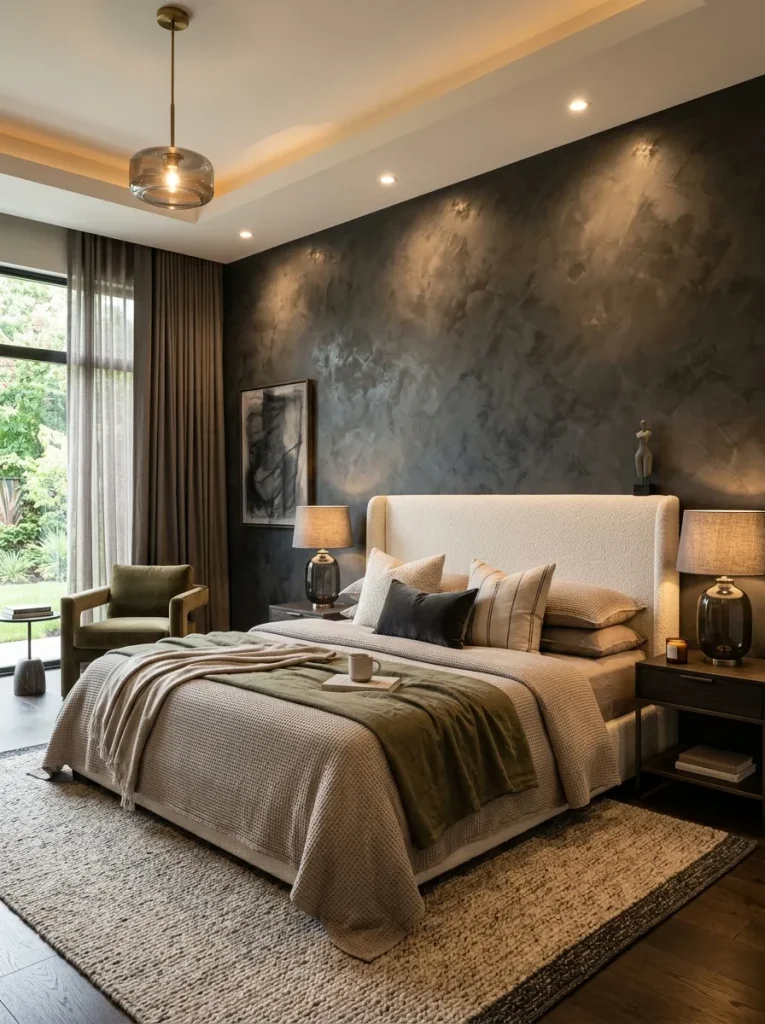
This is the most grown-up wall on this list, and also the one I would not attempt on a rushed weekend. I worked with a limewash-style plaster in a smoked obsidian tone, applied in thin layers with a wide trowel, and the result is a wall that shifts colour as the light moves across it — cloudy, soft, never flat like ordinary paint. The trick, if there is one, is patience: each layer needs to dry before the next, and I did three thin coats over two days rather than trying to force it in one. I sealed it with a matte wax finish so it can be wiped down, which matters in a bedroom where you lean against the wall reading. The materials cost me about 120 euros, which is more than a tin of paint, but the texture is the whole point here — you are paying for a surface that looks handmade, because it is. Practise on a spare board first: my first test patch looked streaky, and only the second, with lighter pressure, taught me the rhythm.
4. The Moody Botanical Chinoiserie Mural Wall
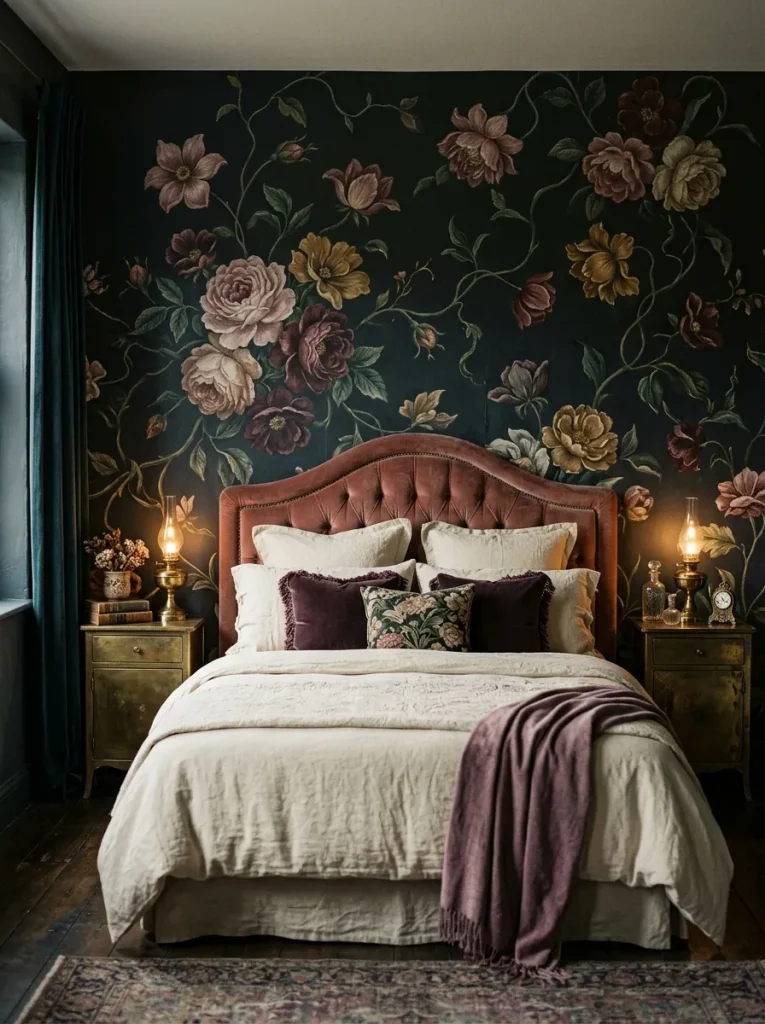
I was sceptical about mural wallpaper — I had visions of peeling corners and crooked flowers — but this one turned out to be the fastest transformation of the ten. I chose a dark-ground mural with oversized muted botanicals and trailing vines on a midnight-charcoal background, the kind that looks like an antique oil painting from across the room, and pasted it on the headboard wall only. Because the mural comes in numbered panels, hanging it was mostly a matter of measuring carefully and keeping the pattern matched at the seams; I did it with a friend in about three hours, including the paste drying time. The room instantly felt layered and romantic in a way paint alone never quite manages, and the white bedding I already owned suddenly looked intentional against it. The mural itself cost around 180 euros, which is the priciest single item on this list, but there was no painting, no sanding, no primer. Order one extra panel if you can, in case a seam goes wrong.
5. The Deep Indigo Blue Wainscoting & Picture Frame Molding
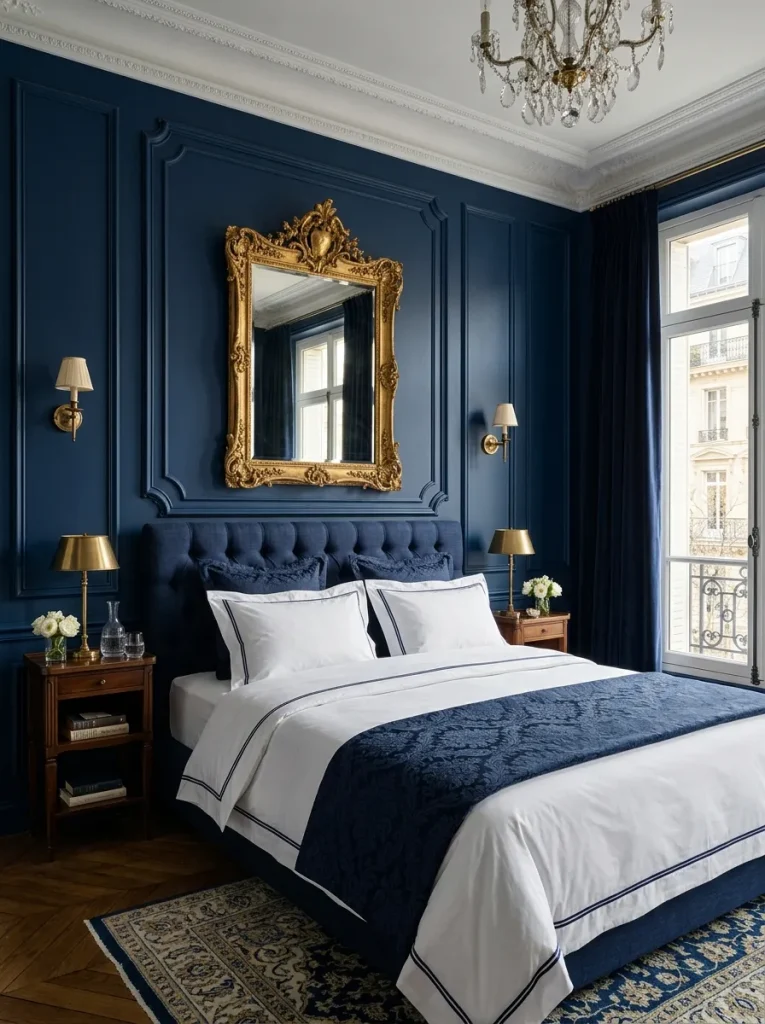
This is the Parisian one, and it suits a bedroom with a proper wooden bed frame better than any other idea here. I fitted slim picture-frame moulding — thin rectangular frames of painted pine trim — across the whole headboard wall, then painted wall and moulding together in one deep indigo blue, the kind that reads almost black in the evening and properly blue in morning light. Painting everything the same colour is the key decision: if you leave the moulding white it looks like a cheap add-on, but drenched in indigo it looks like the wall was built that way. I used a matte finish and a grey-tinted primer, two coats, and I painted the skirting board the same indigo too, because a bright white skirting line cutting across a dark wall breaks the whole effect. The trim cost about 70 euros and the paint another 45, and the fiddly part was cutting the mitred corners — I measured twice and still had to fill one corner with caulk, which is fine, because dark matte paint forgives a lot.
6. The Modern Asymmetrical Color-Blocked Midnight Nook
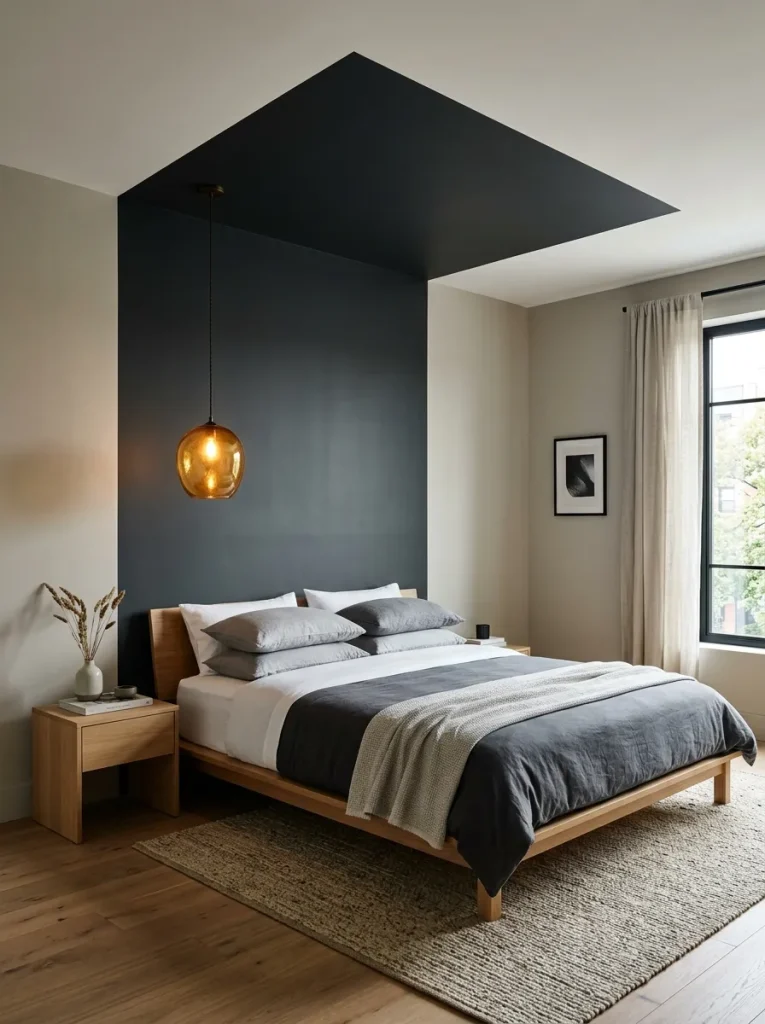
This is the idea for people who like the drama of a dark wall but do not want to commit a whole wall to it. Instead of painting the full headboard wall, I painted an asymmetrical midnight shape — a big graphic polygon that started behind the bed, wrapped around the corner and ran a little way across the ceiling — so the bed sits inside its own dark nook. I mapped the shape with painter’s tape first and lived with the taped outline for two days, adjusting the angles until it felt right, which I strongly recommend because once the paint is on, moving a line means repainting. The effect is surprisingly cosy: the bed feels like a separate little room inside the bedroom, and the rest of the walls stay pale so the room never feels heavy. It used less than half a tin of paint, about 30 euros, and took one afternoon. For a clean edge, press the tape down firmly, seal it with a thin coat of the pale wall colour first, then paint the dark colour and peel the tape while the last coat is still slightly wet.
7. The Rich Espresso Shiplap with Integrated LED Cove
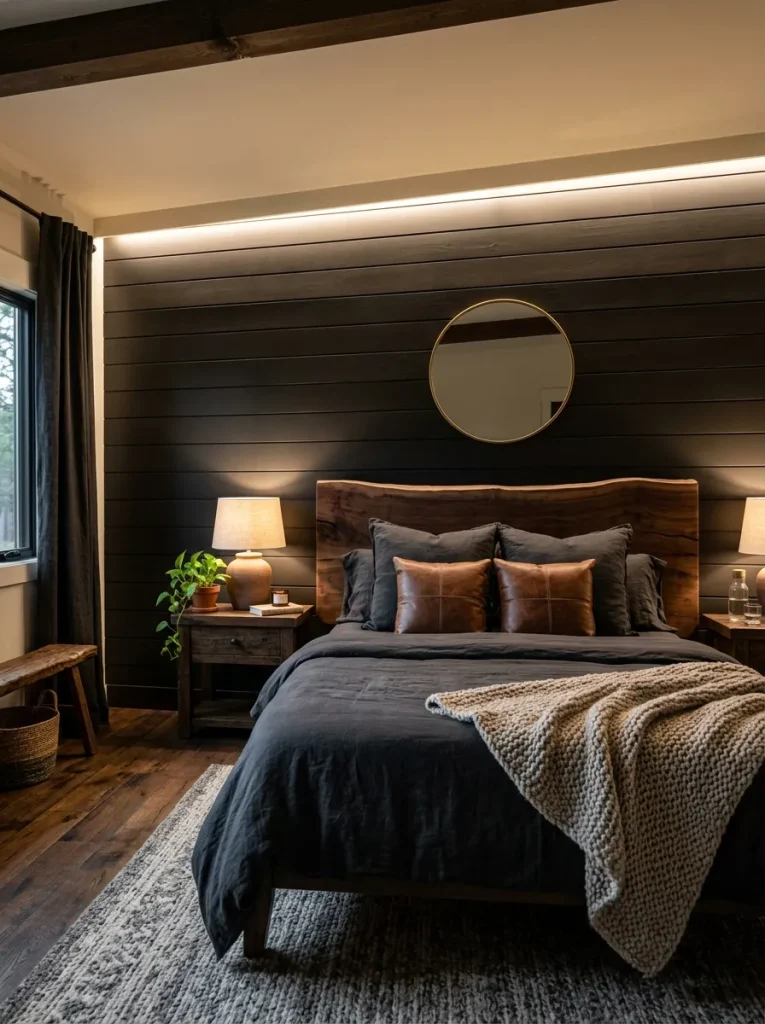
This wall is the one I get asked about most when people visit, and it is almost entirely because of the light. I fitted wide horizontal shiplap boards in a rich espresso stain across the headboard wall, and tucked a warm LED strip into a slim cove at the top, hidden behind a small pelmet, so a soft 2700K glow washes down across the wood channels all evening. The horizontal lines make the wall feel wider, which suits a low, wide bed, and the warm light makes the espresso tones look expensive rather than flat. The boards cost around 140 euros, the LED strip and driver another 40, and I spent a weekend fitting it — the boards themselves are quick, the wiring and the cove are the slow part. If you are not comfortable with electrics, get an electrician for the driver connection; it is a small job and worth doing properly. Stain the boards before fitting them — staining the grooves afterwards took me an entire evening with a small brush.
8. The Dramatic Dark Plum & Fluted Wood Panel Fusion
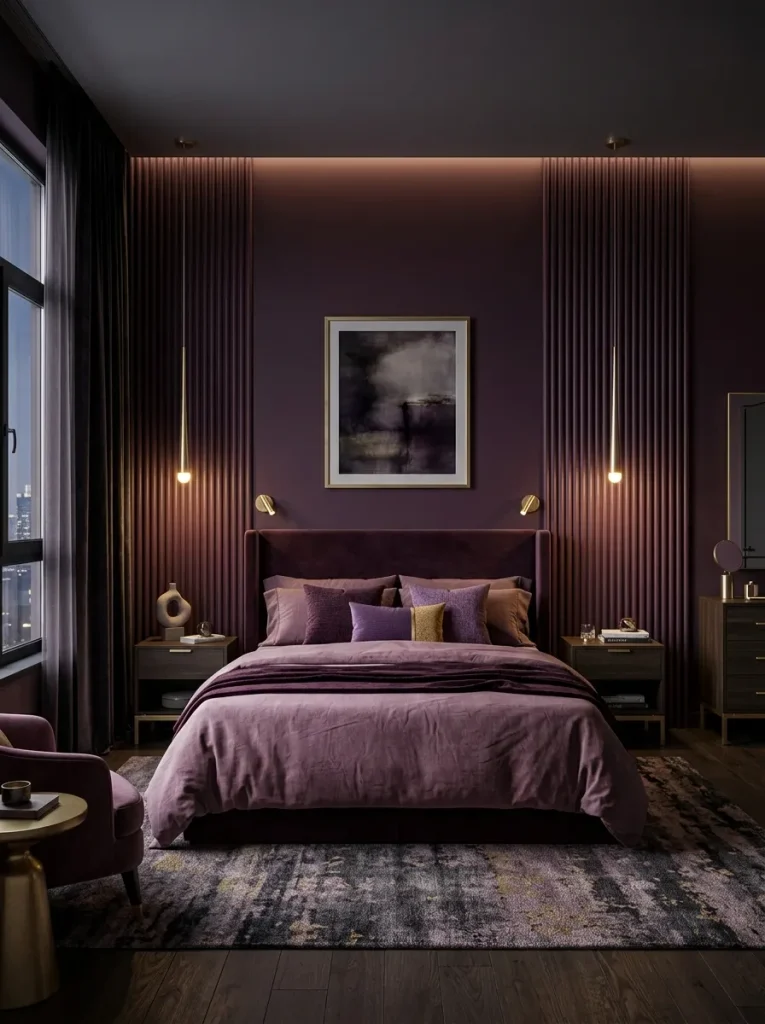
Plum is the colour I was most afraid of — I kept picturing a purple bedroom from a 1990s catalogue — but done right it is the warmest dark on this list. I painted the centre of the headboard wall in a deep aubergine plum, then flanked the bed with narrow vertical fluted wood panels, the half-round tambour kind, in a natural oak tone. The fluting catches the light in thin vertical lines, which stops the plum from feeling flat, and the oak warms it up so the room reads luxurious rather than gloomy. The plum paint needed a grey-tinted primer and two coats, and I tested it under my actual bedroom lamps before committing, because plum can lean very purple under cool light — with warm 2700K bulbs it stays rich and wine-dark, which is what I wanted. The fluted panels were the expensive part at about 200 euros for the two sections, but they come ready-made and fix to the wall with adhesive and a few screws, so fitting took an hour. Keep the bedding pale — cream linen or oatmeal wool — because light textiles against plum are what make the combination sing.
9. The Industrial Dark Exposed Brick & Matte Black Sconces
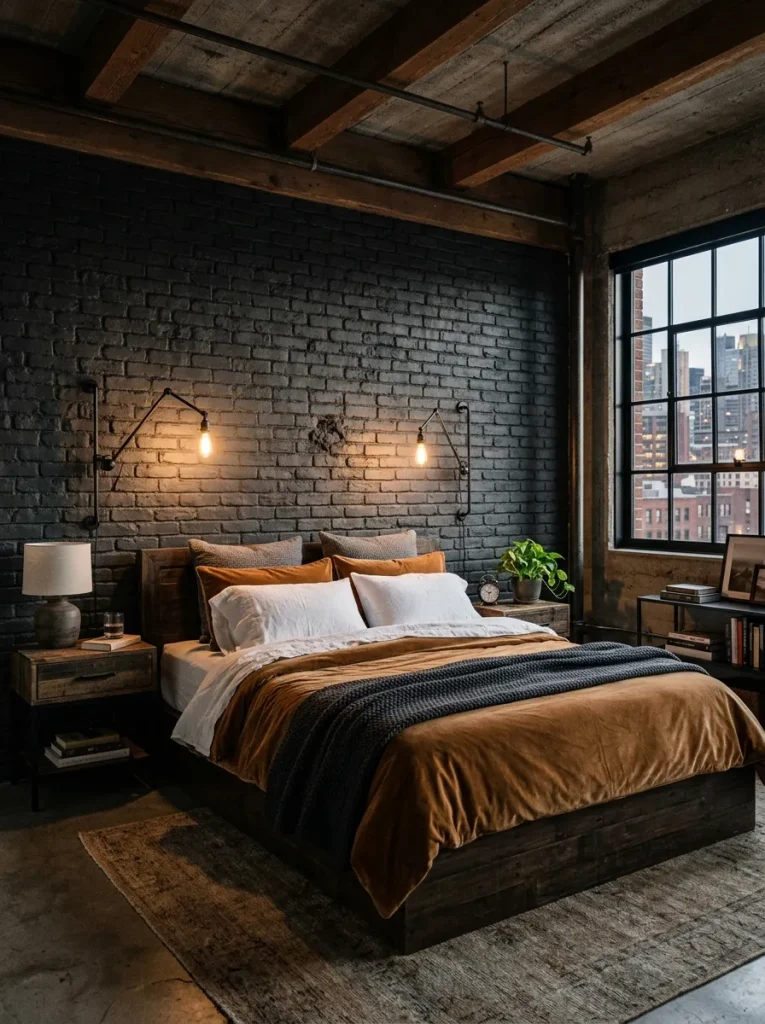
This one is for the bedroom that already has a bit of grit — a loft flat, an old building, a room with steel or raw wood in it. I used thin-brick veneer panels across the headboard wall and washed them in a dark charcoal stain rather than painting them solid, so the rough mineral texture of the brick still shows through and the wall keeps its character. A solid coat of paint would have buried the texture, and texture is the entire reason to have a brick wall, so the wash was the right call — two thin coats, wiped back with a rag while still wet, until the depth felt right. Then I fitted two matte black sconces at bed height, one each side, with warm bulbs, because brick without dedicated light just turns into a dark hole after sunset. The veneer panels cost about 170 euros and the sconces 60, and the job took a weekend including the mortar drying time. It is heavy, dusty work, so clear the room and wear a mask — but the result is the most tactile wall on this list.
10. The High-Contrast Monolithic Black & Float-Mounted Floating Nightstands
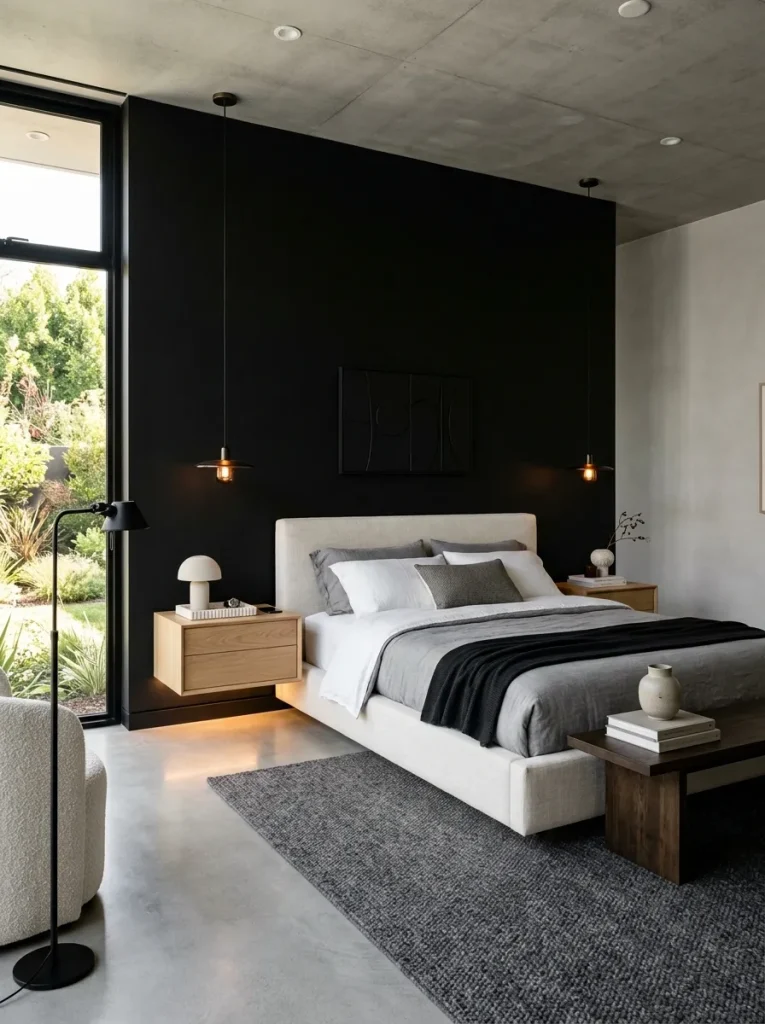
This is the boldest and the simplest idea here, and it only works if you commit to it completely. I painted the headboard wall one flat, matte jet black — no moulding, no slats, no pattern — and mounted two floating oak nightstands directly to the wall so they look as if they hover against the black. The contrast is the whole design: the pale oak, the white linen, a single warm lamp each side, all floating on a wall that seems to disappear behind them. Because there is nothing to hide behind, the wall has to be properly prepped — I filled every dent, sanded, primed with a dark-tinted primer, and used two coats of matte paint, because matte black shows every flaw and every roller mark if you rush it. The nightstands were the investment, about 220 euros for the pair, fitted with proper wall anchors into the masonry, and they hold a book, a glass of water and a phone without any wobble. If your bedroom is small, this is actually a good choice: the black wall recedes, the floating tables free up the floor, and the room feels bigger and calmer than it did when the wall was white.
Conclusion
If I had to pick one piece of advice from all ten walls, it would be this: test the colour in your own room, under your own lamps, for at least a few days before you paint. A dark wall is not a leap of faith, it is a decision you make with a tester pot and a bit of patience, and every wall on this list started that way in my flat. My charcoal board-and-batten wall is still the one I wake up to, and five years on I have never once wished it back to white.