10 Stone Fireplace With Mantle Ideas
Last spring my parents asked me to help them redo the fireplace in their house, the one my father built in the nineteen-eighties with bricks he bought on sale and a wooden mantel he varnished three times too many. The fireplace worked fine, but it had never looked right — the mantel was too high, the bricks were a muddy brown, and nothing about it invited you to sit down. My mother wanted something she would enjoy looking at, and my father wanted something he would not have to repair every year.
We spent weeks visiting stone yards together, and I learned more about my parents in those afternoons than I had in years — my mother running her hand over limestone the way you would test fabric, my father tapping each stone and listening for the dull thud that means it is solid. The ten fireplaces below are the styles we seriously considered, with the practical things we discovered along the way.
One thing I would tell anyone starting this project is to live with samples for a week before ordering. We propped six stone samples against the old fireplace, and by day four two early favourites were clearly wrong in evening light. Samples are free at most yards, and they save expensive mistakes.
1. Rustic Fieldstone Fireplace with Hand-Hewn Timber Mantel

My father loved this one immediately, because fieldstone reminded him of the stone walls on his grandparents’ farm. Each stone is a different shape and shade, and a mason who knows fieldstone will spend as much time choosing and turning each piece as laying it — that labour is why this style costs more than panel stone, and why it is worth it. The hand-hewn timber mantel adds a warmth that balances the rough stone, and we found a beam from a demolished barn for 120 euros that had more character than any new timber we looked at.
What surprised my mother was how much dust fieldstone collects in its crevices, so if you choose this style, plan on a soft brush every couple of weeks and a vacuum with a brush head twice a year. We oiled ours with a natural beeswax finish, which darkened the wood slightly and brought out the tool marks beautifully.
2. Modern Dry-Stack Ledger Stone Fireplace with Floating Metal Mantel
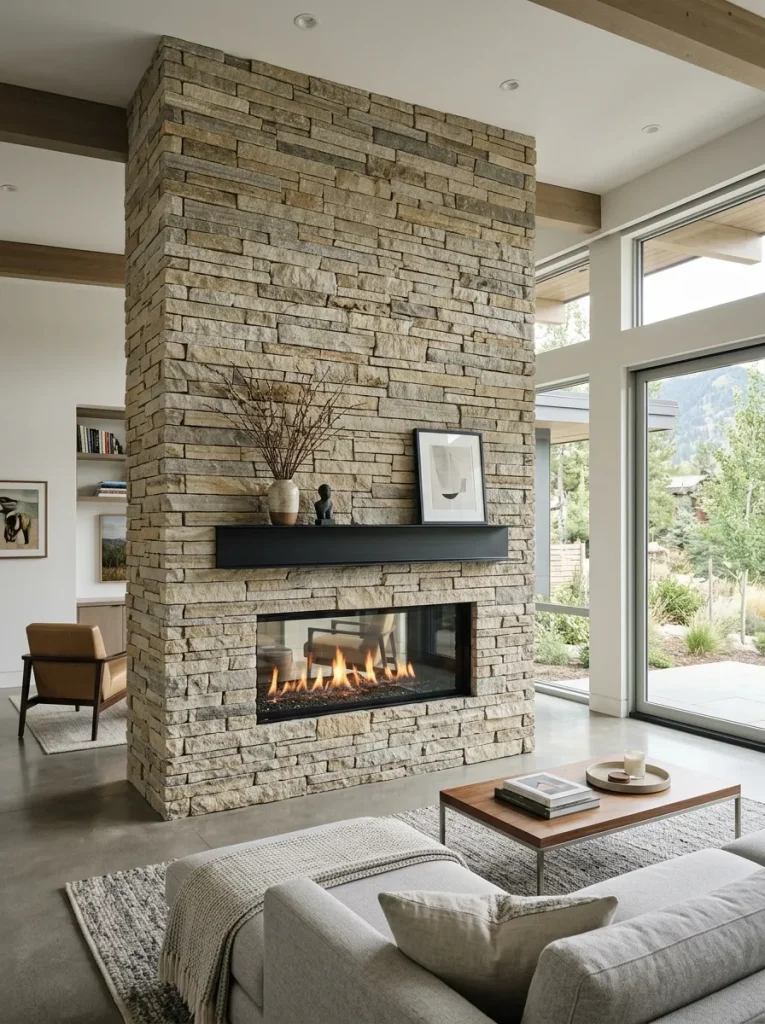
This was my suggestion, and my parents were sceptical until they saw one in a showroom with the fire lit. Dry-stack ledger stone gives you the texture of real stone without the depth, because the panels are only a few centimetres thick, and that matters in a room where every centimetre of floor space counts. The panels interlock, so an experienced DIYer can fit a full fireplace wall in a weekend, though I would still hire someone for the firebox surround itself.
The floating metal mantel is a simple steel shelf, and its appeal is how little it asks of you — no dusting of carvings, no oiling, just a wipe with a damp cloth. We looked at blackened steel and brushed stainless, and my father chose the blackened one because it did not show fingerprints the way stainless did.
3. French Country Overmantel Limestone Fireplace
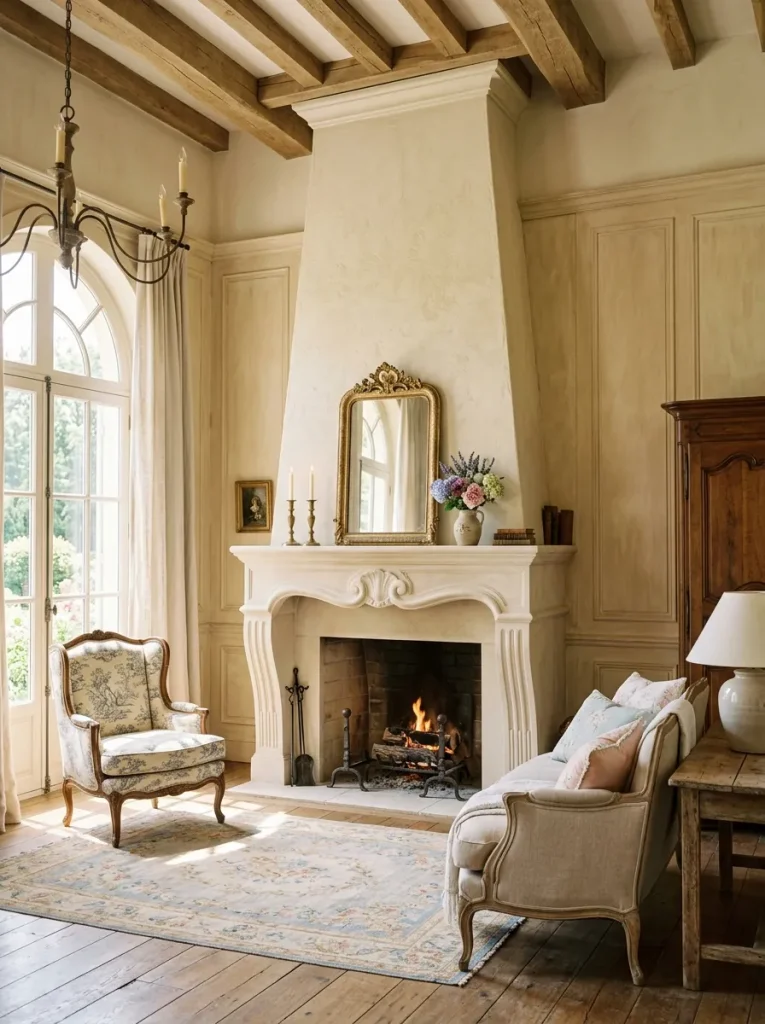
My mother kept returning to this style, and I understand why — limestone has a gentle, creamy colour that makes a room feel softer, and the overmantel panel gives the fireplace a finished, furniture-like quality. The panel above the mantel shelf is the perfect place for a mirror, which bounces light around a dim room, or for a painting that means something to your family. In my parents’ house, that panel now holds a small landscape my grandmother painted, and it finally has a proper home.
Limestone is softer than granite, so it will show wear over time, and I have come to see that as part of its charm rather than a flaw — the edges round slightly, the surface gains a patina. But it does stain, so seal it before the first fire and reseal once a year; a litre of good stone sealer costs about 30 euros and covers the whole surround.
4. Coastal White Mortar-Washed River Rock Fireplace with Driftwood Mantel
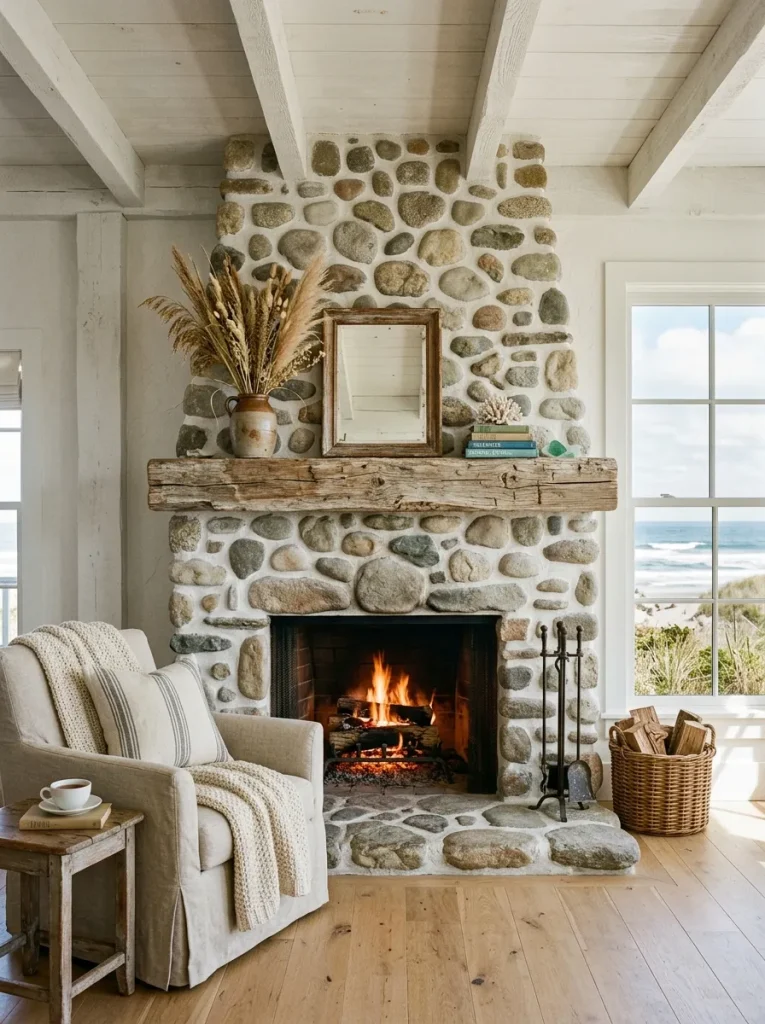
We considered this one for my parents’ guest room, which has pale blue walls and a view of the garden, and the mortar wash is what makes it work outside a beach house. River rocks on their own can look heavy and dark, but brushing thinned white mortar over them lightens the whole wall while keeping the rounded shapes visible. The effect is like a stone wall seen through sea mist, and it pairs beautifully with white-painted woodwork.
The driftwood mantel needs care in choosing: a genuine piece should be kiln-dried and treated against insects, and reputable suppliers will tell you exactly where it came from. We found one for 90 euros that was beautifully weathered but still solid when you pressed a thumbnail into it — soft or crumbly driftwood will not hold up above a fireplace.
5. Mid-Century Modern Stacked Stone Fireplace with Asymmetrical Mantel
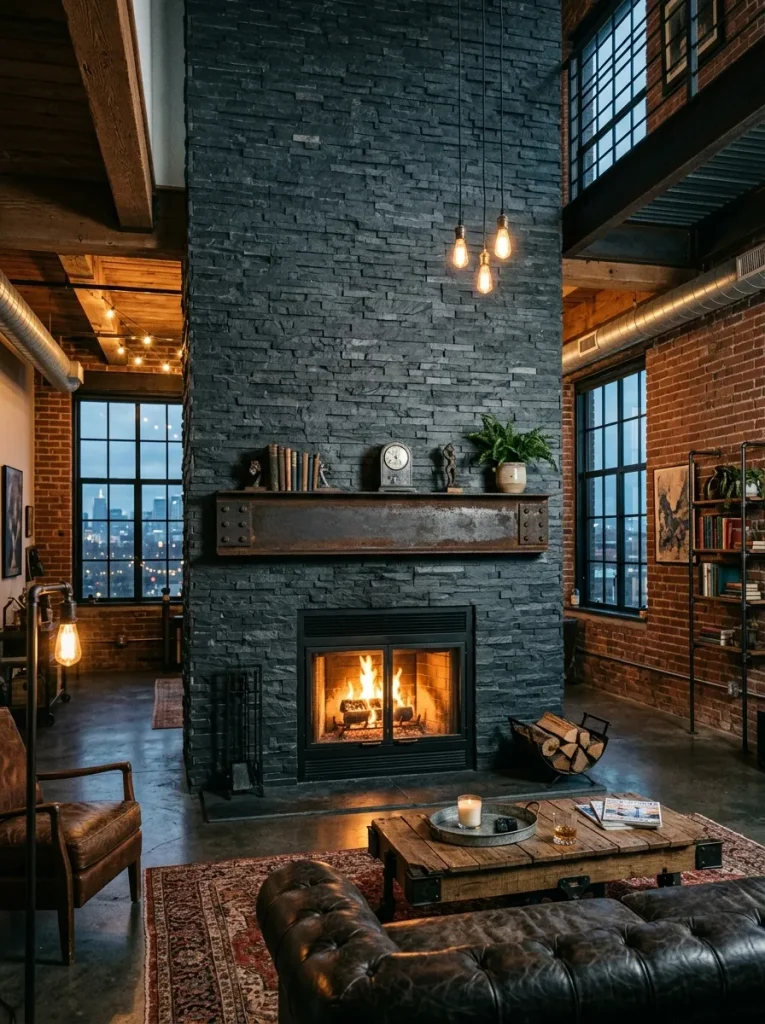
The asymmetrical mantel is the detail that makes this fireplace feel designed rather than assembled, because it deliberately breaks the symmetry most fireplaces rely on. One side extends further than the other, or sits slightly higher, and that small imbalance gives the whole wall a relaxed, modern energy. My father was unsure about it at first — he likes things even — but once we taped the outline on the wall with masking tape, he admitted it made the room feel less formal.
Stacked stone in thin horizontal courses is what holds this look together, and the courses need to be genuinely level, because the eye follows each line straight across the wall. A good mason will check every second course with a spirit level, and I would not accept work where the lines wander.
6. Industrial Dark Slate Fireplace with Reclaimed Steel I-Beam Mantel

This one was never going to suit my parents’ house, but I include it because I fitted one for a friend in a loft, and it taught me how powerful a dark fireplace can be in the right room. Slate is matte and almost black, so the fire becomes the only bright thing in the room, and on winter evenings that contrast is genuinely dramatic. The large slate tiles keep the wall from looking busy, which matters when the stone itself is so dark.
The reclaimed steel I-beam is the star, and sourcing one honestly is half the project — scrap yards and demolition firms are the best sources, and expect to pay 150 to 250 euros for a beam in good condition. It will be heavy, so the wall behind it must be solid masonry or properly reinforced, and you will need two strong people and a plan for lifting it.
7. Craftsman Cut-Granite Fireplace with Bracketed Wood Mantel

My father respects this style more than any other, because Craftsman design refuses to fake anything — the brackets under the mantel actually hold it up, the granite joints are honest and visible, and every material is what it appears to be. Cut granite blocks give the fireplace a solid, grounded feeling, and the stone’s natural speckling means no two fireplaces ever look quite alike. We priced granite from three yards and found a surprising range, from 80 to 160 euros per square metre depending on the quarry.
The wooden brackets are where a joiner’s skill shows, and I would pay for a proper joiner here rather than buying decorative brackets that are only glued on. Ours were cut from the same oak as the mantel shelf, mortised in, and they have held a shelf full of books and candles for two years without a millimetre of movement.
8. Transitional Limestone Panel Fireplace with Integrated Floating Shelf
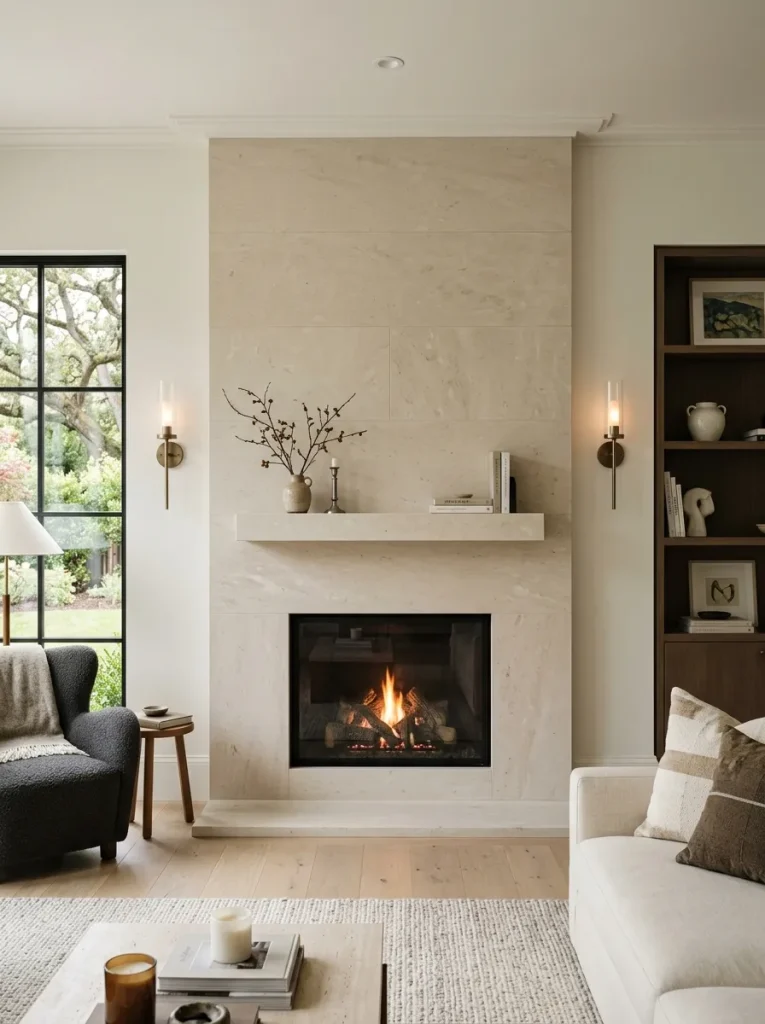
Transitional style was the compromise my parents nearly chose, and I still think it is the safest choice for anyone who likes both traditional and modern rooms. Large limestone panels mean the wall looks calm rather than busy, and the floating shelf grows out of the stone without visible brackets, which keeps the whole thing feeling light. In a room with mixed furniture — some inherited, some new — this fireplace does not fight with anything.
The hidden bracket inside the wall is the part you must get right, because a floating shelf that sags is worse than no shelf at all. The shelf itself was a single piece of limestone, cut to match the panels, and the seam between shelf and wall is so fine that guests assume it was carved from one block.
9. Tuscan Villa Rubble-Stone Fireplace with Arched Display Niche

Rubble stone is the most forgiving stone to work with, because its rough, irregular shapes hide small mistakes that would show immediately in cut granite or neat panels. The arched niche is the detail that makes this fireplace feel like it belongs in an old villa rather than a new build — a shallow arch, just deep enough for a candle or a small vase, built into the stonework beside the firebox. My mother fell for this detail the moment she saw it, and I think it is because arches feel sheltering in a way flat shelves do not.
Building the arch takes patience: the stones above the opening need a temporary wooden support while the mortar sets, and you should not remove it for at least 48 hours. Rubble stone also gives you a practical advantage — because the wall is thick and uneven, it radiates stored heat for an hour or more after the fire dies down, which my parents noticed on their very first evening with it.
10. Scandinavian Light Sandstone Fireplace with Minimalist Blonde Oak Shelf
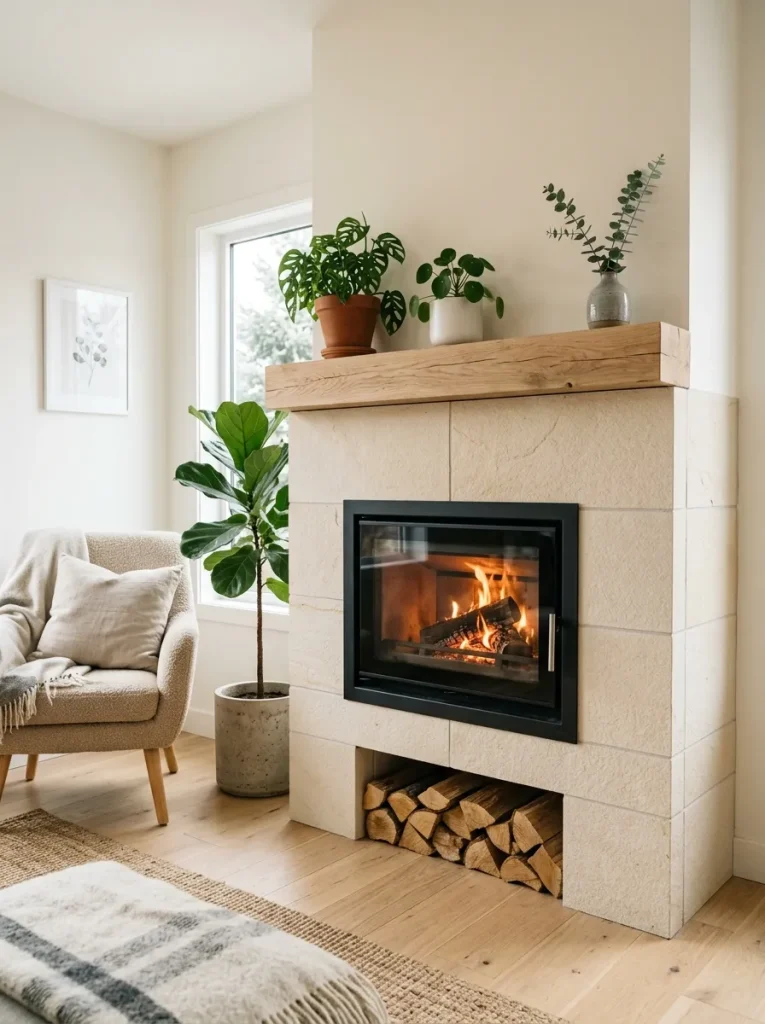
This is the fireplace my parents eventually chose, and seeing it finished taught me that restraint can be the warmest choice of all. Pale sandstone brightens the whole room, the blonde oak shelf holds just two things — a candle and a photograph — and the fire itself gets to be the decoration. My mother says the room feels calmer now, and my father says he has not had to fix a single thing since it was built, which from him is high praise.
The oak shelf needs a light finish, not a dark stain, or you lose the pale-on-pale harmony that makes this style work; we used a clear matte oil that cost about 20 euros and took an afternoon to apply in two thin coats. That small routine has become part of my parents’ autumn rhythm, like stacking the wood and checking the chimney, and the fireplace has become the room’s quiet centre.
When my parents lit their new fireplace for the first time, my mother put her hand on the sandstone and said it finally felt like their house, not just a house they lived in. That is the test I now use for every fireplace I write about: does it feel like it belongs to the people who sit beside it? The ten styles above all passed that test in different homes, and I hope one of them passes it in yours.