10 Best Fall Decorating Ideas
Last October I came home from the Viktualienmarkt with a paper bag of chestnuts, a bunch of dried grasses, and no plan at all, and my flat looked the same pale grey it had looked all summer. The light had already started to go gold by four in the afternoon, and the rooms felt cold in a way that had nothing to do with the heating. I spent that weekend moving cushions around, swapping the light linen throws for wool, and learning, mostly by getting it wrong first, what makes a room feel like autumn instead of a shop window. These ten ideas are the ones that stayed, the ones I still use every year when the first leaves land on my balcony.
Three Habits That Keep Fall Decor From Looking Like a Shop Window
- Start with one room: I decorate the living room first and let the rest of the flat follow, because a single finished corner beats five half-done rooms and it keeps the budget in check.
- Touch before you buy: I hold every throw and cushion in my hands before it comes home, since a fabric that looks warm in a photo can feel thin and scratchy on a sofa.
- Leave one surface bare: I keep the top of one shelf or sideboard empty on purpose, so the eye has somewhere to rest and the room reads as lived in rather than staged.
1. Embrace Earthy and Deep Color Palettes

My living room faces north, so by mid-October the light in there turns flat and grey, and the pale cushions I loved in June started to look washed out. I pulled out two rust cushion covers I had bought the year before for about 12 euros each, added an ochre throw I found in a secondhand shop near Gartnerplatz, and the whole sofa changed in ten minutes. Deep colours do that in a small flat: they pull the walls in a little and make the room feel held together. Three colours, repeated in different spots, give the room a shape without any new furniture.
The mistake I made the first year was buying one thing in every autumn colour I liked, and the sofa ended up looking like a market stall. Now I test a colour with a single cushion for a week before I commit to curtains or a rug in the same tone. Paint sample pots help too: a 250-millilitre pot costs around 6 euros here, and I paint a square on a piece of card and move it around the room for a few days. Dark colours need light to work, so I keep the heaviest tones low, on cushions and throws, and leave the walls pale. That balance keeps a Munich flat from feeling like a cave in November.
Good to know: Rust and ochre look warm under lamplight but can turn muddy in a north-facing room, so test one cushion for a week before you buy a matching rug. This palette suits living rooms and bedrooms best, and it carries through to Christmas with a few pine branches added.
2. Layer Textures for Warmth and Interest

I used to think fall decorating meant buying new things in autumn colours, and then I spent one Saturday layering what I already owned and the room felt new without a single purchase. A chunky wool throw over the arm of the sofa, a boucle cushion against a smooth linen one, a jute rug under the coffee table: each layer adds something the eye can follow and the hand can feel. Texture works because it breaks up flat colour. A room in all rust looks dull; a room in rust wool, rust velvet, and rust wood looks layered and warm.
The mix needs contrast to work. I pair something soft with something rough, a knit throw with a woven basket, a velvet cushion with a wooden tray, and I keep shiny things to a minimum so the room stays calm. The jute rug I bought three years ago for about 40 euros still anchors the living room every autumn. One caution from my own flat: too many textures in a small room turn busy fast, so I leave the dining chairs plain and let the sofa carry the layers. When the textures repeat in two or three spots, a throw here and a cushion there, the room feels planned instead of piled up.
Try this: Fold a wool throw in thirds over one sofa arm instead of draping it across the whole back, and add a woven basket of spare throws beside it. This works in living rooms and reading corners, and it makes a plain sofa look dressed for the season.
3. Incorporate Classic Fall Patterns with a Modern Twist

Plaid has lived in my flat since my first autumn here, and I still reach for it every October. A tartan throw over the sofa arm, a plaid cushion on the reading chair: the pattern reads as autumn before anything else in the room does. The key, I learned after one year when every cushion matched and the sofa looked like a uniform, is to let one plaid piece lead and keep the rest plain. I pick a plaid with a quiet base, rust or olive on cream, and I pair it with solid cushions in one of the colours pulled from the pattern.
Scale matters as much as colour. A large plaid on a throw reads as a blanket; the same plaid shrunk onto four matching cushions reads as a set, and sets are what make a room look like a catalogue page. I mix one plaid with a thin stripe or a plain knit, and I keep the plaid to two spots in a room at most, the sofa and one chair, or the bed and the bench at its foot. My plaid throw cost about 25 euros at a home shop here in Munich, and it has lasted four autumns because I fold it instead of washing it every week.
Budget tip: One good plaid throw beats four cheap matching cushions, and a single piece costs less than a set while looking more considered. This suits living rooms and bedrooms, and the same throw works draped over a chair at a long autumn lunch.
4. Use Seasonal Greenery and Natural Elements
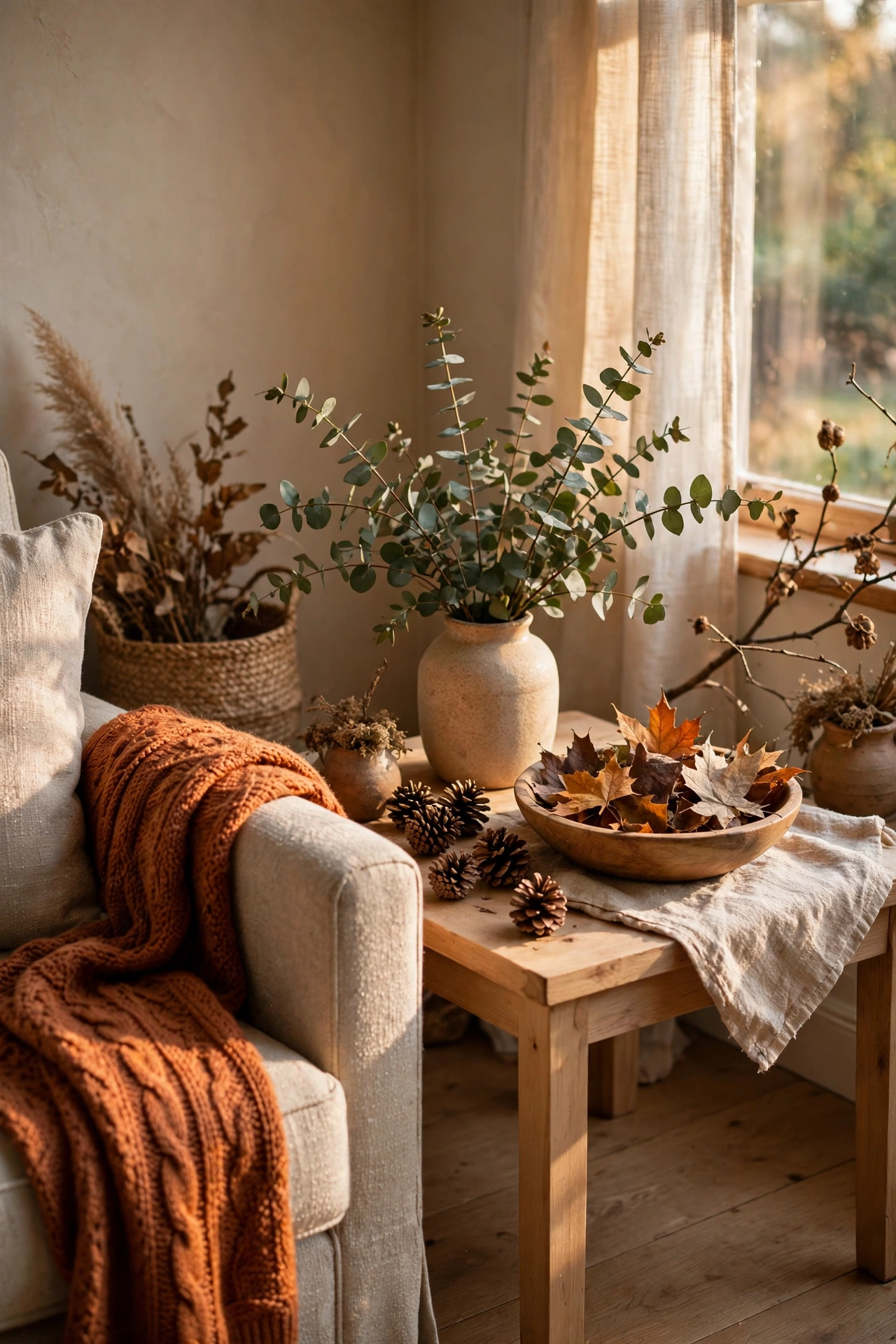
Nothing says autumn in my flat faster than a bunch of branches in a tall vase. I buy eucalyptus at the Viktualienmarkt for a few euros a bunch, and I cut longer branches from the garden of a friend who prunes her trees in October. Pinecones come from walks in the Englischer Garten, where I pick up the closed ones and let them open on a tray by the radiator over a few days. I arrange the branches in a clear glass vase on the sideboard, add a few dried grasses, and the corner smells faintly of the outdoors without any spray or scented candle.
I keep the bigger branches for porch decorating, where wind and rain do not matter much, and I bring the finer stems inside, where they can sit in a ceramic jug on the dining table. Wheat stalks work the same way: a small bundle tied with twine stands in a jug on the kitchen shelf and drops almost nothing if I keep it away from the door draught. Dried flowers hold their colour for months, so I store the best stems in a tall box between seasons and reuse them.
Where it works: A tall vase of branches suits the hallway or the sideboard, where guests see it first, and a small jug of dried grasses fits a kitchen shelf or a bedside table. This idea carries into November with a few pinecones added at the base.
5. Layer Your Lighting to Create Ambiance

By late October the sun sets in Munich before five, and my flat used to go dark in a way that felt flat and tired. I fixed it by layering light instead of turning on one bright ceiling lamp. A floor lamp beside the sofa, a small table lamp on the sideboard, and two candles on the coffee table give the room three pools of warm light, and the corners stay soft instead of black. I use warm white bulbs, 2700 Kelvin, in every lamp, because the cooler daylight bulbs I tried one year made the rust cushions look grey.
The cost stayed low: two LED bulbs for about 8 euros, a string of fairy lights for the bookshelf for 6 euros, and the candles I already owned. One lesson from my first year: a single bright overhead light kills every other effort in the room, so I leave it off from October to March and let the lamps do the work. The room feels smaller and warmer that way, and an evening with a book and a cup of tea feels like a proper pause instead of a wait for spring.
Watch out: One bright ceiling light will wash out every lamp and candle in the room, so leave it off in the evenings and let the lower lights carry the room. This suits living rooms and bedrooms, and it matters most on the short dark evenings from late October on.
6. Introduce Warm Metallic Accents

I own three brass pieces and one copper tray, and that is enough metal for the whole flat. A brass tray on the coffee table holds a candle and a small vase, a pair of copper candleholders stands on the sideboard, and a thin gold frame by the door holds a print I change with the seasons. I found the tray at a flea market near the Isar for 7 euros and polished it with a paste I made from vinegar and salt, and it still looks new after three years of use.
The rule I follow is two or three metal pieces per room, never more, because a fourth one tips the room from warm into glittery. I mix brass with copper but I keep silver out of the autumn rooms, since cool metal fights the rust and ochre palette. The candleholders sit on a wooden board so the wax never touches the sideboard, and the tray moves between the coffee table and the dining table depending on where I eat. Metal also ages well: a few small marks on the tray tell me where it has been, and I leave them alone instead of polishing the piece back to a mirror shine every month.
Make it yours: Start with one brass tray from a flea market and let it move around the flat for a week before you buy anything to match it. This fits living rooms and dining tables, and a single warm metal piece lifts a plain sideboard without any other change.
7. Refresh Your Table Settings

Autumn is when my dining table earns its keep. Friends come for long Sunday lunches that stretch past dark, and the table is where the season shows itself most. I lay a linen runner in a deep rust tone down the middle, add woven placemats, and set stoneware plates that feel handmade in the hand. The centrepiece stays low so people can see each other across it: a wooden board with three candles, a few small pumpkins, and a scatter of dried leaves I press between paper for a week so they lie flat.
I build the table the night before a lunch, because an unhurried half hour with the plates and glasses beats a rushed ten minutes while the oven timer rings. Napkins go in a loose fold with a sprig of dried grass tucked inside, and each place gets a small pumpkin as a marker, which guests take home at the end of the meal. The plates cost about 4 euros each at a home shop here, bought one at a time over two years, and the runner was a remnant piece I hemmed myself. I keep the glasses simple too, plain tumblers that stack in the cupboard and survive a busy evening without worry.
Beginner tip: Set the table the night before your first autumn lunch, with the centrepiece low and the candles ready to light, so the morning stays calm. This suits dining rooms and kitchen tables, and it turns an ordinary Sunday lunch into the kind of meal people remember.
8. Transition Your Soft Furnishings

When the first cold mornings arrive I pack the light linen cushion covers into a box and bring out the wool and velvet ones, and the sofa changes character in an afternoon. A velvet cushion in deep rust, a wool throw in forest green, a knitted cover on the reading chair: the room feels warmer before the heating even comes on. In the bedroom, layered bedding does the same job as throws in the living room, with a wool blanket folded at the foot of the bed and a second pillow in a heavier cover. I buy one or two new covers a year, usually for about 15 euros each, and the rest come from the box I stored last spring.
Storage matters as much as the swap itself. I wash the summer linens, fold them with a lavender sachet, and stack them in a labelled box on top of the wardrobe, so the spring swap takes twenty minutes instead of a lost afternoon. I hold the fabric up to the sofa in daylight before I pay. The covers I keep are the ones that still look good at dusk, when the lamps are on and the room is at its warmest.
Try this: Fold a wool blanket in thirds across the foot of the bed instead of spreading it flat, and add one velvet cushion against the pillows. This suits bedrooms and living rooms, and it makes the first cold mornings feel like a choice rather than a shock.
9. Use Wall Art and Decorative Accessories to Reflect the Season

I change two prints in the hallway every October, and that small swap resets the whole flat for the season. A landscape in warm browns replaces a pale summer print, and a smaller frame with dried leaves pressed behind glass goes up beside it. The frames are the same ones I use all year; only the pictures change, which keeps the cost at almost nothing. I print the images at a copy shop for a few euros each, and I keep the old prints in a folder so the spring swap is just as quick.
The smaller accessories do the rest. A stack of vintage books on the sideboard, a ceramic pumpkin on the shelf, a woven basket by the door for scarves and gloves: each piece is small, but together they tell the season without a single word. I rotate these pieces every few weeks so the room never settles into a display, and I put one or two away when the shelf starts to look crowded. The rule I keep is one seasonal object per surface, never three, because a sideboard with a single pumpkin and a stack of books looks collected, while the same sideboard with five objects looks like a shop shelf.
Good to know: Prints fade fast in direct sun, so hang autumn art on a wall that never gets the afternoon light, and swap the pictures rather than the frames to keep costs down. This suits hallways and living rooms, and the same frames carry winter prints in December.
10. Create Cozy Nooks for Relaxation

My nook is the corner of the living room by the window, where an old armchair faces the balcony and the light lasts longest in the afternoon. I built it one rainy Sunday with what I already had: the chair, a wool throw, a small side table for tea, and a basket of books I keep meaning to finish. The nook works because it has one job only: sitting down with a book and a hot drink, and nothing in it asks to be used for anything else. I keep a small notebook on the side table as well, for the odd thought or shopping list that arrives while I sit, and it saves me getting up mid-chapter.
I built a smaller version in the bedroom too, with a cushion on the window bench and a folded throw within reach, and the same cozy bedroom corner gets a few pine branches in December when the season turns. A nook fails when it becomes storage, so I clear it every Sunday night and put back only the book, the throw, and the cup. That weekly reset takes five minutes and keeps the corner inviting all through the dark months.
Where it works: A nook fits any room with a window and a chair, and it earns its place best in a living room corner or beside a bedroom window, where the last light of the day lands. This is my favourite corner from October to March, and it costs nothing beyond the throw and the lamp I already owned.
Conclusion
Ten ideas sounds like a lot until you try two of them and the flat starts to feel like the season. I still begin with colour and light, because those two changes carry the whole room, and the rest follows over the following weekends. If you try one idea this week, make it the nook: a chair, a throw, and twenty quiet minutes will tell you more about your home in autumn than any shopping trip.